Introduction
Quarter close arrives, and the variance report lands on the CFO's desk. There are invoices from vendors nobody recognizes, software subscriptions that auto-renewed without approval, and professional services engagements that started with an email thread and no purchase order. The budget math doesn't add up - and nobody saw it coming.
This is unmanaged procurement spend. It happens routinely in mid-market firms and PE-backed portfolios operating with lean procurement teams, fragmented financial systems, and policies that people bypass because the compliant path is too slow.
According to Ardent Partners, the average enterprise has only 63.3% of its spend under active procurement management - meaning more than a third flows outside controlled channels. For mid-market companies with less mature processes, the exposure is often higher.
What follows breaks down what unmanaged spend actually is, why it persists even in well-run organizations, the financial consequences, and a practical roadmap for getting it under control.
Key Takeaways
- Unmanaged (maverick) spend covers any purchase made outside approved procurement processes - regardless of transaction size
- Off-contract buying costs 12–18% more per dollar than compliant purchases
- The root causes are process and system failures, not rogue employees
- The fix starts with a clean spend baseline, not new software
- Sustainable control requires assigned ownership - a one-time cleanup won't hold
What Is Unmanaged Procurement Spend?
Two industry bodies anchor the definition. The Institute for Supply Management (ISM) defines maverick or rogue spend as purchasing a product or service without complying with the organization's normal or prescribed process. CIPS extends this further: unauthorized purchasing, often with non-approved suppliers.
This is distinct from tail spend, which is commonly defined as the 20% of total spend distributed across 80% of suppliers - a spend distribution concept, not a compliance category. Tail spend and unmanaged spend overlap, but they're not synonyms. Unmanaged spend can include high-value contracts initiated outside process; tail spend can be fully compliant.
How Unmanaged Spend Actually Shows Up
In practice, it takes several forms:
- Employees purchasing on personal cards and filing reimbursements
- Department heads ordering directly from vendors, bypassing procurement entirely
- Software subscriptions auto-renewing without active approval
- Professional services engagements kicked off via email with no SOW or PO
- Purchases from suppliers not on any approved vendor list
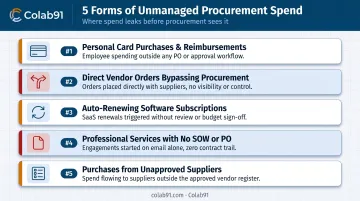
The important framing here: most unmanaged spend is not the result of rogue behavior. When the compliant purchasing process takes five days and a department needs something by tomorrow, people find faster routes. That's a process design failure, and any meaningful solution has to start there.
Why Unmanaged Spend Persists: The Root Causes
Lean Procurement Teams Stretched Too Thin
Mid-market companies typically run procurement with minimal headcount. APQC benchmarking data (across 5,640 companies) puts the median at 36.7 procurement FTEs per $1 billion in revenue - and top-performing organizations operate with fewer than 15. In practice, small and mid-market firms fall well below that median in absolute terms.
With one or two procurement staff, the focus goes to strategic sourcing and large contract management. Day-to-day purchase governance - monitoring ad hoc spend, enforcing PO requirements, reviewing new vendor introductions - gets deprioritized or missed entirely.
Fragmented Financial Systems
Spend data lives everywhere: ERP systems, corporate card platforms, expense tools, AP inboxes, spreadsheets. No single view of third-party spend exists.
Without a unified data layer, identifying patterns of unmanaged spend in real time is effectively impossible. Gartner identifies fragmented, low-quality data across procurement systems as one of the primary obstacles to effective procurement analytics - a problem that long predates AI-driven solutions.
Policies That Create the Problem They're Meant to Solve
Many companies have procurement policies that are outdated, inconsistently communicated, or burdensome to follow. When the policy requires a five-step approval chain for a $500 purchase, employees don't comply - they route around it. The friction in the compliant path drives non-compliance.
No Spend Visibility Baseline
You cannot control what you cannot classify. Many mid-market organizations lack a properly cleansed and categorized spend cube, meaning they cannot identify how much of their total third-party spend flows through controlled versus uncontrolled channels. Without that baseline, prioritizing where to intervene - and measuring whether interventions are working - becomes impossible.
Misaligned Incentives Across Departments
Department heads are measured on output and delivery speed, not procurement compliance. If bypassing the PO process gets a project started three days faster - with no visible consequence - the behavior repeats. Without cross-functional accountability, procurement controls exist on paper and nowhere else.
The Real Cost of Unmanaged Procurement Spend
Direct Financial Leakage
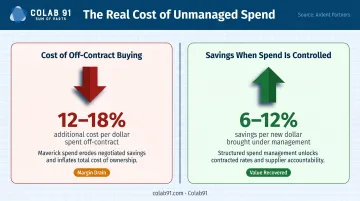
Ardent Partners research puts the cost of maverick, non-compliant spend at 12–18% additional cost for every dollar spent outside contracted channels. Employees buying off-contract pay list prices rather than negotiated rates. At scale, this is a direct and preventable margin drain.
The same research shows that organizations typically realize 6–12% savings for every new dollar of spend placed under procurement's direct control - with actual 2020 savings averaging 7.4%. That gap between what's being lost and what's recoverable is exactly what unmanaged spend costs you.
Supplier Fragmentation and Lost Leverage
Unmanaged spend creates vendor sprawl. Consider five departments each running their own IT staffing vendor:
- Different price points with no consolidated rate negotiation
- Separate invoicing across every engagement
- Ad hoc management with no central visibility
Volume consolidation becomes impossible. The organization pays more while managing more relationships.
Compliance and Audit Exposure
Purchases made outside formal processes often lack the documentation required for a clean audit trail: no PO, no three-way match, no documented approval. For PE-backed companies, this is a material issue during due diligence. Unexplained spend patterns and missing documentation raise questions that slow - or complicate - transactions.
Budget Forecasting Breaks Down
When a significant share of spend flows outside tracked procurement channels, forward-looking numbers lose credibility. Committed spend is underreported, budget headroom is overstated, and mid-quarter surprises become routine.
The finance function loses standing with leadership and PE sponsors when forecasts routinely miss, even when underlying business performance is solid.
Practical Solutions to Control Unmanaged Procurement Spend
Establish a Spend Visibility Baseline First
Before any control measure can work, you need to know what you're dealing with. That means pulling spend data from all source systems - ERP, AP, corporate cards, expense tools - normalizing vendor names, and categorizing all spend by category and business unit.
The output is a spend cube: a structured view of where money is going, with whom, and against which cost centers. This is the foundation for every subsequent decision.
What a usable spend baseline enables:
- Segmenting spend into "managed" vs. "unmanaged" buckets
- Identifying the highest-value unmanaged categories worth addressing first
- Establishing the gap between total AP spend and PO-backed spend as a proxy for unmanaged spend volume
- Prioritizing intervention by spend volume, supplier risk, and savings opportunity
ISM notes that finding rogue spend requires exhaustive examination of financial data and recommends analyzing at least six months of transactions. This data exercise is labor-intensive, and many organizations stall at this step. That's precisely why the baseline needs dedicated resources, not a side project assignment.
Design Procurement Policies That People Will Actually Follow
Tightening policy enforcement without simplifying the policy first usually backfires. Complex approval chains for routine purchases don't reduce maverick spend - they accelerate it.
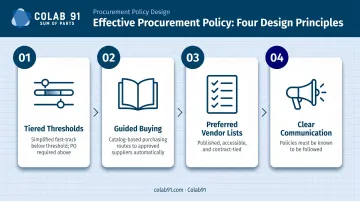
Effective policy design for mid-market companies:
- Tiered thresholds - purchases below a set dollar value use a simplified fast-track process; above that threshold, a PO and approval are required
- Guided buying - catalog-based purchasing for high-frequency categories routes employees to approved suppliers automatically, with no extra sourcing effort required
- Preferred vendor lists - published, accessible, and tied to actual contracts; reduces the incentive to source independently
- Clear communication - policies employees don't know about don't get followed
Ardent Partners benchmarks show Best-in-Class organizations achieve 78% contract-compliant spend versus the average of 65%. The gap is almost entirely attributable to process design and policy adoption, not enforcement.
Build Lightweight Approval Workflows and Ongoing Monitoring
Digital approval workflows that route purchase requests based on spend threshold, category, and department eliminate the "slow approval process" objection, while simultaneously creating a complete audit trail. The goal is removing the bottleneck perception while maintaining control.
Monitoring outputs worth tracking weekly:
- Off-contract spend by category
- New vendor introductions (a reliable signal of unmanaged activity)
- Budget variance by department
- PO coverage rate trend over time
This monitoring doesn't require sophisticated tooling. A regular review of PO versus non-PO spend by category will surface patterns quickly.
For mid-market companies with limited internal procurement headcount, this is where offshore analytics support earns its place. Colab91 builds dedicated India-based teams of procurement and analytics domain experts for mid-market and PE-backed companies, giving organizations the bandwidth to run these functions consistently. The team has hands-on experience in spend analytics and strategic sourcing, with prior work spanning clients such as Carlyle Group, TPG, and Kindred Healthcare.
Building a Sustainable Procurement Control Framework
A one-time spend analysis project followed by no ongoing governance is how unmanaged spend returns within 12–18 months. The organizations that sustain control share one characteristic: assigned ownership.
Whether that's an internal procurement leader, a cross-functional spend committee, or an embedded offshore analytics team, someone needs to own the data, set the reporting cadence, and drive accountability across departments.
Establish a Category Management Rhythm
Quarterly or semi-annual reviews of top spend categories - assessing supplier performance, contract utilization rates, and new unmanaged spend emergence - create the feedback loop that keeps procurement controls current. This connects directly to strategic sourcing and long-term cost reduction, not just compliance.
For PE sponsors managing multiple portfolio companies, that feedback loop needs to work across entities simultaneously. Colab91's shared capability hub model provides this function at the portfolio level - without the cost of building equivalent capacity in-house at each company.
Track KPIs That Create Organizational Focus
Four metrics give leadership reliable visibility into procurement health:
| KPI | Average | Best-in-Class |
|---|---|---|
| Spend under management | 63.3% | 89.8% |
| Contract-compliant spend | 65% | 78% |
| Contract-compliant transactions | 76% | 85.6% |
| Vendor count trend | Monitored per FTE | Optimized |
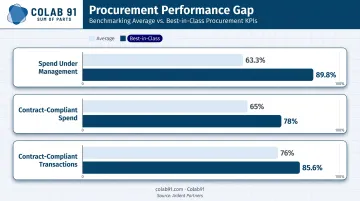
Source: Ardent Partners
Tracking these consistently surfaces problems before they compound - and gives CFOs and PE sponsors the proof of value they need to sustain investment in procurement controls.
Frequently Asked Questions
What is the difference between unmanaged spend and tail spend?
Tail spend refers to the long tail of low-value, high-volume transactions - typically the 20% of total spend distributed across 80% of suppliers. Unmanaged spend is a compliance concept: any purchase made outside established procurement processes, regardless of dollar value.
How do you identify unmanaged procurement spend in your organization?
Start with a spend analysis - pull data from all payment sources and identify purchases with no PO, no approved vendor, or no matching contract. The gap between total AP spend and PO-backed spend is a reliable first-pass proxy for unmanaged spend volume.
What percentage of procurement spend is typically unmanaged?
ISM cites Hackett research putting off-contract indirect spend at 29% on average, with some organizations reaching 80% depending on process maturity. Ardent Partners puts average spend under management at just 63.3%, meaning roughly one-third of spend flows outside controlled channels at a typical enterprise.
How does unmanaged procurement spend affect EBITDA for PE-backed companies?
Off-contract buying inflates third-party costs by bypassing negotiated rates and volume discounts, directly compressing margins. KPMG identifies procurement as a primary lever for EBITDA improvement in PE portfolio value creation programs, which is why spend control features in most operating partners' playbooks.
What is the first step a company should take to control maverick spend?
Build a clean spend baseline. Consolidate and categorize all spend data to establish what is currently managed versus unmanaged, and which categories represent the highest opportunity.
Can mid-market companies control unmanaged spend without a large procurement team?
Yes - with prioritization (focus on highest-value unmanaged categories first), simplified policies that reduce bypass incentives, and external or offshore procurement support for analytical and monitoring work. The practical target is controls scaled to where the real spend risk actually sits, not a full enterprise procurement build-out.