Introduction
Offshore development centers have moved well past their origins as a cost-cutting footnote. Today, enterprises and PE-backed companies alike treat them as a core building block for scaling operations - using dedicated India-based teams to run functions that range from software engineering to procurement intelligence and spend analytics.
The scale of adoption reflects this shift. India's GCC ecosystem now exceeds 1,800 centers, employing over 1.9 million professionals and generating $68B+ in economic contribution by 2025 - up from $19B a decade ago.
Despite this growth, most decision-makers understand ODCs in name only. They know it involves hiring offshore. What they don't fully grasp is how the model actually operates, what it can support, and how it differs structurally from outsourcing. This guide covers the mechanics in full.
Key Takeaways
- An ODC is a dedicated offshore team built exclusively for one company, embedded into its processes, culture, and workflows
- Unlike outsourcing, an ODC gives the parent company direct control over team composition, IP, and performance standards
- Setup follows a defined sequence: scoping → team formation → integration → governance → continuous delivery
- ODCs today support procurement, spend analytics, finance operations, data reporting, and business operations - not just software
- India remains the dominant destination, accounting for 50% of global GCCs and 23% of global software engineering talent
What Is an Offshore Development Center (ODC)?
An ODC is a dedicated unit - team, infrastructure, and operating processes - located in another country, working as a permanent extension of the parent company's operations. It functions like a satellite office: aligned culture, consistent quality standards, and the same performance accountability - just operating from a different time zone.
Why ODCs Exist
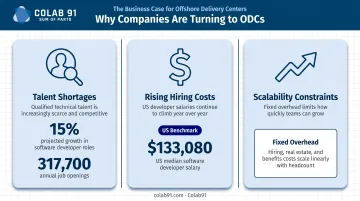
Three pressures drove companies toward this model:
- Talent shortages at home - US tech and analytics roles are growing faster than domestic supply. Software developer employment is projected to grow 15% from 2024 to 2034, with roughly 317,700 IT job openings expected annually
- Rising hiring costs - median US software developer compensation sits at $133,080. Building equivalent capacity onshore at scale is prohibitive for mid-market companies
- Scalability constraints - adding headcount in Western markets takes time and carries fixed overhead. Offshore teams scale faster and at a fraction of the cost
India addresses all three pressures directly. It accounts for 23% of global software engineering talent, with deep specialist pools across engineering, analytics, and procurement - which is why it remains the dominant destination for capability centers. That scale also makes it easier to understand what an ODC actually is versus what it gets confused with.
What an ODC Is Not
The model is frequently conflated with other engagement types. The distinctions matter:
- Not outsourcing - outsourcing is transactional. A vendor takes a project, delivers a result, moves on. An ODC is relationship-first, with the parent company setting standards and owning outcomes
- Not staff augmentation - augmentation fills individual seats. An ODC builds a cohesive team with shared operating cadence
- Not freelance arrangements - no project-based contracts, no rotating talent, no divided loyalties
ODC Engagement Models
| Model | Who Owns Operations | Best For |
|---|---|---|
| Captive (Customer) | Fully owned by parent company | Large enterprises with internal GCC infrastructure |
| Managed (Contractor) | Third-party partner manages ops; parent owns output | Mid-market companies wanting control without full overhead |
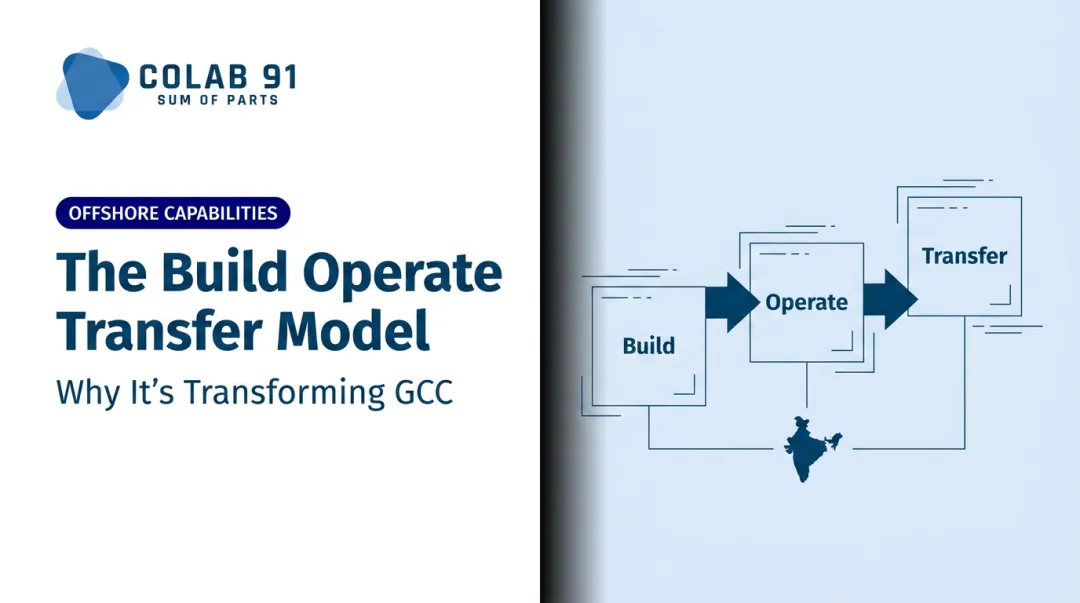
| Build-Operate-Transfer (BOT) | Partner builds and operates, then transfers ownership | Companies planning to internalize the center over time |
Colab91 works primarily with mid-market and PE-backed companies using the managed model - handling entity setup, IP rights, and operational governance on the client's behalf. The goal is to move fast without requiring the client to build internal GCC infrastructure before they're ready to own it.
How Does an Offshore Development Center Work?
An ODC moves through a structured sequence. Each phase builds directly on the previous one - and the setups that struggle almost always cut corners in the early stages.
Initiation: Scoping and Setup
The process starts with strategic clarity, not recruitment. The parent company defines:
- Which functions to offshore and why
- What outcomes the ODC must deliver (not just activities)
- Required team size, seniority mix, and domain expertise
- Engagement model and offshore location
In parallel, the operational foundation gets established: employment structure, IP agreements, data protection compliance (India's DPDP Act, GDPR where applicable), infrastructure, and the tools and workflows the offshore team will inherit from day one.
Compliance sequencing is where early setups often stumble. India's four consolidated Labour Codes set clear obligations around wages, EPF contributions, and employment documentation - and IP ownership must be contractually locked down before anyone writes a line of code or builds a spend model.
Core Operation: Team Formation and Integration
Recruitment is role-specific, not generic. Technical and domain screening aligns directly to the function being built - procurement analysts aren't hired with software developer profiles, and vice versa.
Once hired, integration is the real work:
- Offshore team embedded into existing project management tools, sprint planning, and documentation standards
- Defined overlap hours between time zones (critical for India-US collaboration)
- Knowledge transfer protocols that allow the team to operate independently - not requiring constant hand-holding from onshore counterparts
- Communication cadences that mirror how the parent company actually works, not a separate parallel process
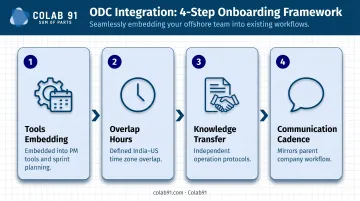
Done well, the offshore team operates as a direct extension of the parent organization, not a separate unit trying to stay in sync.
Output and Governance: Delivery and Control
Performance management is what separates a functioning ODC from a disconnected remote team. This means:
- Defined KPIs tied to business outcomes, not just activity metrics
- Regular review cycles - sprint retrospectives, monthly governance calls, quarterly strategic reviews
- Quality metrics appropriate to the function (defect rates for engineering, accuracy rates for analytics, savings identified for procurement)
With that governance layer in place, the offshore team becomes a genuine delivery asset: one that scales as the business grows rather than requiring constant rebuilding.
What Functions Can an ODC Support?
The ODC model started with software development. Today, it covers far more ground.
Nearly 90% of India-based GCCs now operate as multi-functional units, running functions well beyond engineering. KPMG identifies the current functional range as:
- Software development, QA, DevOps
- Data analytics and business intelligence
- Finance and accounting operations
- Procurement and strategic sourcing
- HR operations and compliance
- Marketing and demand generation support
For mid-market and PE-backed companies specifically, the highest-value functions often aren't technical at all. Procurement intelligence, spend analytics, vendor risk modeling, and operational reporting are where offshore capability centers deliver the strongest returns - because these functions require domain expertise that's expensive to hire onshore and difficult to scale through generalist outsourcing.
Colab91 builds India-based capability centers focused on exactly these domains - procurement and analytics - drawing on 16+ years of hands-on experience scaling these functions for PE sponsors including Carlyle Group, TPG, Elliott, and BC Partners.
The proof of concept is concrete. Colab91's leadership scaled Impendi's India operations to 100+ practitioners before Accenture's acquisition, running this exact functional mix: strategic sourcing, spend analytics, and process transformation for leading private equity portfolios.
The right function mix depends on three things: where the company's operational gaps are, what growth stage demands most urgently, and how mature the offshore talent market is in that domain. Defining this before setup determines whether the ODC creates lasting value or becomes a coordination burden.
ODC vs. Traditional Outsourcing vs. GCC
These three terms get used interchangeably - but they describe fundamentally different models, each suited to a different stage of organizational maturity and operational need.
ODC vs. Outsourcing
| Dimension | ODC | Traditional Outsourcing |
|---|---|---|
| Team ownership | Exclusively yours | Vendor-managed, shared |
| IP protection | Contractually owned by parent | Requires careful agreement |
| Control | Direct - your tools, your standards | Indirect - vendor delivers outcome |
| Scalability | Scales with your direction | Constrained by contract scope |
| Cost over time | Improves as team matures | Resets with each contract cycle |
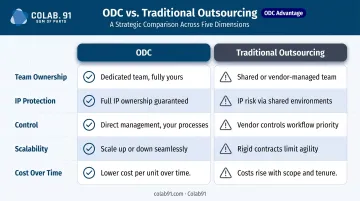
Outsourcing works for short-term, well-defined projects where outcome delivery matters more than team ownership. An ODC works when you need sustained capacity, institutional knowledge, and full visibility into how the work gets done.
ODC vs. GCC
A Global Capability Center is a fully-owned offshore subsidiary: a legal entity, typically multi-functional, built for large enterprises with the infrastructure to run a captive operation. An ODC can sit inside a GCC, or it can function as a lighter, partner-supported version of the same idea.
Mid-market companies now operate 480 GCCs in India, representing 27% of the country's total GCC count. Most of them started with a managed ODC model before building out a full captive center - using the partner-supported phase to test the function mix, build the talent pipeline, and validate governance before taking on full legal and operational ownership.
When each model makes sense:
- Outsourcing - defined project, clear deliverable, short timeline
- ODC - long-term team need, IP-sensitive work, controlled cost scaling
- GCC - enterprise scale, full subsidiary, multiple functions, internal HR and finance infrastructure
Common Challenges in Setting Up an ODC - and How to Address Them
Every ODC faces predictable friction points. None of them are inherent to the model - each one has a practical, operational fix.
Time Zone and Communication Gaps
The India-US time overlap is narrow, typically 3–4 hours in standard business hours. Teams that don't design around this struggle with slow decision loops and blocked dependencies.
The fix is structural: define overlap windows explicitly, front-load async documentation, and give the offshore team decision-making authority within defined scope rather than requiring approvals on every step.
Talent Vetting and Retention
India's overall attrition rate declined to 16.2% in 2025, returning close to pre-COVID levels according to Aon. But competitive offshore markets still require active retention strategies - particularly for domain-specialist roles in procurement and analytics.
Retention strategies that hold up:
- Treat offshore team members as organizational citizens, not contractors - with career paths, performance reviews, and access to meaningful work
- Benchmark compensation to the local market (India salary increases are projected at 9.1% in 2026)
- Build cultural connection to the parent company's mission, not just task completion
Legal and IP Complexity
Talent and retention challenges are solvable with the right people practices. The harder complexity - and the one that catches companies off-guard - is the legal and compliance layer that comes with operating across jurisdictions:
- India DPDP Act - governs personal data processing; requires notice, consent, and defined roles for Data Fiduciaries and Processors
- GDPR - applies when EU data subjects are involved, regardless of where processing occurs; requires processor contracts under Article 28
- Labour Codes - India's four consolidated codes set wage, EPF, gratuity, and employment documentation obligations
- IP ownership - requires explicit contractual assignment from day one, covering work product, data, and proprietary methods
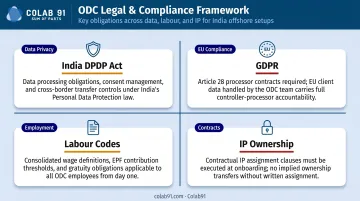
Companies with experienced local partners - or leadership that has built India centers before - navigate this faster. Colab91's engagement models explicitly account for entity ownership, IP rights, and compliance frameworks as part of the initial setup design, so the structure is right before operations go live.
Frequently Asked Questions
What is an offshore development center?
An ODC is a dedicated team located in another country that works exclusively for one parent company as a permanent extension of its operations. Unlike outsourcing, the parent company controls team composition, workflows, IP, and performance standards directly.
Is an offshore development center the same as outsourcing?
No. Outsourcing transfers project delivery to a third-party vendor that manages its own team and processes. An ODC gives the parent company a dedicated, exclusively managed team - operating under the parent company's tools, standards, and governance.
What is the difference between a GCC and an offshore development center?
A GCC is a fully-owned offshore subsidiary - typically a separate legal entity covering multiple functions at scale. An ODC is often a more focused, partner-supported structure that many mid-market companies use as an entry point before building out a full captive GCC.
How much does it cost to hire through an offshore development center in India?
India-based software developers average ₹6,78,050 annually (Glassdoor, June 2026) versus a US median of $133,080. Procurement analysts in India average ₹5,50,000 versus US purchasing roles at $79,830 median - a gap that widens further once benefits, overhead, and recruitment costs are included.
What functions can an ODC handle beyond software development?
ODCs support procurement and strategic sourcing, spend analytics, finance operations, data management, HR processes, and business intelligence. For non-tech companies, these domain-specific functions often generate more measurable ROI than engineering alone.
How long does it take to set up an offshore development center?
Timelines typically range from 4 to 12 weeks depending on location, engagement model, team size, and legal complexity. Managed/partner-supported models launch faster than fully captive setups, which require establishing a separate legal entity before operations begin.