Introduction
Growing companies hit a predictable wall. They've outgrown corporate cards and spreadsheets, but they don't yet have the procurement infrastructure - or the headcount - to manage third-party spend with any real discipline.
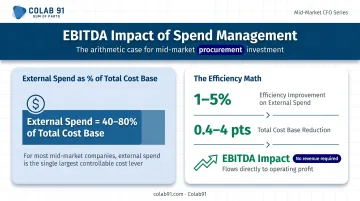
The financial stakes are real. According to McKinsey, external spend with suppliers commonly represents 40% to 80% of a company's total costs. At those levels, even modest inefficiencies translate directly to margin erosion - and in a PE-backed environment or a CFO scrutiny cycle, a 3-5% savings gap on external spend can represent millions in EBITDA left on the table.
Closing that gap is what this guide is about. It covers:
- What spend management actually means for mid-market companies
- The five operational levers that drive savings and control
- A sequenced approach to building a program
- How to close the capability gap that prevents most teams from realizing full value
Key Takeaways
- Spend management spans the full third-party lifecycle: sourcing, contracting, payment, and analytics - not just AP automation
- Mid-market companies outgrow basic tools before they can afford enterprise procurement functions - a gap that compounds fast
- Five levers drive effective spend management: visibility, strategic sourcing, category management, compliance, and analytics
- Building a program requires a sequenced approach: diagnose first, prioritize by impact, then enable with governance and tools
- For PE-backed and fast-growing companies, closing the procurement capability gap often requires augmenting lean in-house teams with specialized external expertise
What Is Spend Management and Why It Matters for Mid-Market Companies
Defining Spend Management in a Mid-Market Context
Spend management is the end-to-end process of controlling, analyzing, and optimizing all third-party expenditure across an organization. It connects sourcing, supplier management, contract management, procurement, accounts payable, and expense management as a single discipline - not a collection of separate functions.
Two terms often get conflated with spend management but are narrower in scope:
- Expense management - reactive and employee-focused; it captures what was spent, not whether it should have been
- AP automation - improves process efficiency but doesn't address what you buy, from whom, or at what price
Spend management is proactive. It determines the right suppliers, right terms, and right channels - before the purchase happens. Understanding what it is only matters if the stakes justify the investment - and for mid-market companies, they do.
The Mid-Market Inflection Point
The National Center for the Middle Market defines the US middle market as companies with annual revenues between $10M and $1B - nearly 200,000 businesses that together employ 44.5 million people and generate roughly $10 trillion in annual revenue.
What makes this segment distinctive isn't just size - it's the pace of change. Fast-growing headcount, an expanding vendor base, rising transaction volumes, and increasing CFO or PE scrutiny on costs all arrive faster than the organization can build structure around them.
At these revenue levels, the math on spend management is straightforward. If external spend represents 40–80% of your cost base, a 1–5% improvement in spend efficiency equates to 0.4–4 points of total cost reduction - before any technology investment. That's real EBITDA impact, accessible without adding headcount.
The 5 Levers of Mid-Market Spend Management
Lever 1: Spend Visibility and Data Centralization
Most mid-market companies have spend data scattered across an ERP, corporate card platform, AP tool, and expense system - with no single unified view. The first lever is establishing a cleansed, categorized picture of all spend: who is spending, with which suppliers, in which categories, and at what cost.
This "spend cube" is the prerequisite for everything else. McKinsey research shows advanced spend analytics can identify 10–20% of addressable spend as potential savings - but that number is meaningless without clean, classified data underneath it.
Lever 2: Strategic Sourcing and Supplier Rationalization
Strategic sourcing is the systematic process of identifying the right suppliers, running competitive events, and negotiating terms that reflect the company's actual buying power.
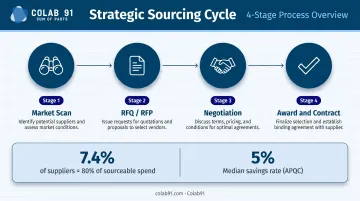
A basic strategic sourcing cycle looks like this:
- Market scan - understand who supplies the category and at what price points
- RFQ/RFP - solicit competitive bids from qualified suppliers
- Negotiation - leverage competitive tension and volume concentration
- Award and contract - formalize terms and transition to preferred suppliers
For mid-market companies, this lever often reveals consolidation opportunities - multiple suppliers serving the same category across different business units. ISM data from 2021 shows that just 7.4% of active suppliers account for 80% of sourceable spend - meaning there's often significant leverage sitting in a small number of relationships. APQC benchmarks put the median achieved savings rate from sourcing events at 5%.
Lever 3: Category Management
Category management treats groups of related spend - logistics, IT, facilities, professional services - as distinct strategic portfolios, each with its own market dynamics and optimization approach.
Most mid-market companies don't operate this way. Spend gets managed transactionally - each purchase treated as a one-off event, with no accumulated market knowledge or supplier strategy at the category level.
What that produces in practice:
- Missed volume consolidation across business units buying the same thing
- No price benchmarks to pressure-test renewals or new bids
- Supplier relationships that drift rather than get managed
When category management is absent, savings opportunities compound quietly and go uncaptured - and that pattern persists until someone builds the capability to break it.
Lever 4: Compliance and Policy Governance
Maverick spend - purchases made outside approved channels or contracted suppliers - is one of the most expensive and overlooked problems at mid-market companies. Ardent Partners data indicates that maverick spend costs organizations an extra 12–18% per non-compliant dollar, and average contract-compliant spend sits at just 65% across enterprises.
This lever involves:
- Defined approval thresholds by spend category and dollar value
- A preferred supplier list with contracted pricing
- Clear purchase-to-pay workflows that route spend through approved channels
- Escalation paths for exceptions, with documented rationale
Governance doesn't require a large team - it requires clear rules, consistent enforcement, and a process that doesn't give people an easy way around it.
Lever 5: Spend Analytics and Continuous Improvement
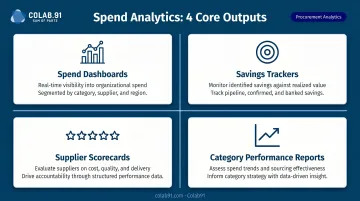
Analytics converts raw spend data into actionable decisions. The key outputs a mid-market spend management program should produce:
- Spend dashboards - category and supplier views updated on a regular cadence
- Savings trackers - realized savings versus targets, by initiative
- Supplier scorecards - performance against delivery, quality, and pricing benchmarks
- Category performance reports - trend analysis, price variance, and emerging risks
Without this infrastructure, the gains from sourcing events don't hold. Savings erode as contracts go unmonitored, supplier performance slips without scorecards to surface it, and new spend quietly accumulates outside any managed category. Analytics is what keeps the program from reverting to baseline after the initial push.
Key Challenges Mid-Market Companies Face with Spend Management
Three structural problems explain why most mid-market spend management programs underperform or never get off the ground.
The Fragmented Tech Stack
Most mid-market finance teams have assembled a collection of point solutions: one tool for corporate cards, another for AP, another for expense reimbursements. None of them talk to each other.
The result: finance teams spend days each close cycle manually reconciling data across systems, and there's no reliable view of total spend. A 2026 CFO.com survey of 225 mid-market finance leaders found that only 4% had fully automated AP from invoice to payment, with 48% seeing little to no cost savings from the automation tools they'd already deployed. Integration difficulty and unclear ROI were the most commonly cited barriers.
The Resource and Talent Gap
Mid-market companies rarely have a dedicated Chief Procurement Officer or strategic sourcing function. Procurement responsibilities are split across finance, operations, and business unit heads - with no central ownership and no deep category expertise.
Without dedicated ownership, spend management initiatives stall against competing priorities - and no one has the domain knowledge to execute a sourcing event or build a category strategy from scratch. Most organizations with over 1,000 employees have a formalized procurement function, but many mid-market companies haven't crossed that threshold operationally, regardless of headcount.
Data Quality and Classification
Even when spend data exists, it's rarely reliable. Duplicate supplier records, inconsistent GL coding, unclassified transactions, and shadow spend (purchases made without a PO) degrade the quality of any analysis built on top.
A 2025 Cherry Bekaert survey of 200 mid-market CFOs found that 49% felt blocked from making critical financial decisions because of poor data quality. Without a spend taxonomy and basic data governance, any savings estimate is unreliable from day one.
Building a Strategic Spend Management Program
Step 1: Conduct a Spend Diagnostic
Every spend management program starts with data collection. That means pulling transaction records from all source systems, cleansing them, and classifying them against a standard taxonomy.
Source systems typically include:
- ERP and AP systems
- Corporate card platforms
- Expense management tools
- Procurement or P-card data
Cleansing covers deduplication, supplier normalization, and error removal. Classification maps everything to a standard taxonomy.
The output is a spend baseline: a clear picture of where money is going, at what scale, and with which suppliers. This baseline drives every prioritization decision that follows.
Colab91's Savings Opportunity Assessment completes this diagnostic in 4–6 weeks and typically identifies 5–15% of addressable spend as recoverable savings - with a category-by-category roadmap detailing where savings exist and how to capture them.
Step 2: Prioritize by Impact, Not Complexity
Use the spend baseline to apply the 80/20 principle: identify the categories and suppliers representing the majority of spend, then assess which combine high savings potential with manageable execution complexity.
Quick wins in high-spend, low-complexity categories (telecom, logistics, office supplies, SaaS subscriptions) build organizational confidence and generate savings that can fund more complex initiatives. Don't start with the hardest categories on day one.
Step 3: Establish Governance and Policy
A spend management program without governance reverts to old behaviors within months.
Core governance elements include:
- A procurement policy with approval thresholds and purchasing channels by category
- A preferred supplier list tied to contracted pricing
- Clear ownership - who is accountable for spend management decisions across the business
- Exception escalation paths, documented and enforced
Clear ownership and consistent application matter more than team size.
Step 4: Enable with Technology Appropriate to Your Scale
Mid-market technology selection criteria differ from enterprise. The right questions:
- Does it consolidate multiple point solutions or add another one?
- Does it integrate with the existing ERP without a multi-year implementation?
- Does it support spend analytics and reporting out of the box?
- Is it scalable as the company grows without a full re-implementation?
Resist the pull toward over-engineering. A mid-market company doesn't need a full enterprise procurement suite on day one. Colab91's approach is platform-agnostic - the offshore analytics capability works with Coupa, Ariba, Jaggaer, and Ivalua, and connects directly to ERP and AP source data when no procurement platform exists yet.
Step 5: Measure, Report, and Iterate
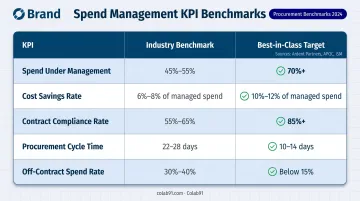
Track these KPIs from the start:
| KPI | Benchmark |
|---|---|
| Spend under management (% of addressable spend) | Ardent Partners avg: 63%; Best-in-Class: 90% |
| Cost savings realized vs. target | APQC median: 5% of sourced spend |
| Contract compliance rate | ISM 2022 benchmark: 79% |
| Procurement cycle time (requisition to PO) | APQC median: 40 days |
| Off-contract spend rate | Target: below 20% |
Report these metrics monthly or quarterly to finance leadership and PE sponsors. Transparent reporting keeps spend management funded and prioritized - even as other initiatives compete for attention.
Bridging the Capability Gap: Talent, Expertise, and Offshore Models
Effective spend management requires domain expertise in strategic sourcing, category management, and spend analytics. These skills are expensive to hire full-time, often unavailable in mid-market companies, and rarely justified for a single role.
Three models exist for closing this gap:
- Build in-house - slow, costly, and difficult when competing for talent with enterprise employers
- Engage management consultants - expensive, short-term, and rarely designed to transfer capability to internal teams
- Partner with a specialized capability provider - blends domain expertise with scalable delivery at a fraction of the cost
For PE-backed companies, the timeline pressure makes this choice even more acute. McKinsey has noted that digital procurement in PE portfolio companies can lift EBITDA by up to 20% within six months - but only when the right execution capability is deployed quickly. Sponsors running 100-day plans can't wait 6–9 months for a hiring cycle to close.
Colab91 is built for exactly this constraint. The firm establishes dedicated, India-based offshore capability centers combining procurement and spend analytics expertise - spend diagnostics, category analysis, RFI/RFP management, savings tracking, and supplier scorecards - at the cost structure and deployment speed that lean mid-market teams actually need.
The "Sum of Parts" model works as follows: Colab91's offshore teams extend the client's existing procurement or finance function - not replace it.
Onshore leadership retains strategic control and stakeholder relationships. Offshore analysts and procurement specialists absorb the analytical and execution workload that in-house teams lack the capacity to run.
Colab91's leadership team previously built and scaled Impendi's India operations to 100+ practitioners before Accenture's acquisition - working with PE sponsors including Carlyle Group, TPG, Elliott, and BC Partners, and portfolio companies across healthcare, manufacturing, retail, and financial services. That operational history - across the exact PE and mid-market program types described in this guide - shapes how Colab91 structures, staffs, and delivers engagements for clients today.
Frequently Asked Questions
What are the 5 levers of spend management?
The five levers form the operational framework every mid-market spend management program must address:
- Spend visibility and data centralization
- Strategic sourcing and supplier rationalization
- Category management
- Compliance and policy governance
- Spend analytics and continuous improvement
Address all five consistently, and you have the foundation for sustainable savings and cost control.
What is mid-market account management in a procurement context?
In spend management, mid-market account management refers to how finance and procurement leaders manage their supplier, vendor, and spend relationships - ensuring contracts remain active, spend flows through approved channels, and supplier performance is tracked. It overlaps with vendor management and category oversight.
What is the difference between spend management and procurement?
Procurement covers sourcing and acquiring goods and services: supplier selection, negotiation, and PO management. Spend management is the broader discipline that includes procurement but also encompasses expense management, contract compliance, AP, and ongoing analytics. Procurement is a subset of spend management, not a synonym for it.
How do mid-market companies typically start a spend management program?
Most successful programs begin with a spend diagnostic: collecting and categorizing all transaction data to establish a baseline before moving into sourcing initiatives or technology investments. Starting with visibility prevents a common failure mode - investing effort in categories that turn out to be small or already well-managed.
What KPIs should mid-market companies use to measure spend management success?
The core metrics are: percentage of spend under management, cost savings realized as a percentage of addressable spend, contract compliance rate, procurement cycle time, and supplier performance scores. Report these on a monthly or quarterly cadence to finance leadership and PE sponsors - programs with regular metric reviews consistently secure the budget and executive attention needed to sustain momentum.