Introduction
Most offshore development centers underdeliver. Companies skip the foundational decisions that determine whether an ODC becomes a strategic asset or drifts into a cost-management experiment with no clear end state.
This problem hits mid-market and PE-backed companies hardest. Unlike large enterprises, they operate with tighter timelines, thinner operational buffers, and less tolerance for the 12-to-18-month learning curve that comes with poorly scoped offshore engagements.
According to Everest Group, fewer than 10% of global capability centers reach top-tier maturity - a useful baseline for companies that assume offshoring success is automatic.
This checklist covers 25 factors across five stages, designed to help decision-makers build an offshore center that functions as a genuine capability hub:
- Strategy - defining scope, ownership, and business case before any hiring begins
- Talent - recruiting domain experts, not just available headcount
- Governance - establishing accountability structures that scale
- Infrastructure - setting up systems, tools, and compliance frameworks
- Performance - tracking outcomes that matter to the business, not just activity metrics
TLDR: Your ODC Success Checklist at a Glance
- Strategic Foundation (1–5): Define your why, what, and how before choosing where
- Talent and Team Design (6–10): Hire, onboard, and retain with a plan built in from Day 1
- Governance and Integration (11–15): Set clear rules for how onshore and offshore teams operate together
- Infrastructure, Legal, and Compliance (16–20): Protect operations, IP, and people through the right frameworks
- Performance and Scaling (21–25): Track outcomes, refine the model, and scale on a repeatable foundation
Strategic Foundation: Factors 1–5
Factor 1: Define the Strategic Purpose of Your ODC
"Reduce costs" is not a strategy. It's a starting assumption - and companies that treat it as the finish line end up with offshore teams that execute tasks cheaply but create zero strategic value.
Before committing to an engagement, answer this: is your ODC meant for cost arbitrage, capability building, talent access, or operational scale? The answer shapes every decision downstream, from which functions you offshore to how you structure the team.
This matters especially for PE-backed firms operating under value creation mandates. McKinsey reports that 5%–34% of enterprise innovation now flows through the global operating model, with roughly 10% of CEO-1 and CEO-2 roles based within it - clear evidence that offshore centers have moved well beyond labor arbitrage.
Colab91's engagements with PE sponsors including Carlyle Group and TPG are built on this premise: the offshore center must generate measurable business value, with headcount savings as one outcome among several.
Factor 2: Identify Which Functions Actually Belong Offshore
Not every function translates well to an offshore model. Before making the move, evaluate each candidate function against four criteria:
- Process maturity - Is the process documented and stable, or still being defined?
- Documentation readiness - Can an offshore team understand and execute it without constant hand-holding?
- Onshore interdependency - Does this function require real-time collaboration that time zones will break?
- Data sensitivity - Does the data involved require access controls or residency restrictions?
The most common mistake: offshoring a function that is still chaotic onshore. This doesn't fix the chaos - it exports it, adds distance, and multiplies coordination costs.
Functions in procurement, spend analytics, and financial operations tend to transfer well when they meet these criteria. Customer-facing functions with high variability rarely do.
Factor 3: Set Measurable ROI Targets Before You Start
Entering an ODC engagement without quantified success criteria makes it impossible to evaluate performance or course-correct when things drift.
Before launch, define specific benchmarks:
- Target cost reduction percentage (year 1 vs. year 3)
- Time-to-hire and ramp-to-productivity benchmarks
- Throughput improvements per FTE
- Error rate or quality metrics tied to the specific function
Without these, teams default to measuring activity - hours logged, tasks completed - rather than outcomes. ODCs can appear operational for months while steadily drifting from the business case that justified them.
Factor 4: Choose the Right Engagement Model for Your Stage
Three primary models exist. Choosing the wrong one for your current stage is a common and expensive mistake:
| Model | Best For | Key Trade-off |
|---|---|---|
| Captive | Large enterprises with in-country expertise and long-term commitment | Maximum control, highest setup complexity and cost |
| BOT (Build-Operate-Transfer) | Companies that want ownership eventually but need help getting there | Balanced risk; transitions ownership after the operate phase |
| Partner-Led | Mid-market companies without in-country infrastructure | Fastest to launch, lower risk, less direct control initially |
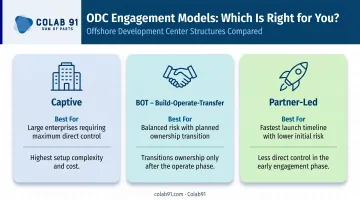
For mid-market companies without in-country expertise, a partner-led model - one that blends onshore strategic guidance with offshore execution - typically delivers faster, lower-risk results than going captive too early. This is the model Colab91 uses: designing the operating model, recruiting domain experts, and managing operations, while clients retain strategic direction and visibility.
Factor 5: Secure Executive Sponsorship and an Onshore Champion
Name an internal owner at the leadership level before the offshore center goes live. Without one, communication gaps fill with assumptions - and offshore teams start optimizing for visibility rather than impact.
An onshore champion should own:
- Strategic alignment between the offshore team and company priorities
- Escalation authority when cross-functional issues arise
- Internal advocacy - representing the offshore team's interests, resources, and recognition
- Governance cadence - keeping leadership engaged, not just informed
This is not a coordination role. It requires genuine authority and organizational credibility.
Talent and Team Design: Factors 6–10
Factor 6: Map Required Roles to Your Operating Model Before Recruiting
Role design must precede recruitment - not follow it. For capability-focused ODCs in procurement or analytics, this means defining:
- Seniority mix - What proportion of senior analysts to junior associates does the work require?
- Domain expertise requirements - Industry context, not just technical credentials
- Interaction model - Will offshore team members work independently, or in real-time collaboration with onshore counterparts?
Listing job titles and posting them is not role design. A procurement analyst supporting a PE-backed healthcare portfolio needs different domain calibration than one supporting a manufacturing client.
Factor 7: Build a Shared Hiring Process Between Client and Partner
Delegating all hiring to a vendor without client involvement is one of the most common ODC mistakes. The result: technically qualified candidates who don't understand the client's industry, culture, or working style.
A well-structured hiring process divides responsibility clearly:
- Partner manages: Sourcing, initial screening, local market calibration, logistics
- Client participates in: Domain-specific technical assessments, cultural fit interviews, final selection decisions
This shared model is slower than full delegation - and consistently produces better hires.
Factor 8: Prioritize Domain Expertise, Not Just Technical Skills
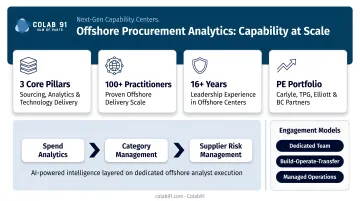
For business process capability centers - procurement, analytics, finance operations - domain understanding is as critical as technical proficiency. A candidate who can run spend analysis in Excel but doesn't understand category management, supplier leverage, or procurement cycle dynamics will execute instructions without generating insight.
Offshore capability centers are increasingly expected to go beyond execution. NASSCOM reports that 49% of enterprises now view BPM relationships as strategic partnerships, and over 60% are focused on functional digital transformation rather than task completion.
Factor 9: Design a Structured Knowledge Transfer Plan from Day 1
Knowledge transfer is not a one-time handoff. It's an ongoing system. A strong plan covers:
- Process documentation - Written, version-controlled, accessible to the offshore team
- Institutional context - Why decisions are made, not just what decisions to make
- Decision rationale - The judgment behind standard operating procedures
- Access protocols - How the offshore team gets the information they need without creating bottlenecks
Build this before the team starts. Retrofitting it mid-engagement costs weeks of momentum.
Factor 10: Build Retention Into the Model from the Start
Attrition erodes institutional knowledge, inflates recruitment costs, and disrupts delivery continuity - often before onshore leadership registers the damage. SHRM estimates replacing an employee costs 50%–200% of annual salary depending on seniority. In India's competitive talent market, tech-role attrition can exceed 15% annually.
Retention levers that consistently matter for India-based teams:
- Compensation benchmarked to local market rates, not internal headcount budgets
- Clear career progression paths with defined advancement criteria
- Meaningful work ownership, not just task execution
- Visibility with senior onshore leadership, not just middle management
Colab91 builds retention into its operating model from day one - because high-performing offshore centers require the same talent investment discipline as onshore teams.
Governance, Operating Model, and Onshore-Offshore Integration: Factors 11–15
Factor 11: Define Reporting Lines and Decision-Making Authority Clearly
Ambiguous reporting - especially when offshore teams support multiple onshore functions simultaneously - is a leading source of misalignment. When nobody is clearly accountable, priorities conflict and offshore teams default to whoever is loudest.
Clear governance means:
- Named decision owners at both onshore and offshore levels
- Defined escalation paths (with response time expectations)
- Scheduled review cadences - weekly operational, monthly governance, quarterly strategic
- Written clarity on which decisions the offshore team can make independently
Factor 12: Establish Communication Rhythms, Not Just Tools
Selecting Slack, Teams, and Zoom is not communication planning. The tools matter less than the rhythm.
Design structured overlap that accounts for the US-India time difference:
- Daily standups - 30 minutes in the morning India time (evening US time, or vice versa, depending on overlap window)
- Weekly syncs - Deeper review of priorities, blockers, and handoffs
- Monthly governance reviews - Performance against KPIs, process issues, resource needs
- Asynchronous protocols - Clear norms for non-urgent communication so offshore teams aren't waiting for responses
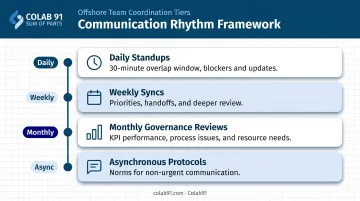
Time zone overlap should be structured and protected, not assumed to happen organically.
Factor 13: Align Workflows and Handoff Protocols Across Locations
Offshore teams working without visibility into upstream and downstream processes cannot deliver consistently. They fill the gaps with assumptions - and assumptions create errors.
Before the team goes live:
- Map end-to-end workflows with handoff points identified explicitly
- Define handoff checklists - what information changes hands, in what format, by when
- Create shared dashboards that give both teams live visibility into process status
- Run at least one tabletop simulation of the workflow before going live
Factor 14: Invest in Cultural Integration as a Business Priority
Real integration goes beyond a sensitivity training module. It means including offshore team members in company all-hands meetings, product launches, and strategic updates - creating a genuine "one team" identity rather than a headquarters-and-satellite dynamic.
For India-based teams specifically, managers should understand:
- High power distance (score: 77) - Team members may not escalate problems or push back on instructions without explicit permission to do so
- Collectivist orientation (score: 24 on individualism) - Relationship context matters; feedback delivered publicly can feel very different than feedback delivered privately
- Indirect communication norms - "I'll look into it" often means "this is a problem I'm not comfortable raising directly"
Understanding these norms lets you design management structures that actually surface problems - instead of ones that bury them.
Factor 15: Treat Offshore Team Members as Full Company Citizens
Cultural integration only holds if it's backed by day-to-day practice. Offshore teams treated as cost line items deliver lower quality, generate higher attrition, and produce limited innovation - a pattern Colab91 sees consistently in ODCs that were set up without this principle from the start.
"Full citizenship" in practice looks like:
- Recognize offshore contributors in company-wide communications, not just internal offshore metrics
- Give team members access to the same professional development resources as onshore counterparts
- Share company performance, strategy, and direction openly - not just what's relevant to their tasks
- Include offshore staff in team celebrations, promotions, and milestone acknowledgments
The offshore team's institutional knowledge - built over months or years - walks out the door when attrition spikes. Full inclusion is how you protect that asset.
Infrastructure, Legal, and Compliance: Factors 16–20
Factor 16: Plan for Total Cost of Ownership, Not Just Labor Rates
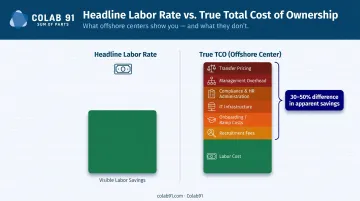
Labor arbitrage is real - but it's only part of the cost picture. Companies that compare only salary rates to their onshore equivalent consistently underestimate the true cost of an offshore center.
A 3-year TCO model should include:
- Recruitment fees and time-to-fill costs
- Onboarding and ramp-time productivity loss
- Infrastructure setup and ongoing IT costs
- Compliance, HR management, and payroll administration
- Management overhead - both offshore and onshore
- Transfer pricing and arm's-length markup requirements
KPMG identifies transfer pricing compliance as the top regulatory priority for 81% of GCC leaders - a cost category many first-time ODC builders overlook entirely. Build the break-even projection on TCO, not headline labor rates. The difference is often 30–50% of the apparent savings.
Factor 17: Establish IP Protection and Data Security Protocols
Before any offshore team member accesses client data or systems, the following must be in place:
- Contractual: NDAs, IP assignment clauses, data residency agreements
- Technical: Role-based access controls, encrypted connections, endpoint security
- Compliance: Alignment with ISO/IEC 27001 information security standards and India's Digital Personal Data Protection Act (DPDPA) - identified as a top priority by 49% of GCC leaders surveyed by KPMG/NASSCOM
For PE-backed companies, investor and board-level expectations around data governance make this non-negotiable before day one.
Factor 18: Navigate Local Labor Laws and Employment Compliance
India's employment regulations differ materially from US or UK equivalents. Getting this wrong creates financial and operational risk that can surface months or years after the mistake.
Key areas requiring local legal expertise:
- EPF contributions: 12% of wages for employees; EPS at 8.33% subject to wage ceiling
- Gratuity obligations: Payable after five years of continuous service at 15 days' wages per completed year
- Termination provisions: The Industrial Disputes Act mandates 60 days' notice for establishment closures
- Contract structures: Fixed-term, contractual, and permanent employment carry different obligations
Engage local legal and HR expertise - either through your partner or independently. Do not apply home-country assumptions.
Factor 19: Build Physical and Digital Infrastructure Aligned to HQ Standards
Infrastructure gaps create productivity friction and signal to offshore team members that they are not resourced to succeed. Baseline requirements include:
- Enterprise-grade connectivity with redundancy
- Development and work environments that mirror HQ tools and platforms
- Secure physical access controls at the office level
- Backup systems and business continuity protocols
Colab91 operates from Gurugram - a mature technology hub with established enterprise infrastructure - which shortens setup timelines compared to emerging tier-2 locations where connectivity and real estate options are still developing.
Factor 20: Draft Contractual Safeguards That Protect Both Parties
Standard vendor contracts are not designed for long-term capability center relationships. Review and negotiate:
- Team scaling notice periods - How much lead time is required to add or reduce headcount?
- SLA definitions and penalties - What constitutes a breach, and what are the consequences?
- Exit and transition procedures - How does knowledge and team continuity transfer if the engagement ends?
- Governing law and jurisdiction - Which country's courts handle disputes?
- Warranty provisions - What remedies exist for underperformance?
The exit and transition clause deserves particular scrutiny - it's the provision most commonly absent from standard vendor agreements and most consequential when an engagement changes direction.
Performance Management and Scaling: Factors 21–25
Factor 21: Define KPIs That Measure Business Outcomes, Not Just Activity
Activity metrics - hours logged, tasks completed, tickets closed - are easy to track and nearly useless for evaluating ODC value. Outcome metrics are harder to define upfront and far more meaningful.
For procurement and analytics capability centers, meaningful KPIs include:
- Cost savings realized vs. target (procurement ROI = annual savings ÷ procurement operating cost)
- Spend under management as a percentage of total addressable spend
- Process cycle time improvements (e.g., PO-to-payment, sourcing event duration)
- Error rate and rework frequency as quality indicators
- Throughput per FTE measured against onshore or industry benchmarks
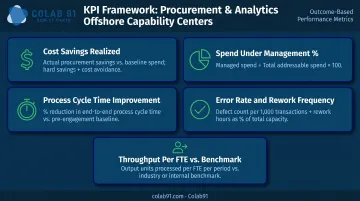
Define these before the team starts. Tie them directly to the strategic objectives you set in Factor 1.
Factor 22: Run a Structured Pilot Before Full-Scale Ramp-Up
A good pilot is not a soft launch. It has defined parameters:
- Scope: Narrow enough to be manageable, representative enough to be meaningful
- Success criteria: Specific, pre-agreed metrics that determine whether to proceed
- Complexity: Low criticality, but reflective of the actual work complexity ahead
- Review: A formal retrospective at the end - not just an informal check-in
Pilots de-risk the broader engagement and give both sides the opportunity to calibrate expectations before significant investment is committed. They also surface governance and integration gaps that are much cheaper to fix at small scale.
Factor 23: Build a Continuous Improvement Feedback Loop
The best offshore capability centers evolve through structured feedback, not ad hoc adjustments. Formalize this without creating administrative burden:
- Monthly retrospectives - What's working, what's broken, what needs a decision
- Quarterly process audits - Review documentation, handoffs, and KPI trajectories
- Bidirectional feedback - Collect input from offshore team members, not just onshore leadership
- Action logs - Track identified issues through to resolution, not just acknowledgment
Without this structure, the same gaps resurface - each time slightly harder to fix and slightly more expensive to ignore.
Factor 24: Plan Team Scaling with Intentional Milestones
Hiring quickly when demand spikes produces teams that outgrow their governance infrastructure. Intentional scaling means defining readiness criteria before adding headcount:
- Documents current scope thoroughly enough for new members to onboard without handholding
- Confirms team leads can absorb additional direct reports without quality erosion
- Verifies physical and digital infrastructure can accommodate the expanded team
- Demonstrates the existing team has achieved sufficient operational independence
Build a hiring roadmap with defined triggers rather than responding to demand after the fact.
Factor 25: Evolve the ODC from Cost Center to Strategic Capability Hub
The most successful offshore centers eventually transition from execution arms to centers of strategic value. Colab91's leadership built a 100+ practitioner organization at Impendi (later acquired by Accenture) through exactly this kind of deliberate evolution.
Signals that an ODC is ready to evolve:
- Offshore team members are proactively identifying process improvements, not just executing instructions
- Senior onshore leaders are directly engaging with offshore counterparts on strategic questions
- The team is generating insights - not just delivering outputs
- Attrition is low, tenure is increasing, and institutional knowledge is deepening
Investments that accelerate this transition include senior talent development, expanded scope with genuine decision-making authority, and direct access to client strategy discussions.
The shift doesn't happen automatically. It requires deliberate investment - and the right timing to make that investment count.
Frequently Asked Questions
How is an offshore development center different from traditional outsourcing?
ODCs are dedicated, long-term extensions of the client company - operating under the client's brand, culture, and strategic direction. Traditional outsourcing is typically project-based, with the vendor managing delivery, team allocation, and methodology. The key difference is ownership of the team's identity and direction.
How long does it take to set up an offshore capability center?
Partner-led models can be operational in 8–12 weeks. Fully captive setups typically take 6–12 months. Timeline depends on how clearly scope, roles, and governance are defined before engagement begins. Ambiguity at the start consistently compounds into delays.
What size company benefits most from setting up an ODC?
Mid-market companies with ongoing, scalable operational needs - not just large enterprises. PE-backed companies with defined value creation timelines often benefit most when the ODC is scoped around measurable cost or efficiency outcomes from the outset.
What are the most common mistakes companies make when setting up an ODC?
Four failure patterns appear consistently:
- Unclear strategic objectives from the start
- Delegating hiring entirely to the vendor
- Under-investing in governance and integration
- Treating the offshore team as temporary rather than a long-term capability
Why is India a strong location for offshore capability centers?
India hosts over 1,800 GCCs generating $64.6B in annual revenue, and accounts for nearly 40% of global sourcing spend. The talent pool across procurement, analytics, finance, and operations is deep - though English proficiency varies significantly by city, which makes location selection within India a meaningful decision.
How do you measure whether an offshore capability center is actually succeeding?
Measure against the original strategic objectives defined before engagement - cost reduction achieved, throughput improvement, capability built, or speed to market. Activity metrics confirm the team is working. What matters is whether the ODC is hitting the specific outcomes it was built to deliver.