Introduction
Scaling specialized capabilities fast - without bloating onshore headcount or ceding control to a third-party vendor - sits at the center of a real operational dilemma for mid-market and PE-backed companies today. Onshore data scientists command a median salary of $112,590, purchasing managers $139,510, and financial analysts $101,350. Hiring a full team at those rates isn't a structural solution. It's a budget problem waiting to happen.
An offshore Center of Excellence (CoE) offers a different approach: a company-controlled team in a lower-cost geography that owns outcomes, builds domain depth, and scales on your timeline - not a vendor's.
This guide covers what a CoE actually is, how it differs from outsourcing, when to build one, and what separates high-performing CoEs from expensive experiments.
TLDR:
- An offshore CoE is a company-controlled strategic hub in a lower-cost geography, built around a specific domain capability
- Unlike outsourcing, ownership, IP control, and long-term capability development stay entirely with the client
- Three core building blocks: talent strategy, governance structure, and domain alignment
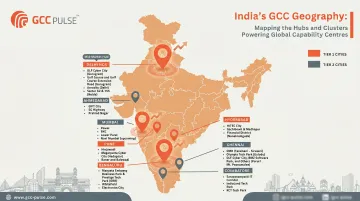
- India (Gurugram, Bengaluru, and Pune in particular) is the dominant CoE destination for US mid-market companies
- Top two failure modes: launching without a clear charter, and scaling headcount before the operating model is proven
What Is an Offshore Center of Excellence?
An offshore CoE is a dedicated, company-controlled team based in a lower-cost geography that functions as a strategic hub - not a delivery arm - for a specific domain or set of capabilities. Common domains include procurement analytics, financial modeling, spend analysis, data operations, and process transformation.
The distinction matters. Deloitte notes that GCCs have evolved from cost arbitrage centers into trusted business partners and global skills hubs, expected to own outcomes, drive innovation, and integrate deeply into the parent organization's strategy. For mid-market and PE-backed companies, that shift means offshore teams can now carry genuine strategic weight - not just task load.
How a CoE Differs from Shared Services and Back-Office Setups
The Hackett Group defines a CoE as an organizational entity dedicated to both service delivery and continuous improvement of those services - not just execution. That's the key distinction.
| Model | Purpose | Scope | Control |
|---|---|---|---|
| Shared Services Center | Centralize repeatable processes for efficiency | Broad, cross-functional | Moderate |
| Captive Back-Office | Handle defined administrative tasks | Narrow, task-based | High |
| Offshore CoE | Own a specific capability domain strategically | Focused, expertise-driven | Full |
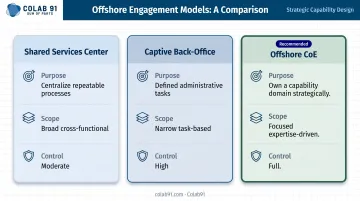
What separates a CoE from the other models isn't size or location - it's intent. A CoE is designed to own a domain, not just service it. That distinction directly shapes which functions belong in one.
Domains Best Suited for a CoE
Knowledge-intensive functions where talent depth matters more than physical proximity are the natural fit:
- Procurement and strategic sourcing
- Spend analytics and category management
- Financial modeling and reporting
- Data operations and business intelligence
- Process transformation and operational improvement
These are the domains Colab91 focuses on - building India-based teams where domain expertise, the right hiring process, and governance structure determine whether an offshore CoE delivers real strategic value.
Offshore CoE vs. Outsourcing vs. ODC: Understanding the Differences
Not all offshore models deliver the same strategic value. Outsourcing, ODCs, and CoEs solve different problems - and choosing the wrong structure creates problems that compound over time.
Traditional Outsourcing
You hand defined tasks to a third party, trade control for convenience, and accept limited visibility into execution. The economics often look compelling upfront, but KPMG reports that 77% of businesses struggle to maintain a fit-for-purpose third-party risk management model - covering operational, IP, and information-security risks. Misalignment and vendor dependency erode the cost case over time.
Offshore Development Centers (ODCs)
ODCs are typically tech-focused and vendor-managed. A dedicated team is built, but cultural and strategic integration with the parent company is shallow. The team executes tasks reliably but rarely drives strategic initiatives or builds institutional knowledge.
The Offshore CoE Model
The CoE is owned or co-operated by the client, aligned to company strategy, and built with long-term talent retention in mind. Key differentiators:
- Keeps institutional knowledge inside the organization, not locked with an external vendor
- Measures the offshore team against the same business outcomes as the onshore function
- Treats CoE members as an extension of the parent organization, not a separate "offshore resource pool"
- Builds toward growing depth and scope over time, not just maintaining steady-state delivery
For PE-backed companies managing sensitive data and active value creation mandates, that level of control isn't a nice-to-have. It's the baseline requirement.
When Should You Build an Offshore CoE?
Timing matters more than most companies realize. Build too early and you're burning resources on structure that has no workload to justify it. Wait too long and you've left years of cost and capability gains on the table.
Signals That Indicate Readiness
You're likely ready when:
- The function has a clear, steady workload - not project-based spikes
- A 2+ year roadmap exists and scope will only grow
- Senior onshore staff are handling work that could run offshore, crowding out higher-value priorities
- The cost model needs a structural reset, not a one-time budget trim
The Zinnov-NASSCOM 2025 mid-market GCC report confirms this model isn't limited to large enterprises: India now hosts 480+ mid-market GCCs employing over 210,000 professionals, with 35% established between FY2023 and FY2025. The window for early-mover advantage is narrowing.
The PE-Specific Trigger
These signals apply broadly - but for PE sponsors and portfolio companies, the trigger connects directly to the value creation plan. When a portfolio company needs to scale procurement analytics, spend management, or operational capabilities rapidly - but can't justify a large onshore hiring surge and won't accept the control risks of outsourcing - a CoE is the structural answer.
What NOT to Do
- Don't build a CoE for one-time or highly variable workloads
- Don't launch before defining clear outputs, success metrics, and a charter
- Don't treat it as a temporary fix - the model only compounds value if built with long-term intent
How to Build an Offshore CoE: 5 Key Building Blocks
Defining the CoE Charter
The charter is the foundation. Without it, the offshore team operates without direction and quickly becomes a cost line rather than a capability asset.
A strong charter defines:
- Scope of ownership - what the CoE is accountable for, specifically (not "analytics support" but which reports, what turnaround standards, what escalation paths)
- Integration points - how the offshore team connects to onshore workflows and decision-making
- Success metrics - business outcome KPIs, not just activity metrics
- Governance structure - who owns the relationship onshore, who leads execution offshore
The charter enables autonomy. A team with clearly defined scope and outcome standards can make judgment calls independently - and escalate the right things at the right time.
Talent Strategy and Hiring
Talent is the core asset of a CoE - not the infrastructure. The right approach:
- Hire for domain expertise and learning agility, not just task execution capacity
- Involve domain experts in the interview process, not just HR generalists - a procurement analyst should be assessed by someone who understands category management, not just someone checking competency boxes
- Build a career path that gives high performers a reason to stay beyond 18 months
- Compensate competitively within the local market - attrition rewards or punishes this decision quickly
India's talent pool for procurement, analytics, and finance functions is deep. NASSCOM reports India has the highest number of STEM graduates globally and the second-largest English-speaking youth population. Compensation matters more than most clients expect: India saw 8.9% actual salary growth in 2025, projected at 9.1% in 2026 per Aon, and attrition declined to 16.2% in 2025 from 18.7% in 2023 for organizations that competed well on pay and culture. The quality of hiring, though, depends on the specificity of the job brief and the rigor of the selection process.
Operating Model and Integration
Once the talent strategy is clear, the entity and operating model determines how quickly you can execute it. Three primary structures exist:
| Model | Who Owns Entity | Who Manages Operations | Best For |
|---|---|---|---|
| Fully Captive | Client | Client | Large enterprises with India experience |
| Co-operated/Managed | Partner or shared | Partner handles compliance, HR, infrastructure; client drives work | Mid-market companies new to India |
| Hybrid | Evolving | Shared and transitioning | Companies planning to go captive over time |
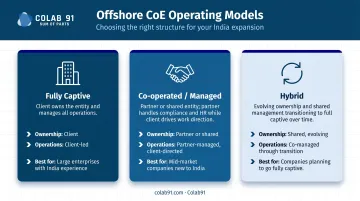
For mid-market companies without prior India entity experience, a co-operated model - like what Colab91 provides - dramatically reduces time-to-hire and compliance risk while preserving strategic control over talent and work direction. Deloitte's Build-Operate-Transform-Transfer (BOTT) framework captures the logic: a partner helps stand up and stabilize the center while the client retains strategic ownership throughout.
Without integration into daily workflows, the CoE defaults to a work-package model - isolated, reactive, and limited in impact. Shared tools, regular standups, and joint accountability for outcomes are the practical markers of a team functioning as an extension of the onshore function, not a vendor receiving instructions.
Governance and Performance Management
Keep governance lightweight but consistent. A functional structure:
- Onshore CoE lead: Owns the charter, relationship, and business outcome accountability
- Offshore CoE head: Manages day-to-day execution and team performance
- Weekly/monthly review cadence: Status, blockers, output quality, pipeline
- Clear escalation path: Defined triggers and response expectations
The KPIs that matter are business outcomes - cost savings identified, reports delivered on time, process cycle time improvements - not hours logged or tickets closed. Everest Group's 2025 GCC research flags unclear mandates and disconnect between GCC leaders and CXOs as primary governance risks. A charter that names outcome owners on both sides - and review cadences that surface blockers before they become misalignment - closes that gap before it widens.
Infrastructure and Tools
The offshore team needs access to the same data systems and reporting environments as their onshore counterparts. Parity of access matters - an offshore team working with incomplete data or delayed exports cannot genuinely own outcomes.
For procurement and analytics CoEs, this means:
- Secure access to spend data, ERP systems, and reporting platforms
- Shared collaboration tools (not email-only handoffs)
- Domain-specific platforms the team is trained on, not just exposed to
Best Practices for Running a High-Performing Offshore CoE
Treat It as a Strategic Hub, Not a Support Function
The biggest differentiator between high-performing and underperforming offshore CoEs is what leadership actually asks the team to do. High-performing CoEs are given real problems to solve - not overflow work.
Teams that start with basic data validation and evolve into full analytical decision support don't do so accidentally. The evolution happens when onshore leadership progressively assigns harder problems, gives the offshore team visible outcomes to own, and shares the domain context needed to make decisions independently.
Invest in Domain Expertise, Not Just Headcount
Scaling headcount without scaling domain depth is one of the most common failure patterns. More analysts doing shallow work doesn't translate into strategic value.
Colab91's "Sum of Parts" model addresses this directly: augmenting in-house talent with domain-expert leadership onshore and a trained, specialized team offshore - rather than hiring generalists and hoping expertise develops organically. The onshore layer brings strategic context and domain authority. The offshore layer brings execution depth and analytical capacity. Together, they deliver more than either could independently.
Build Culture Deliberately
Cultural integration across geographies doesn't happen automatically. Best practices:
- Onboard offshore CoE members the same way you onboard onshore staff - company values, strategic context, business objectives - not just task training
- Invest in periodic in-person collaboration, especially in the first 6-12 months when norms are being established
- Recognize offshore contributions visibly at the organizational level - attribution matters for retention and engagement
Colab91 builds teams around this principle - professionals who integrate deeply with client culture and operate as an extension of in-house functions. That outcome is designed in from day one, not left to chance.
Establish a Continuous Improvement Loop
A CoE that only executes to a fixed scope is a back-office function. A CoE that regularly evaluates its own processes, flags inefficiencies, and proposes improvements is a capability center.
Build a structured cadence where the offshore team participates in identifying what's working, what's breaking down, and what could be done differently. Without that review cycle, even well-designed functions drift toward routine execution over time.
Scale Thoughtfully Based on Demonstrated Value
Start focused - one domain, one clear charter. Prove the operating model works. Then expand scope and headcount deliberately.
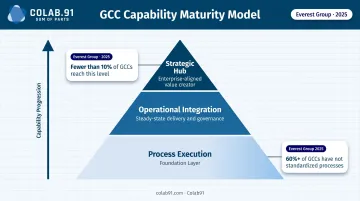
Everest Group's 2025 research found that fewer than 10% of GCCs reach the top maturity tier, and that more than 60% had not sufficiently standardized their processes. Premature scaling before the operating model is stable is a primary reason. Resist the urge to grow the team faster than the governance structure can support.
Common Pitfalls That Derail Offshore CoEs
The "Lift and Drop" Failure
Moving tasks offshore without re-engineering workflows or providing context produces offshore teams that are technically busy but not adding strategic value. The work arrives disconnected from the business logic that makes it meaningful. Co-designing the operating model, rather than simply exporting existing processes, is what separates CoEs that compound value from ones that stagnate.
Leadership Disconnect
When onshore leadership treats the offshore CoE as an IT ticket queue rather than a strategic partner, talent attrition follows. High-caliber domain experts in India have options. They leave when the work is low-complexity and the connection to business outcomes is invisible. Consistent, substantive, two-way leadership engagement is one of the strongest predictors of offshore team retention.
The Governance Vacuum
CoEs without a defined charter, clear ownership, and regular review cycles drift into ambiguity. The offshore team doesn't know what good looks like. Onshore stakeholders lose confidence. Output quality follows.
This failure mode is entirely preventable. Lightweight but consistent governance needs to be in place from day one - not retrofitted once the team is already operating in a vacuum.
Frequently Asked Questions
What is the difference between an offshore Center of Excellence and traditional outsourcing?
A CoE is company-owned or co-operated, strategically integrated, and built for long-term capability development. Outsourcing hands defined tasks to a third party with limited visibility, IP exposure, and vendor dependency. Cost savings that look attractive upfront often erode as misalignment compounds over time.
What functions are best suited for an offshore CoE?
Knowledge-intensive, repeatable functions with clear outputs - procurement analytics, spend analysis, financial reporting, data operations, and process transformation - are ideal. Highly variable or relationship-dependent work (like active client negotiations or C-suite advisory) is less suited.
How long does it take to set up an offshore Center of Excellence?
A co-operated model can get a foundational team operational in 60–90 days. A fully captive entity takes considerably longer due to legal setup requirements. Either way, the first six months should be treated as a stabilization phase, not a performance phase.
What are the most common reasons offshore CoEs fail?
Most failures trace back to three root causes: launching without a clear charter, weak governance and leadership disconnect from onshore stakeholders, and scaling headcount before proving a repeatable operating model.
How do you measure the ROI of an offshore Center of Excellence?
Measure on business outcomes - cost savings identified, process efficiency gains, analytical quality - not input metrics like hours worked. Most CoEs take 12–18 months to show full ROI once the operating model stabilizes and the team reaches consistent output quality.
Is India the best location for building an offshore CoE for US companies?
India remains the leading destination, with 1,700+ GCCs and 1.9 million+ professionals in its GCC ecosystem as of FY2024. Deep talent pools in analytics, procurement, and finance - combined with strong English proficiency and time zone overlap with the US East Coast - make it the default choice. City selection matters: Gurugram leads for procurement and finance talent, Bengaluru for tech-adjacent analytics, and Pune for BFSI functions.