
Introduction
Setting up a Global Capability Center is one of the highest-stakes operating model decisions a mid-market or PE-backed company will make. It's a strategic commitment that shapes talent velocity, cost structure, and delivery outcomes for the next three to five years.
Most mid-market companies don't have enterprise-scale planning teams. They need to move fast - often without dedicated internal bandwidth for site selection, legal structuring, talent architecture, and governance design all at once. When that pressure leads to shortcuts, the results follow a familiar pattern:
- Fragmented governance with no clear accountability
- Compliance delays that stall hiring or entity setup
- Talent churn from misaligned role design or compensation
- SLAs defined retroactively instead of before work begins
Getting the sequence right matters. This checklist organizes the 10 must-have elements across three phases - strategic foundation, talent and people, and operational infrastructure - so leaders can pressure-test their readiness before committing. Each element is a decision point where reversing course is costly.
Key Takeaways
- GCC setup is an operating model decision: define scope and mission before infrastructure or headcount
- Validate location, legal structure, and compliance frameworks before hiring begins
- Onboard talent leadership before bulk hiring; the sequence directly affects outcomes
- Lock in governance and outcome SLAs from day one - retrofitting them post-launch rarely works
- Follow a phased roadmap (pilot → stabilize → optimize) to avoid scaling before foundations are set
Elements 1–3: Strategic Foundation
The first three elements form the foundation layer. Decisions made here define the GCC's mission, commercial structure, and risk profile for years. Getting them wrong is expensive - not just financially, but in organizational momentum.
Element 1: Define Your Operating Model and Scope
A GCC without a clearly articulated mission drifts into being a generic headcount extension. The operating model must answer three questions before anything else:
- Which functions are in scope? Procurement, analytics, finance, technology, R&D - or some combination?
- What does success look like beyond cost savings? Quality thresholds, speed-to-delivery, transformation milestones
- How does the center connect to enterprise objectives? Not just as a cost center, but as a strategic capability hub
Two charter types shape this decision. An activity-based charter defines what the team does: process steps, task volumes. An outcome-based charter defines what the team delivers: cycle time reduction, analyst coverage per FTE, savings identified. Mid-market companies with leaner governance structures need the outcome-based model. It creates accountability without requiring constant HQ oversight.
Element 2: Choose the Right Location
India accounts for nearly 50% of global GCC activity and hosts GCCs for approximately 1,300 global organizations, making it the default starting point for most mid-market location decisions. Choosing India is only the first decision. City-level selection matters just as much.
Key scoring factors for location decisions:
- Talent depth by function: not just engineers, but domain specialists in finance, procurement, and analytics
- Cost-to-serve: real estate, attrition risk, and compensation benchmarks
- Time-zone alignment: overlap hours with the parent company's primary operating location
- Regulatory environment: state-level compliance variations and infrastructure quality
According to ETGCC data, Bengaluru accounts for 34% and Delhi-NCR for 15% of mid-market GCC distribution. Bengaluru leads in tech and AI/ML talent; Delhi-NCR (including Gurugram, where Colab91 operates) draws companies needing proximity to North Indian talent pools and certain financial services capabilities; Hyderabad has seen significant R&D investment from firms like Accenture, Deloitte, and Microsoft. Your functional priorities should drive the city decision, not the other way around.
Element 3: Decide Your Engagement Model
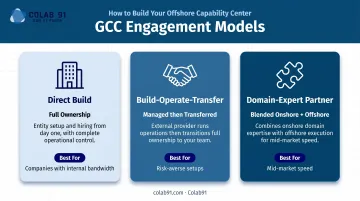
Three primary models define how you enter:
| Model | What It Means | Best For |
|---|---|---|
| Direct Build | Full ownership from day one - entity, hiring, operations | Companies with internal bandwidth and long time horizons |
| Build-Operate-Transfer (BOT) | External provider runs the center initially, then transfers ownership | Risk-averse setups that need operational proof before full commitment |
| Domain-Expert Partner | Blends onshore expertise with offshore execution | Mid-market companies that need to move fast without building from scratch |
Many mid-market firms underestimate the operational weight of a direct build. Entity setup, compliance infrastructure, local hiring pipelines, and governance design all hit simultaneously - and without internal bandwidth, each one becomes a bottleneck.
Colab91's "Sum of Parts" approach addresses this directly: augmenting a client's in-house talent with domain expertise so the offshore team functions as a strategic hub rather than a disconnected service unit. The right model comes down to three variables: speed-to-value requirements, risk appetite, and an honest read of internal capacity.
Elements 4–6: Talent and People
Talent decisions either accelerate or stall a GCC. The order in which those decisions are made matters as much as the hiring plan itself.
Element 4: Hire Leadership Before Headcount
Onboarding a capable local GCC leader - Head of Delivery, Head of India Operations, or equivalent - before bulk hiring begins is non-negotiable. Without local leadership, teams lack direction on standards, culture, and delivery expectations. Headquarters ends up managing operationally from a distance, which defeats the purpose.
BCG's GCC research shows that 60% of top-performing GCCs operate under centralized or semi-centralized decision models, and 70% host more than 16 global roles within their India hubs. Leadership density is a deliberate design choice, not a byproduct of growth.
Leadership hiring should define:
- Clear accountability between the GCC leader and the parent-company sponsor
- What "good" looks like in Year 1 (specific KPIs, not just role descriptions)
- Decision rights between local leadership and HQ from the start
Element 5: Design a Scalable Talent Acquisition Strategy
Standard job-board recruiting rarely works for GCC domain-specialist roles in procurement, analytics, or finance transformation. Nearly 90% of GCCs in India are multi-functional, which means competition for niche talent is real.
A structured talent pipeline for mid-market GCCs should include:
- SLA-backed replacement terms specifying recourse if a placed professional exits within a defined window
- Culture-fit screening aligned to parent-company values, not just technical qualifications
- Defined conversion-to-hire paths for contract roles, so strong performers have a clear trajectory
- Separate sourcing channels for procurement and analytics talent versus technology roles
Element 6: Invest in People Ops and Retention from Day One
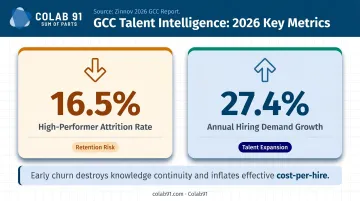
Attrition is the single largest operational risk for a mid-market GCC. Zinnov's 2026 GCC report tracks high-performer attrition at 16.5% and average annual hiring demand at 27.4% across GCCs. Early churn destroys knowledge continuity and inflates effective cost-per-hire significantly.
Designing the employee value proposition before the first hire is made - career paths, learning investment, manager quality - prevents reactive retention spending later.
Compliance is the operational layer that makes retention strategy viable. Getting it wrong early creates liability that undercuts everything else. The baseline before onboarding begins:
- Shops and Establishments Act registration (required within 30 days of commencing operations in Karnataka and Telangana)
- EPF enrollment (applies at 20+ employees)
- ESI registration (applies at 10+ employees in most states)
- POSH Internal Committee constitution
- Employee handbook covering policies, conduct standards, and grievance mechanisms
Elements 7–10: Operational Infrastructure and Governance
This phase covers the invisible scaffolding that determines whether the GCC actually delivers. Compliance gaps, technology debt, and governance ambiguity all compound quickly once hiring begins at scale.
Element 7: Legal, Compliance, and Regulatory Readiness
For most mid-market GCCs in India, the standard entity structure is a Private Limited Company registered under the Companies Act, 2013. Key setup steps:
- MCA company registration via SPICe+ and AGILE-PRO-S forms
- PAN, TAN, and GST filings linked through the incorporation process
- FDI/FEMA compliance - DPIIT's FDI policy allows FDI up to 100% under the automatic route in most sectors, but post-investment reporting to RBI via Form FC-GPR must be completed within 30 days of share allotment
Data protection is a growing compliance requirement that can't be deferred. India's Digital Personal Data Protection (DPDP) Act, 2023 creates obligations for:
- Consent management (free, specific, informed, and unambiguous)
- Breach notification to the Data Protection Board and affected individuals
- Cross-border data transfer restrictions subject to central government notification
GCCs handling sensitive data - procurement records, financial data, patient information - need DPDP compliance frameworks in place from day one, not as an afterthought.
Element 8: Technology Stack and Security Foundations
Technology readiness means standardizing the core stack before teams are onboarded, not after. Retrofitting security and tooling during active hiring creates rework, inconsistent environments, and gaps that are difficult to close under delivery pressure.
Minimum standards before onboarding begins:
- Cloud platforms selected and access policies defined
- Identity and access management (IAM) configured with role-based controls
- Collaboration tools standardized across HQ and GCC
- Data classification policies in place for sensitive information handling
- Incident response playbooks documented before they're needed
Role-based access controls, audit logging, and breach response procedures need to be configured at setup - not retrofitted once delivery is underway.
Element 9: Governance Framework and Outcome SLAs
Governance defines how decisions are made, escalated, and measured between HQ and the GCC. BCG research on top-performing GCCs consistently shows that outcome-based KPIs - covering cost reduction, process digitization, and revenue contribution - are tracked far more rigorously than effort hours.
A functioning governance framework includes:
- Joint steering cadences - defined frequency, attendees, and agenda structure
- RACI between HQ and GCC - who decides, who executes, who is consulted, who is informed
- SLA dashboards tracking outcomes (time-to-value, cost-per-output, quality thresholds) rather than effort hours
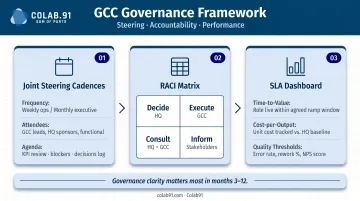
Ambiguous ownership of platforms, budgets, and priorities is one of the leading causes of GCC underperformance. Governance clarity matters most in months 3–12, when the center is stabilizing but HQ hasn't yet fully delegated authority.
Element 10: Phased Scale Roadmap
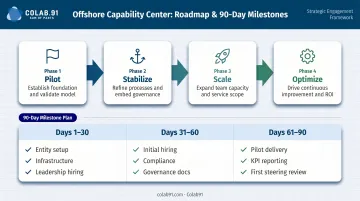
Trying to do everything in the first 90 days is the most common form of GCC failure. A phased roadmap stages delivery in waves:
- Pilot - one or two initial functions, controlled scope, learning mode
- Stabilize - mature delivery processes, confirm governance, address early gaps
- Scale - expand headcount and functional scope with confidence
- Optimize - shared services, Centers of Excellence, automation layers
First 90-day milestone framework:
| Phase | Focus Areas |
|---|---|
| Days 1–30 | Entity setup, infrastructure selection, leadership hiring |
| Days 31–60 | Initial hiring, compliance frameworks, governance documentation |
| Days 61–90 | Pilot process delivery, KPI reporting begins, first steering review |
Common GCC Setup Mistakes That Derail Mid-Market Companies
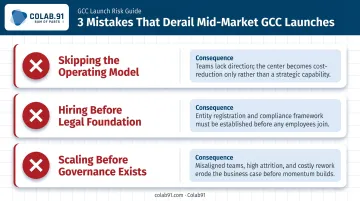
Most GCC failures trace back to three mistakes - and they show up in the same sequence every time:
Skipping the operating model. Organizations that rush past scope definition end up with teams that lack strategic direction. The center becomes a cost-reduction exercise rather than a capability asset - building long-term dependency on HQ instead of reducing it.
Onboarding employees before the legal foundation is ready. Starting hires before entity registration, labor law compliance, and payroll frameworks are in place creates legal exposure, payment delays, and early trust erosion that's hard to walk back. The sequence matters: entity first, employees second.
Scaling headcount before governance exists. Hitting headcount targets without functional leadership and defined SLAs produces misaligned teams, high early attrition, and costly rework. In most cases, the time lost to fixing a rushed ramp-up exceeds whatever was saved by moving fast.
Pro Tips for a Faster, More Resilient GCC Launch
Front-load clarity in an inception sprint. A 4–6 week planning sprint to finalize the operating model, confirm the location, align the engagement model, and nail down governance prevents months of reactive corrections. Colab91's team brings direct experience building and scaling India delivery centers for PE-backed firms like Carlyle Group and TPG. That institutional knowledge compresses the sprint timeline and reduces the costly back-and-forth that typically slows mid-market launches.
Use quarterly readiness audits. Re-assessing governance, compliance, and delivery maturity at the 30-, 60-, and 90-day marks surfaces gaps before they compound into operational problems. Build these reviews into the governance calendar from the start.
Document everything from day one. Comprehensive documentation across legal setup, HR policies, process SOPs, and governance agreements reduces penalty risks, accelerates regulatory reviews, and ensures knowledge continuity during leadership transitions.
Frequently Asked Questions
What is a GCC (Global Capability Center)?
A GCC is an offshore unit established by a multinational or mid-market company to manage strategic functions such as IT, finance, analytics, procurement, or R&D. Unlike traditional outsourcing, the company retains full ownership, control, and strategic direction of the center - the talent, tools, and institutional knowledge belong to the enterprise.
How do you set up a GCC capability center?
The high-level stages: define operating model and scope, select location and legal structure, hire local leadership, establish compliance and technology foundations, then scale in phases. Mid-market companies typically benefit from partnering with specialists who have executed this before, since the sequencing matters as much as the individual steps.
Why are companies setting up GCCs?
The core drivers are access to deep and cost-effective talent pools and the ability to build strategic offshore capability rather than transactional outsourcing. GCCs also create value beyond cost savings - through operational improvement, IP retention, and long-term institutional knowledge. India is projected to host 950 mid-market GCCs by 2030, led largely by PE-backed companies.
What licenses and approvals are required to set up a GCC in India?
Key requirements include:
- Company registration with MCA via SPICe+
- PAN, TAN, and GST registration
- FDI/FEMA compliance (most activities qualify for the automatic route)
- Post-investment RBI reporting via FC-GPR
- State-level registrations: Shops and Establishments Act, EPF, and ESI
How long does it take to set up a GCC in India?
Legal entity setup typically takes 4–8 weeks, with initial hiring and compliance frameworks achievable within 60–90 days. Reaching a stable, productive operating state generally takes 6–12 months depending on scope, engagement model, and planning thoroughness.
What is the difference between a GCC and outsourcing?
In outsourcing, the vendor owns the team, tools, and processes - the client receives outputs. In a GCC, the company owns the entity, controls the talent and culture, and builds institutional knowledge over time. GCCs are preferred when strategic capability, IP protection, and long-term operational control matter more than short-term cost reduction.