Introduction
Most companies enter offshore work the same way - through a project outsourcing engagement. It's fast, requires no headcount commitment, and the risk is capped to a defined budget. That logic holds until it doesn't.
As work evolves, the project model starts generating friction:
- Vendors who need re-briefing every cycle
- Quality that varies with staff rotations
- Scope changes that trigger renegotiation
- Per-unit costs that rise steadily as volume grows
Deloitte's 2024 Global Outsourcing Survey found that 70% of executives say their Vendor Management Office is not fully mature - a governance gap that compounds each of these problems.
The core tension is straightforward: project outsourcing optimizes for speed and flexibility; dedicated offshore teams optimize for continuity, control, and long-term cost efficiency. Picking the wrong model for your growth stage drains value without ever triggering a clear alarm.
This article defines both models, compares them across key dimensions, and identifies the specific signals that tell you it's time to make the switch.
Key Takeaways
- Project outsourcing: hire a vendor to deliver a defined scope - they own staffing, delivery, and execution
- Dedicated offshore team: your team, your direction - a partner handles HR, infrastructure, and compliance in-country
- The real question is who owns the outcomes - and who retains the expertise when the engagement ends
- Outsourcing fits time-bound, well-defined work with low strategic complexity
- For recurring, growing functions, dedicated teams build domain depth that compounds over time
What Is Project-Based Outsourcing?
Project outsourcing means engaging a third-party vendor to deliver a specific, scoped outcome - a one-time spend analysis, a software module, a quarterly reporting cycle. The vendor owns staffing decisions, delivery management, and execution. You're buying a deliverable, not building a capability.
Why It Attracts Early-Stage Organizations
No headcount on your books, fast ramp-up, exposure capped to a fixed budget or timeline. For companies testing whether a function is worth investing in, project outsourcing is a sensible first step.
It works well when:
- Deliverables can be fully specified before the work begins
- The engagement has a natural end date
- The function is peripheral or exploratory
- The organization isn't ready to manage an offshore team directly
For PE portfolio companies in early value-creation phases - where a one-time vendor audit or benchmark study is needed but longer commitment isn't warranted - project outsourcing fits the moment.
Where the Model Breaks Down
That fit has limits. Once the work becomes recurring or strategic, the model's structural weaknesses surface - and the core problem is ownership.
The vendor's team serves multiple clients at once, so institutional knowledge never accumulates on your side. Every scope change triggers renegotiation, and priorities shift toward whoever is applying the most pressure that week. KPMG's 2024 outsourcing paper identifies fragmented reporting, accountability disputes, unexpected costs, and SLA complexity as recurring outsourcing challenges - issues that compound as work becomes more ongoing and strategic.
What Is a Dedicated Offshore Team?
A dedicated offshore team is a group of full-time professionals in an offshore location who work exclusively for your company. They're integrated into your processes, tools, and reporting lines. A local partner (like Colab91) handles HR, payroll, infrastructure, and compliance while you retain direct control over priorities, workflow, and output quality.
The Structural Difference That Matters
In outsourcing, the vendor decides who works on your account and when. In a dedicated model, you direct the team. That distinction determines whether institutional knowledge stays with the vendor or builds on your side.
Over time, a dedicated team becomes more valuable, not less. Staff learn your business context, your data, your decision-making patterns. A procurement analytics team that has worked inside your vendor data for 18 months delivers qualitatively different output than one briefed fresh each quarter.
Cost Structure
Instead of project or hourly rates with vendor margin embedded, you access offshore talent at local market rates with a transparent management fee. As team size and tenure grow, the economics improve - fixed overhead spreads across more output, and experienced staff require less supervision.
Deloitte's 2025 Global Business Services Survey found that approximately 55% of organizations with a global GBS leadership role achieved more than 20% average savings through this model - not from rate arbitrage alone, but from governance maturity and scale.
Dedicated teams work best when:
- Work is recurring and multi-functional
- Continuity and domain depth matter to output quality
- Volume has grown to justify two or more full-time equivalents
- The function has strategic relevance to the business
This is the scenario Colab91 is built for. The firm works with mid-market and PE-backed companies to establish India-based capability centers in procurement, analytics, and supply chain - where the offshore team operates as an integrated extension of the onshore organization.
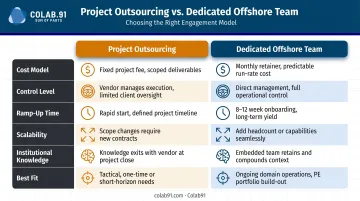
Outsourcing vs. Dedicated Offshore Teams: Quick Comparison
| Dimension | Project Outsourcing | Dedicated Offshore Team |
|---|---|---|
| Cost model | Project or hourly rate with vendor margin | Per-seat rate with transparent management fee |
| Control level | Vendor-managed delivery | Client-directed work |
| Ramp-up time | Days to weeks | 6–10 weeks (hiring, onboarding, integration) |
| Scalability | Limited by contract scope | Modular and ongoing |
| Institutional knowledge | Stays with vendor | Accumulates with client |
| Best fit | Time-bound, well-defined tasks | Recurring, strategic, evolving functions |
The right choice comes down to two factors: how central the function is to your business, and whether the work ends on a deadline or compounds in value over time.
Which Model Fits Your Business Stage?
Scope Definition
If the work has a clear start, defined deliverables, and a natural end point - outsourcing fits. If requirements evolve, scope expands, or the function needs to mature alongside the business, a dedicated team is the right structure. The test is simple: can you write the full spec before the work starts?
Strategic Importance of the Function
Peripheral or one-off tasks - a benchmark study, a one-time vendor audit - suit outsourcing. Core functions that drive competitive advantage: procurement cost optimization, spend analytics, financial modeling - warrant the continuity and ownership a dedicated team provides. Handing a core function to a vendor means the institutional knowledge disappears when the contract ends.
Volume and Frequency
Low, intermittent volume favors outsourcing. When volume grows to justify two or more dedicated FTEs running continuously, the dedicated model becomes structurally and economically superior.
The crossover point isn't fixed - it depends on utilization, function complexity, and embedded vendor margin - but most organizations reach it sooner than they expect.
Cost Trajectory Over Time
Outsourcing rates are predictable per project but become expensive relative to output at scale. Project pricing embeds vendor overhead, margin, and the cost of serving multiple clients simultaneously. As volume grows, you pay that premium repeatedly. A dedicated team amortizes setup costs across growing output, and the per-unit cost declines as the team matures.
Which Model Is Right for You?
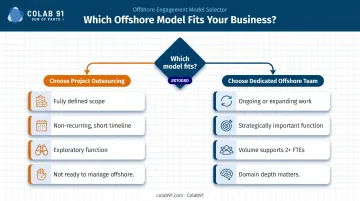
Taken together, these four dimensions - scope, strategic importance, volume, and cost trajectory - point toward a clear decision framework.
Choose project outsourcing if:
- Scope is fully defined and unlikely to change
- Work is non-recurring with a short timeline
- The function is exploratory and commitment isn't confirmed
- Your organization isn't ready to manage an offshore team directly
Choose a dedicated offshore team if:
- Work is ongoing or expanding beyond original scope
- The function is strategically important to the business
- Volume supports two or more continuous FTEs
- Building domain depth and institutional knowledge matters
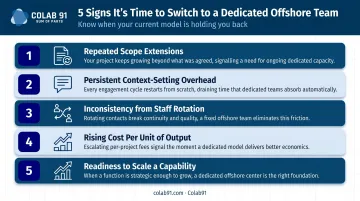
5 Signs It's Time to Transition to a Dedicated Offshore Team
Sign 1: Repeated Scope Extensions and Change Orders
If you're constantly renegotiating with the same vendor because the work has evolved past the original brief, the engagement has become ongoing - it just isn't structured that way. Every change order is a transaction cost. Collectively, they signal that the work has outgrown the project model and needs a dedicated ownership structure.
Sign 2: Persistent Context-Setting Overhead
When your team spends meaningful time re-briefing the vendor on business context, past decisions, and company processes at the start of each engagement, institutional knowledge is not being retained. That overhead has a real cost - it diverts your senior people from higher-value work and compresses the time the vendor actually spends on analysis rather than orientation.
Deloitte's research on workforce knowledge risk found that 52% of respondents identified knowledge loss due to workforce movement as one of their top three operational concerns. In a vendor relationship, that risk is structural - it's built into the model.
Sign 3: Inconsistency from Vendor Staff Rotation
Outsourcing firms reassign staff across client accounts as workloads shift. If your deliverables reflect different working styles, varying assumptions, or inconsistent methodology across engagement cycles, staff rotation is the likely cause - not talent quality. The lack of continuity is the root problem, and it doesn't improve within a project outsourcing structure.
Sign 4: Rising Cost Per Unit of Output
As the relationship matures and volume grows, project-rate pricing often exceeds what a dedicated FTE would cost at equivalent output. Vendor pricing includes overhead, margin, and account management costs that don't scale down as your volume grows.
A dedicated team's cost per output unit declines over time as setup costs amortize and productivity improves. When you're running monthly project engagements at premium rates, the crossover has likely already passed.
Sign 5: Readiness to Scale a Function, Not Just Complete a Task
This is the clearest signal. If the goal has shifted from finishing a project to building a capability - a procurement center of excellence, an analytics function, a finance operations hub - the project model cannot serve that ambition. Capability centers require something the project model cannot provide:
- Defined career paths that retain domain expertise
- Coordination across functions, not just task handoffs
- Leadership structure with accountability to long-term outcomes
That demands a dedicated team.
Colab91's leadership built exactly this at Impendi, scaling an India-based multifunctional organization from the ground up to 100+ practitioners serving PE sponsors including Carlyle Group, TPG, Elliott, and BC Partners. That hands-on experience informs how Colab91 approaches this transition today: which functions to staff first, how to structure governance, and how to integrate offshore teams with onshore leadership.
If you're seeing these signs in your current outsourcing setup, Colab91 can help you assess the right model, define the team structure, and move from design to operational standing quickly.
Conclusion
Project outsourcing is not the wrong model - it's often the right starting point. Transitioning to a dedicated offshore team is a question of timing, not rejection. The work simply matures past what a project-based engagement can sustain.
The signals are typically visible before the pain becomes acute: scope creep, context-setting overhead, staff rotation, rising per-unit costs, and a growing ambition to build rather than just buy. When those signals appear together, the transition isn't a disruption. It's overdue.
For mid-market and PE-backed companies, where every function needs to justify its cost and demonstrate value creation, the choice between these models has direct implications for operational scalability and cost predictability.
A dedicated offshore team that builds domain depth over time delivers compounding returns:
- Lower costs through a stable, optimized cost structure
- Better decisions driven by institutional knowledge rather than repeated onboarding
- Faster execution as the team internalizes business context over time
- A function that scales with the business, not one that resets with each new vendor contract
Frequently Asked Questions
What is the transition phase when moving from project outsourcing to a dedicated offshore team?
The transition typically involves a parallel-run period where the dedicated team is onboarded (hiring, process documentation, and system integration) while the existing outsourcing relationship is wound down in stages. Knowledge transfer happens during this overlap to prevent continuity gaps before the vendor is fully replaced.
What is the main difference between project outsourcing and a dedicated offshore team?
In project outsourcing, the vendor owns delivery and staffing decisions; institutional knowledge stays on their side. In a dedicated team model, the client directs the work and retains the knowledge, while the offshore partner manages administrative and operational infrastructure.
How long does it take to set up a dedicated offshore team?
A well-structured setup covering hiring, onboarding, and integration can typically be completed in 6–10 weeks. Timeline varies by function complexity and the provider's domain depth.
When does project outsourcing make more sense than a dedicated team?
Outsourcing fits when scope is clearly defined, the work is non-recurring, the timeline is short, or the organization isn't ready to manage an offshore team directly. It's the right starting point when you're still testing whether a function warrants long-term investment.
What are the hidden costs of staying in project outsourcing too long?
The main hidden costs include:
- Repeated context-setting that pulls senior staff away from higher-value work
- Premium project pricing on what has effectively become steady-state work
- Output inconsistency caused by vendor staff rotation
- Lost opportunity to build institutional knowledge that compounds over time