Introduction
US employers are paying more per hour than ever. According to the Bureau of Labor Statistics, management, professional, and related occupations averaged $75.86 per hour in total compensation as of March 2025 - with benefits alone accounting for nearly 30% of that figure. Healthcare costs are rising on top of that, with WTW projecting a 7.7% increase in employer healthcare costs for 2025, following consecutive years of similar increases.
For mid-market and PE-backed companies, this isn't an abstract trend. RSM reported that 67% of middle-market executives saw prices paid rise in Q3 2025, while only 48% saw prices received rise - a margin squeeze that directly limits how aggressively companies can invest in headcount.
Offshore teams are a proven response to this pressure - but cost outcomes vary far more than most executives expect. Geography matters less than the model: what drives real savings, or quietly erodes them, is how teams are designed, which roles are selected, and how the engagement is governed.
Key Takeaways
- Labor arbitrage delivers real savings, but the magnitude depends on role selection, engagement model, and governance
- Setup costs, rework, and onshore management overhead accumulate before a team reaches full output - and are rarely budgeted
- What to offshore, how to structure the engagement, and whether domain expertise is embedded are decisions that must be made before hiring begins
- Mid-market and PE-backed companies see the most value when offshore teams function as capability centers with embedded expertise
- Poor governance can partially or fully erase labor savings; net outcome is determined by integration quality
How Offshore Team Costs Actually Build Up
Offshore costs don't appear as a single line item. They accumulate across phases that most companies don't budget separately.
The Four Phases Where Cost Builds
| Phase | What It Includes | Why It's Often Invisible |
|---|---|---|
| Pre-engagement | Scoping, vendor selection, contracting | Absorbed into internal management time |
| Setup | Onboarding, tooling, process documentation | Treated as one-time, often underestimated |
| Ramp | Knowledge transfer, early inefficiencies | Output gaps aren't tracked as cost |
| Steady-state | Ongoing coordination, quality control, attrition | Spread across budget lines, hard to isolate |
The initial labor cost comparison is what gets offshore engagements approved. But the actual cost figure that matters is total cost of engagement: onshore coordination time, rework from miscommunication, and delayed output during integration.
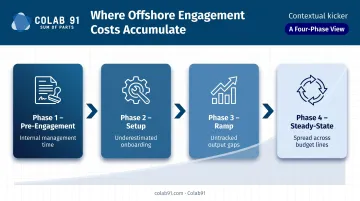
What makes this difficult is that these costs stay invisible until scale or failure exposes them. A poorly scoped offshore role generates rework. Rework consumes onshore management bandwidth. That delays other functions.
The "cheap hire" becomes a budget drain within months. And the problem compounds - it rarely self-corrects without deliberate intervention.
Key Cost Drivers for Offshore Teams
Role Selection
Not all offshored roles produce equivalent savings. Transactional roles - data entry, scheduling, basic reporting - generate labor savings quickly because the work is process-definable and output is easy to measure.
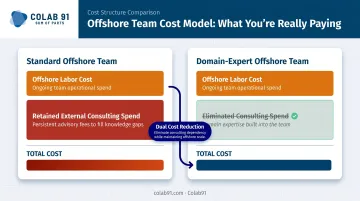
Domain-intensive roles - procurement analytics, spend modeling, financial analysis - are a different calculation. The offshore talent costs more. But the value created is proportionally larger: eliminating consulting spend, accelerating decisions, improving output quality. A procurement analytics team running spend analysis in-house replaces work that would otherwise go to an external firm at significantly higher rates.
The mistake most companies make is treating both categories identically in their business case.
Engagement Model
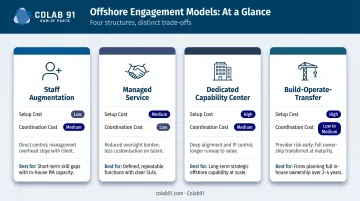
Role type should also inform how the engagement is structured. The engagement model directly affects cost:
- Staff augmentation - Low setup cost, but high ongoing coordination cost. The client owns all management overhead.
- Managed service - Better for early-stage offshoring where processes aren't yet documented. The vendor handles coordination, but scope control is weaker.
- Dedicated capability center - Higher initial investment, lower long-run cost per unit of output. Institutional knowledge accumulates within the team rather than evaporating with vendor rotation.
- Build-Operate-Transfer (BOT) - Useful when the end goal is ownership of the team; costs front-load toward the build phase.
Governance and Management Overhead
Onshore management time spent directing, correcting, and coordinating offshore teams is a real cost that almost never appears in the business case. The less self-sufficient the offshore team, the more it taxes onshore staff - effectively shifting labor cost from one budget line to another without reducing it.
When offshore teams require constant direction rather than delivering against defined outcomes, the cost model breaks down.
Attrition and Continuity
India's technology and professional services talent markets are competitive. NASSCOM reported attrition for top Indian technology services firms stabilized at 12.7% in Q1 FY25 - and salary growth continues, with Aon projecting a 9.2% salary increase across India in 2025.
High attrition resets institutional knowledge and restarts ramp time. The nominal cost of an offshore hire looks attractive, but the effective cost per productive output hour - once ramp cycles, replacement costs, and knowledge loss are factored in - is substantially higher than it appears on paper. SHRM estimates replacing a professional-level employee can cost 50% to 200% of annual salary, depending on seniority.
Cost-Reduction Strategies for Offshore Teams
Most offshore cost problems aren't caused by bad talent - they're caused by decisions made before the first hire and management habits that quietly inflate overhead once the team is running. The strategies with durable impact fall into three categories: decisions made before the team is built, management practices while the team is operating, and structural factors that determine long-term outcomes regardless of individual performance.
Decisions That Set the Cost Floor
Role selection before hiring. Prioritize roles where the labor cost differential is high, the work is process-definable, and output is measurable. Avoid offshoring roles where onshore relationships, judgment, or stakeholder access are the primary value drivers - coordination costs will neutralize the savings.
Engagement model selection. Early-stage offshoring - under six months of documented process - often works better as a managed service until processes stabilize. More mature, repeatable functions benefit from a dedicated team that accumulates institutional knowledge over time.
Geography selection by role, not just cost. India consistently leads global services location rankings - Kearney's 2023 Global Services Location Index placed India at the top across financial attractiveness, talent availability, and business environment. That depth is particularly concentrated in analytics, procurement, finance, and technology, which are precisely the functions mid-market and PE-backed companies prioritize.
Scope definition before contracting. Vague scope generates scope creep, which inflates headcount and coordination costs. Require a statement of work that specifies inputs, outputs, quality standards, and escalation paths before the engagement begins.
Once role selection, geography, and scope are locked, the focus shifts to how the team is actually managed day to day.
Management Practices That Control Ongoing Cost
Output-based metrics over activity monitoring. Define what good looks like in measurable terms: turnaround time, accuracy rate, throughput per analyst, cost per deliverable. Managing against outcomes reduces coordination overhead and sharpens accountability.
Structured handoff protocols. Clear documentation standards, handoff templates, and acceptance criteria ensure output is usable on the first pass. Rework is one of the largest hidden cost drivers in offshore engagements - almost entirely preventable with proper process design.
Single points of accountability on each side. When multiple managers direct the same offshore resource without coordination, conflicting priorities fragment output and inflate management time. One accountable owner per side compresses the management layer significantly.
Business context during onboarding, not just technical training. Offshore team members who understand the client's business, decision framework, and end users make better independent calls. Fewer escalations means less onshore bandwidth consumed on issues that shouldn't reach that level.
Getting management right controls costs in the near term. But the structural decisions below determine whether offshore savings compound or plateau.
Structural Factors That Determine Long-Term Outcomes
Domain expertise in the team, not just execution capacity. An offshore team with genuine functional depth - in procurement strategy, spend analytics, or financial modeling - can run work that would otherwise require external consulting. This cuts costs on two fronts: lower labor cost and reduced third-party spend, without sacrificing analytical quality.
A long-term charter, not a headcount-for-hire mindset. Teams that are continuously rebuilt due to attrition or scope changes never reach full productivity - their cost per unit of output stays permanently elevated. Teams with a defined mandate, an expansion path, and real integration into the operating model accumulate institutional knowledge that makes them more valuable over time.
Colab91's capability center model is built around this principle: India-based teams with embedded domain expertise and a long-term operating model, designed specifically for mid-market and PE-backed companies.
Align offshore scope with where external spend is already high. The highest-ROI offshore deployments target functions where the company already pays consultants or third parties - procurement, analytics, compliance, back-office finance. Offshoring into these areas reduces both labor costs and the vendor spend they were previously funding simultaneously.
Conclusion
Reducing costs through offshore teams depends on identifying where cost actually originates - in role design, engagement structure, governance quality, and operating model - not simply in the decision to move headcount to a lower-cost geography. Companies that go offshore without addressing these upstream variables capture marginal or short-lived savings, often at the cost of onshore productivity.
Companies that achieve sustained cost reduction treat offshore teams as strategic assets. That means investing in talent who bring real domain depth, building governance that scales, and managing for outcomes rather than activity metrics. For mid-market and PE-backed businesses under simultaneous margin pressure and growth demands, the gap between offshoring that compounds value and offshoring that compounds overhead is precisely where results diverge.
Colab91's leadership team has spent two decades building offshore capability centers from the ground up - including scaling Impendi's India operations to 100+ practitioners for PE sponsors like Carlyle Group and TPG before its acquisition by Accenture. If you're building an India-based team for procurement, analytics, or technology functions and want a proven operating model behind it, that's exactly what Colab91 is designed to deliver.
Frequently Asked Questions
How much money do companies save by outsourcing?
KPMG's Global Business Services research cited typical cost reductions of 20% to 40% as offshore models mature, though this reflects broad GBS programs rather than India-specific professional services offshoring. Actual savings vary by function, seniority mix, and engagement model, and extend beyond labor arbitrage to include reduced benefits, recruiting, and overhead costs.
What are the hidden costs of offshore teams that businesses often overlook?
The most common hidden costs are onshore management overhead (directing and correcting offshore teams consumes real hours), rework from poor scoping or unclear handoffs, knowledge loss from attrition that restarts ramp cycles, and setup and integration costs that are rarely included in the initial business case.
Which business functions are most cost-effective to offshore?
Analytics, procurement support, finance and accounting, back-office operations, and technology development consistently produce strong results. Domain-intensive functions - like spend analysis or financial modeling - generate the largest cost reductions when the offshore team has genuine functional expertise, because they replace both labor costs and external consulting spend.
How is an offshore capability center different from traditional outsourcing?
Traditional outsourcing draws on shared vendor resources with limited institutional knowledge and high provider dependency. A capability center is a dedicated team embedded in the company's operating model - with defined scope, domain expertise, and a long-term charter that builds institutional knowledge over time.
How long does it take to see cost savings from an offshore team?
Labor cost savings are typically visible within the first quarter. Full productivity - where total cost of engagement drops below the onshore equivalent - generally takes 3 to 6 months, depending on role complexity, how tightly scope was defined, and how well the team was onboarded and integrated.
Can mid-market companies realistically build offshore teams, or is this only viable for large enterprises?
Mid-market companies are now among the primary beneficiaries of offshore capability models. Purpose-built offshore partners can set up structured, domain-expert teams at 10 to 50-person scales without requiring enterprise-level infrastructure or the overhead typically associated with larger programs.