
Introduction
Mid-market and PE-backed companies building dedicated teams abroad face a decision that rarely gets the scrutiny it deserves: nearshore or offshore? The two models get treated as interchangeable. They aren't, and choosing the wrong one has real consequences.
The wrong choice affects more than cost. It shapes how well your team collaborates with onshore leadership, how quickly you can scale, and whether the function delivers measurable business impact or just adds headcount. This distinction matters most in procurement, analytics, and business operations - where the quality of output, not just coverage, drives ROI.
This guide breaks down the key differences between nearshore and offshore dedicated teams, how each model works in practice, and the factors that determine whether a dedicated team succeeds - regardless of where it sits on the map.
Key Takeaways
- Nearshore teams sit in nearby countries with overlapping time zones - best for real-time, daily collaboration
- Offshore teams operate from more distant regions like India - best for cost efficiency, talent depth, and scalability
- The right model depends on collaboration cadence, budget, and whether your work runs best in real-time or on a structured daily handoff rhythm
- For PE-backed and mid-market companies building procurement or analytics teams, offshore India typically delivers the strongest ROI when the operating model is designed correctly
- Geography is one factor. Team structure, domain expertise, and operating model design determine whether it actually works
Nearshore vs Offshore Dedicated Teams: Quick Comparison
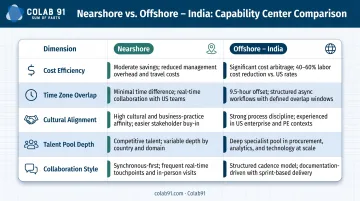
Here's how nearshore and offshore dedicated teams stack up across the factors that matter most to US-based decision-makers.
| Factor | Nearshore | Offshore (India) |
|---|---|---|
| Cost Efficiency | Moderate savings over onshore | Significant cost advantage; Kearney ranks India #1 in its 2023 Global Services Location Index |
| Time Zone Overlap | High - easy daily sync | Limited with US, but structured windows are workable |
| Cultural Alignment | Strong default proximity | Requires deliberate onboarding; strong English proficiency in tech/business hubs |
| Talent Pool Depth | Skilled but geographically constrained | Deep at scale - India produces 2.14M STEM graduates annually, ranked #2 globally |
| Collaboration Style | Synchronous, iterative | Primarily async with structured sync windows |
What Is a Nearshore Dedicated Team?
A nearshore dedicated team is based in a country geographically and time-zone close to the client's headquarters. Unlike a vendor relationship, the team functions as a continuous extension of the business - participating in the same working hours, attending the same stand-ups, and operating within the client's workflows rather than alongside them.
The operational appeal is straightforward: minimal scheduling friction, faster feedback loops, and lower coordination overhead. A US company building a team in Mexico or Canada can expect near-complete working-hour overlap, which removes most of the logistical complexity that distributed teams typically face.
The trade-off is cost and scale. Proximity carries a price premium: nearshore labor costs run higher than offshore, and the talent pool, while capable, is limited by geography.
For specialized functions that require depth at volume - spend analytics, data modeling, procurement operations - nearby markets may simply not have enough qualified professionals to meet demand.
When Nearshore Makes Sense
Nearshore dedicated teams work best when:
- Real-time collaboration is essential: agile product teams, client-facing functions, or roles requiring rapid iteration
- Compliance demands geographic alignment: shared regulatory frameworks, data residency requirements, or legally sensitive work
- Early team integration needs to move fast, and cultural friction would slow it down
In practice, this covers US companies building teams in Mexico or Canada for daily-overlap functions, and European firms using Eastern Europe for tech teams embedded in agile delivery cycles.
What Is an Offshore Dedicated Team?
An offshore dedicated team is based in a more distant country - typically a different region of the world - and operates as a dedicated extension of the client organization rather than a transactional outsourcing arrangement. The distinction matters: dedicated means the team works exclusively on your business, carries your context, and builds institutional knowledge over time.
The value proposition is straightforward: significantly lower labor costs, access to a far larger talent pool, and the ability to build high-performance multifunctional teams that serve as strategic hubs. For comparison, US Bureau of Labor Statistics data puts median annual wages for data scientists at $112,590, financial analysts at $101,350, and management analysts at $101,190 - figures that illustrate the onshore baseline against which offshore cost structures are measured.
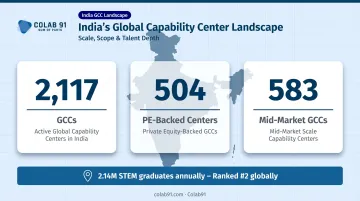
India stands apart as the dominant offshore destination for business operations. According to the Zinnov-NASSCOM India GCC Landscape Report 2026, India now hosts 2,117 Global Capability Centers across 3,728 units, including 504 PE-backed centers and 583 mid-market GCCs. This reflects a mature, well-established market - not an emerging experiment.
Offshore does not mean low quality or loss of control. When teams are built with clear ownership, structured onboarding, and genuine alignment to client workflows, they perform as effectively as in-house teams. The operating model determines quality - full stop.
When Offshore Makes Sense
Offshore dedicated teams excel when:
- Functions are process-defined with measurable deliverables - spend analytics, procurement reporting, data operations, financial modeling
- Talent depth is a priority - India's analytics and procurement talent pool far exceeds what nearshore markets can supply at scale
- The goal is a long-term capability center - not a short-term resource supplement or project-based engagement
- PE-backed companies need rapid scale - offshore India allows teams to scale in alignment with value creation timelines
Healthcare and logistics companies have used offshore procurement teams to free up onshore leadership bandwidth. PE-backed businesses have built analytics centers of excellence in India that now run core reporting and modeling functions for global portfolios.
Nearshore vs Offshore: Which Model Fits Your Business Goals?
The decision should not start with geography. It should start with what the business actually needs.
Key Questions to Answer First
- How frequently will internal stakeholders interact with this team?
- Is real-time responsiveness a delivery requirement, or is structured async collaboration sufficient?
- What does cost efficiency mean for the business case - and how does it affect long-term sustainability?
- Does the function require niche expertise at scale, or does proximity matter more than depth?
Signals That Point to Nearshore
- Daily stakeholder sync is genuinely non-negotiable (not just a preference)
- Cultural or regulatory proximity is a hard requirement, not a nice-to-have
- The function involves evolving, ambiguous requirements that need constant back-and-forth to resolve
Signals That Point to Offshore
- The function is well-defined with repeatable, measurable deliverables
- Headcount needs to scale rapidly - and the talent requirements exceed what nearby markets can supply
- The business wants to build a long-term capability hub, not just plug a short-term gap
- Cost efficiency is a primary driver, not a secondary consideration
Research from Rice University published in Organization Science found that a one-hour increase in temporal distance reduces synchronous communication by 11%. That's not an argument against offshore - it's an argument for designing the right workflows around the model you choose.
What Actually Determines Whether a Dedicated Team Succeeds
Geography alone does not predict delivery quality. The operating structure around the team does.
The primary drivers of long-term performance are:
- Team stability and low rotation
- Strong onboarding with clear ownership from day one
- Genuine workflow alignment between offshore and client teams
A poorly structured nearshore team will underdeliver. A well-structured offshore team can exceed the performance of in-house functions.
Colab91's approach addresses this directly. Rather than placing talent in a lower-cost market and stepping back, Colab91 designs the operating model upfront: defining domain expertise requirements in procurement and analytics, structuring the India team setup, and building toward a long-term capability hub from the start.
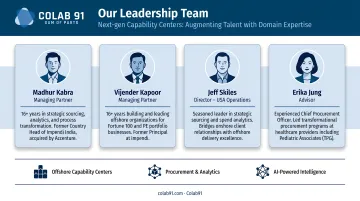
The track record behind that approach is concrete. Managing Partners Madhur Kabra and Vijender Kapoor - both formerly of Impendi, acquired by Accenture - built and scaled India operations to a multifunctional organization of 100+ practitioners. Clients served include Carlyle Group, TPG, Elliott, and BC Partners. That's a proven offshore model, validated at scale.
Conclusion
Neither nearshore nor offshore is universally the right answer. The right choice depends on two factors working together:
- Nearshore fits when collaboration proximity is the dominant operational requirement and the cost premium is justified
- Offshore is the stronger choice when the business needs to build deep functional capability at scale - and when the operating model is structured to support it
For mid-market and PE-backed companies building procurement, analytics, or operations teams, offshore India is increasingly the stronger strategic option. India's GCC ecosystem is mature, the domain talent pool at the mid-market level is deep, and companies like Carlyle Group and TPG portfolio businesses have already validated the model at scale.
Geography is only part of the decision. What determines outcomes is how the team is designed, how talent is recruited, and how the operating model is built to sustain performance over time. If your company is evaluating a capability center in India, connect with Colab91 to explore what a structured offshore model looks like for your specific goals.
Frequently Asked Questions
What is the difference between nearshore and offshore?
Nearshore teams are based in neighboring countries with overlapping time zones, making real-time collaboration straightforward. Offshore teams operate from more distant regions, typically offering greater cost efficiency and access to deeper talent pools. Structured communication processes handle the time zone gap.
What is the difference between onshore and offshore teams?
Onshore teams work within the same country as the client - maximum alignment, but at the highest cost. Offshore teams are based in distant countries, delivering significant cost advantages and broader talent access. Asynchronous workflows and structured sync windows handle most coordination needs.
What are the four types of outsourcing?
The four models are: onshore (same country), nearshore (neighboring countries, similar time zones), offshore (distant countries, different time zones), and hybrid/multi-shore (a combination of models). Each serves different priorities across cost, control, talent access, and collaboration.
Is offshore outsourcing cheaper than nearshore?
Yes, offshore is more cost-effective. Kearney ranks India #1 for global services location based on financial attractiveness, talent availability, and business environment. For knowledge work roles in analytics, procurement, and finance, the cost differential versus US onshore or nearshore markets is substantial.
What makes a dedicated offshore team successful long-term?
Success depends far less on geography than on operating model design. Team stability, strong onboarding, clear ownership, low rotation, and deep alignment to client workflows are the primary performance drivers. Companies that invest in model design upfront see measurably lower attrition and stronger output quality over time.
Which outsourcing model works better for PE-backed companies building capability centers?
Offshore India tends to deliver the strongest ROI for PE-backed companies. With 504 PE-backed GCCs already operating in India, the ecosystem is proven. The combination of cost efficiency, analytics and procurement talent depth, and the ability to scale rapidly aligns directly with portfolio value creation timelines.