Introduction
Most companies spend 20% to 50% of revenue procuring goods and services, according to Deloitte. For PE portfolio companies, that number isn't just a procurement metric - it's a margin problem waiting to surface.
The gap rarely announces itself. Instead, it compounds through fragmented ERP data, untracked tail spend, manual reconciliation cycles, and unconsolidated reporting workflows. By the time a firm prepares for exit, 72% report that weak data and KPI reporting became their most significant finance issue - a problem that shows up as a negotiation liability, not an operational insight.
None of this is inevitable. Costs become excessive when fragmented data blocks visibility, absent governance prevents action, and manual processes can't keep pace with headcount growth or add-on acquisitions. This article examines where those costs originate - and how AI agents are now one of the most direct ways to address them.
Key Takeaways
- Operational costs in PE portfolio companies compound through unmanaged procurement spend, fragmented ERP data, and manual workflows
- AI agents reduce costs across three dimensions: better decisions, better management, and better operational structure - including cross-portfolio replication
- Procurement is the fastest path to measurable savings - spend diagnostic agents can surface opportunities in days once data is accessible
- Combining AI agents with offshore domain-expert teams compounds savings without adding onshore headcount
- Durable EBITDA improvement requires clean data, measurable KPIs, and phased deployment - not a one-time technology implementation
How Operational Costs Build Up Across PE Portfolio Companies
Cost inefficiencies in PE portfolio companies rarely appear as a single visible line item. They accumulate gradually across procurement, finance, and operations - through duplicate vendor contracts, untracked tail spend, manual reconciliation cycles, and disconnected reporting workflows that each look manageable in isolation.
That isolation is the problem. Fragmented data kills visibility, and without visibility, governance breaks down - leaving savings systematically uncaptured. Each add-on acquisition during the hold period compounds this further: add-ons comprised 77% of US PE deals in 2022, and every new entity adds another layer of complexity without resetting the data baseline.
When the Problem Becomes Visible
The timing of cost discovery creates its own liability. Most firms don't conduct a structured spend diagnostic until they're preparing for exit - at which point the gap between perceived and actual cost structure becomes a direct negotiation risk.
EY's research puts numbers to this:
- 72% of firms identify weak data and KPI reporting as the biggest finance issue at exit
- 65% struggle to accurately reflect value creation initiatives in reported EBITDA
- 41% lack the data granularity required to substantiate their equity story
EY recommends establishing data readiness 12 to 24 months before exit. For most firms, that means the diagnostic work needs to start in year two or three of the hold period - not the final year.
Key Cost Drivers in PE Portfolio Companies
Unmanaged Third-Party Spend
Procurement is the dominant cost driver in most PE portfolio companies. With third-party spend representing 20% to 50% of revenue at many companies, even modest improvements in spend management flow directly to EBITDA.
The problem at mid-market companies is structural. Most lack formal category management, consolidated supplier bases, or meaningful contract visibility. Spend sits uncategorized across ERPs and invoices, while tail spend flows through without governance.
The downstream effect: renegotiation opportunities expire unnoticed. Renewal dates pass. Price escalation clauses go unmonitored. No one catches them because no system is watching.
Manual Process Overhead
Procurement inefficiency is only part of the picture. The other drag on margins is less visible - the operational overhead generated by manual processes. FP&A teams reconcile data across QuickBooks, Salesforce, and spreadsheets each quarter. Finance teams build board reports from scratch. Operating partners chase inconsistent KPI formats from each portfolio company.
APQC found that FP&A professionals spend 75% of their time gathering data and administering processes, with only 25% left for actual analysis. That ratio gets worse at mid-market portfolio companies that lack dedicated FP&A talent and rely on consultant support for recurring reporting cycles.
How the Profile Shifts Across the Hold Period
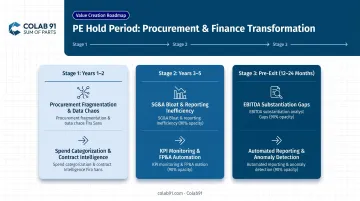
The dominant cost driver changes depending on where a firm is in the hold period:
| Hold Period Stage | Primary Cost Driver | Fastest AI Agent ROI |
|---|---|---|
| Years 1–2 | Procurement fragmentation, data chaos | Spend categorization, contract intelligence |
| Years 3–5 | SG&A bloat, reporting inefficiency | KPI monitoring, FP&A automation |
| Pre-exit (12–24 months out) | EBITDA substantiation gaps | Automated reporting, anomaly detection |
This context determines which AI agent use case delivers the fastest return - and which ones to sequence first.
How AI Agents Drive Cost Savings Across PE Portfolio Companies
AI agents reduce costs through three distinct leverage points: the decisions made about how to source and spend, the management practices used to track and control spend in real time, and the operational context in which portfolio companies operate.
Strategies That Reduce Costs by Changing Decisions
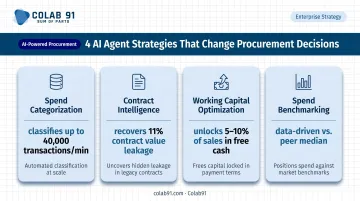
Spend categorization at scale. AI agents can ingest raw spend data from ERPs, invoices, and purchase orders and classify it automatically - replacing weeks of manual cleansing with a unified, actionable view of third-party costs. Deloitte's CognitiveSpend platform, for reference, can classify up to 40,000 transaction line items per minute. That clean data immediately surfaces consolidation and renegotiation opportunities that raw spend files never revealed.
Contract intelligence. Organizations lose an average of 11% of contract value through leakage - from missed savings, unmanaged clauses, and unauthorized changes - according to WorldCC. AI agents can extract key terms, payment schedules, renewal dates, and price escalation clauses across hundreds of supplier contracts simultaneously. Operating partners can then prioritize renegotiations based on actual financial exposure rather than assumption. Without that extraction layer, most mid-market companies are negotiating blind.
Working capital optimization. AI agents can analyze payment term patterns across a supplier base to identify where terms are inconsistent or suboptimal. McKinsey estimates that disciplined working capital management can unlock 5% to 10% of sales in free cash, often within months - without requiring new supplier relationships, just better use of existing ones.
Spend benchmarking. AI agents compare a portfolio company's category-level spend against peer benchmarks to identify where unit costs, supplier pricing, or category coverage are outliers. This shifts negotiation conversations from anecdotal ("we think we're paying too much") to data-driven ("we're 22% above peer median in logistics") - a distinction that changes what gets prioritized and what gets ignored.
Strategies That Reduce Costs by Changing How Portfolio Companies Are Managed
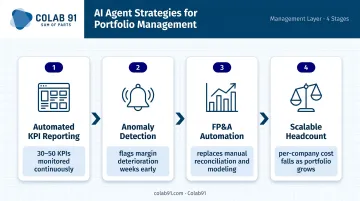
Automated KPI reporting. Instead of finance teams pulling data from multiple systems each quarter, AI agents can continuously monitor 30 to 50 KPIs across portfolio companies and auto-generate variance commentary. Workday's Adaptive Planning, for example, helped Scout24 reduce planning preparation time from three weeks to near-zero. Board prep becomes a review process, not a data assembly exercise.
Anomaly detection. AI agents that monitor margin trends, SG&A ratios, and cost-per-unit metrics in real time can flag deterioration weeks before it appears in monthly financials. That lead time matters: course-correction in month two costs less - in management bandwidth, in consultant fees, in lost margin - than damage control in month five.
FP&A automation. AI agents reduce the cost of financial forecasting by automating data reconciliation, multi-scenario modeling, and variance analysis. This is especially relevant for portfolio companies that rely on expensive consultant support for recurring reporting cycles. Freeing that budget for strategic interpretation - rather than data assembly - is itself a cost reduction.
Scalability without proportional headcount. Once an AI-powered reporting and monitoring workflow is established, it extends to new portfolio companies without adding proportional headcount. The per-company management cost falls as the portfolio grows - a durable efficiency that compounds across the hold period.
That same scalability logic applies at the sponsor level - where shared capabilities across the portfolio create compounding returns that no single-company deployment can match.
Strategies That Reduce Costs by Changing the Operational Context
PE sponsor-level intelligence. Many cost inefficiencies aren't caused by the portfolio company's operations - they're caused by the absence of shared capabilities across the portfolio. AI agents deployed at the sponsor level create cross-portfolio intelligence that compounds over time. McKinsey notes that the share of PE firms applying a consistent value-creation model across their portfolio grew from 50% to 75% over the past decade, driven in part by this kind of centralized capability.
Cross-portfolio replication. When a cost-reduction playbook works at one company - a supplier consolidation strategy, a payment term improvement, a category management framework - AI agents can scan other portfolio companies for the same opportunity. Savings surface area multiplies without starting from scratch each time.
Offshore capability centers with embedded AI. The highest-leverage context change is building an AI-powered capability layer that combines intelligent automation with human domain expertise. Mid-market PE portfolio companies can't afford full internal procurement or analytics teams - but offshore capability centers that embed AI tools alongside trained domain practitioners close that gap at mid-market cost structures.
Colab91 builds exactly this model. The firm establishes dedicated India-based teams of procurement and analytics specialists, then layers AI-powered tools for spend analytics, savings assessment, and supplier risk management on top. Its team brings direct experience supporting PE sponsors including Carlyle Group, TPG, Elliott, and BC Partners. The result:
- Offshore teams that function as extensions of the portfolio company's internal function - not rotating consultants
- AI-powered spend intelligence paired with domain experts who know how PE timelines and value-creation mandates work
- Coverage that compresses typical identification timelines from months to weeks

Integrated procurement and finance operations of this kind can produce a 20% to 40% uplift in realized savings, according to Deloitte - the difference between identifying opportunities and actually capturing them.
Conclusion
Reducing operational costs in PE portfolio companies depends on identifying where cost actually originates - fragmented procurement data, manual management workflows, and the absence of shared intelligent infrastructure - rather than blanket headcount cuts or surface-level fixes.
AI agents are most effective when deployed as part of a structured, phased strategy with clear KPIs, accessible data, and human domain expertise to validate and act on outputs. The firms building this capability now - combining AI-powered intelligence with lean, specialized offshore teams - are creating durable cost advantages that compound across the hold period, strengthening both operating performance and exit valuations.
The diagnostic is the fastest place to start. Once the data is structured, actionable savings opportunities surface within days - not quarters.
Frequently Asked Questions
What types of costs do AI agents most commonly reduce in PE portfolio companies?
AI agents primarily target three cost areas:
- Procurement and third-party spend - spend categorization, supplier consolidation, and contract intelligence
- FP&A and reporting overhead - automation of reconciliation and board reporting
- Portfolio monitoring inefficiency - real-time KPI tracking that replaces manual data chasing across disparate systems
How quickly can AI agents deliver measurable savings for a portfolio company?
Timelines vary by use case. Spend diagnostic agents can surface savings opportunities within days once data is structured. Reporting automation typically delivers time savings within weeks. Sustainable EBITDA impact from procurement actions - closed renegotiations, consolidated suppliers - generally takes 60 to 90 days to realize.
Are AI agents effective for mid-market portfolio companies, or only large enterprises?
Mid-market companies are actually among the highest-ROI deployment targets. They lack the formal procurement functions, analytics teams, and reporting infrastructure that large enterprises have built, so AI agents provide enterprise-grade intelligence without the equivalent headcount cost. The capability gap is larger, which means the improvement is more pronounced.
How do AI agents in procurement differ from traditional spend analytics tools?
Traditional spend analytics tools surface what has already happened. AI agents go further: they clean and classify fragmented data automatically, generate specific recommendations on supplier consolidation and contract renegotiation, and continuously update those recommendations as new data flows in. The shift is from passive reporting to active decision support.
What data does a portfolio company need before deploying AI agents?
The minimum requirement is transaction-level spend data, supplier records, and basic financial data from an ERP or accounting system - messy or inconsistently labeled data is manageable. That said, at least 12 months of historical spend data improves the quality of savings identification.
Can AI agents replace the need for a dedicated procurement or finance team?
AI agents are most effective when paired with domain expertise. They handle data processing, pattern detection, and generating recommendations - but humans are needed to negotiate with suppliers, validate recommendations against business context, and execute initiatives. The optimal model is AI agents augmenting lean, specialized teams rather than replacing them.