Introduction
PE firms acquire companies with fragmented procurement operations - multiple ERP systems, inconsistent vendor coding, no spend visibility, and procurement teams that haven't been asked hard questions before. The holding period is finite, and the 100-day clock starts immediately.
That's the structural pressure that makes procurement analytics different in a PE context than in a stable, publicly traded company. When external spend accounts for 50–80% of a company's cost base, getting visibility into where that money goes - and fast - directly impacts EBITDA and, ultimately, exit value.
The right procurement analytics tool compresses months of spend diagnostic work into days, surfacing savings opportunities before the first board deck is drafted.
This article reviews the best procurement analytics tools built for the PE context in 2026 - covering what each platform does well, where it falls short, and how to choose based on your portfolio's complexity and hold-period timeline.
Key Takeaways
- Procurement analytics tools help PE firms rapidly diagnose portfolio company spend and track cost reduction through the holding period
- Top PE-grade tools deliver spend visibility, supplier analytics, benchmarking, and multi-entity reporting in one place
- Top tools in 2026: Coupa, GEP SMART, Sievo, SpendHQ, and Jaggaer - selected based on portfolio size, integration needs, and analytics maturity
- Selection should prioritize speed-to-insight, ERP integration flexibility, and compatibility with PE reporting cadence
- Tools alone don't deliver value; the analysts, data governance, and operating model behind them determine actual outcomes
Why Procurement Analytics Is a Value Creation Lever for Private Equity
PE operates under conditions that most enterprise procurement leaders don't face: compressed holding periods, LP return expectations, and acquisitions where the underlying data is a mess.
Bain's 2026 Global Private Equity Report notes that buyout funds are sitting on a record $3.8 trillion in unrealized value, with average holding periods at exit drifting toward seven years. With multiple expansion and leverage no longer reliable return drivers, operational value creation - including procurement - now drives return targets in most deal theses.
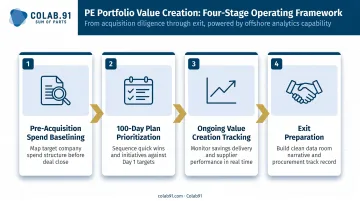
Four PE-Specific Use Cases for Procurement Analytics
Pre-acquisition spend baselining: During due diligence, analytics tools categorize a target's historical AP data to expose spend concentration risks, supplier dependencies, and cost reduction potential before the deal closes.
100-day plan prioritization: Post-close, spend analytics identifies which categories offer the fastest, highest-confidence savings - shaping sourcing wave sequencing and resource allocation in the critical first three months.
Ongoing value creation tracking: Through the hold period, platforms track savings realization against the thesis, monitor supplier consolidation progress, and surface contract compliance gaps before they turn into leakage.
Exit preparation: A clean, data-backed procurement story - documented savings, supplier rationalization, contract compliance rates - strengthens the operational narrative for buyers and supports EBITDA quality of earnings.
McKinsey's procurement benchmarking research found that procurement leaders achieve EBITDA margins at least five percentage points higher than laggards. In a PE context, those five points don't just improve returns - they reframe what's achievable from a single deal.
Top Procurement Analytics Tools for Private Equity in 2026
These tools were evaluated on three dimensions most relevant to PE: ability to handle fragmented, post-acquisition data; speed of time-to-insight; and scalability across multi-entity portfolios.
Coupa
Coupa is an enterprise-grade spend management platform used across PE-backed and Fortune 500 companies. Its Business Spend Management (BSM) suite covers spend analytics, procurement, invoicing, and supplier management in a single cloud-native platform, recognized as a Leader in both the 2025 Gartner Magic Quadrant for Source-to-Pay Suites and the IDC MarketScape for Worldwide AI-Enabled Source-to-Pay.
The standout for PE is Coupa's Community.ai benchmarking, which draws on data from over $10 trillion in spend and 10 million-plus buyers and suppliers. This lets PE sponsors benchmark a newly acquired company's category-level spend against verified peer data, particularly useful when prioritizing sourcing initiatives without internal benchmarks.
| Dimension | Details |
|---|---|
| Best For | PE portfolios with mid-to-large enterprise portfolio companies needing full source-to-pay coverage |
| Key Analytics Features | Spend classification, supplier analytics, contract compliance tracking, AI-driven peer benchmarking |
| Deployment Fit for PE | Cloud-native SaaS; integrates with SAP, Oracle, NetSuite, and Microsoft Dynamics |
GEP SMART
GEP SMART is an AI-powered unified procurement platform built specifically for environments where spend data is scattered across heterogeneous ERP systems - the standard reality for newly acquired portfolio companies.
GEP's patented AI handles ingestion and classification from multiple, inconsistent data sources with minimal manual normalization. Published case data shows the platform ingesting 175-plus source data files from 40-plus source systems for a single organization, reaching approximately 93% classification accuracy across 850 affiliates in 58 countries.
For PE firms managing portfolios with varied IT infrastructure, that data handling capacity meaningfully compresses time-to-spend-baseline. GEP was also named a Leader in the 2025 Gartner Magic Quadrant for Source-to-Pay Suites.
| Dimension | Details |
|---|---|
| Best For | PE portfolios managing multiple companies with diverse, non-standardized ERP environments |
| Key Analytics Features | AI-driven spend classification, savings tracking, supplier consolidation analysis, market intelligence |
| Deployment Fit for PE | Flexible deployment; strong professional services support for rapid data onboarding |
Sievo
Sievo is a spend analytics specialist - not a full procurement suite. It's built for organizations that want deep, accurate spend intelligence above sourcing execution or P2P workflows.
Its strength is granular spend classification and benchmarking quality. Sievo's Community Data product provides transaction-validated, anonymized peer benchmarks drawing on $2 trillion in annual data, letting PE-backed companies compare category-level spend directly against industry peers at the point of acquisition.
The platform also includes savings pipeline management and CO2 analytics for Scope 3 emissions reporting, increasingly relevant for ESG-focused PE funds. Sievo functions as a complement to broader suites, not a replacement.
| Dimension | Details |
|---|---|
| Best For | PE firms prioritizing deep spend analytics and external benchmarking over full procurement automation |
| Key Analytics Features | Spend analytics, peer benchmarking via $2T dataset, savings pipeline tracking, CO2 analytics |
| Deployment Fit for PE | Analytics-layer deployment; integrates with existing ERP and source-to-pay systems |
SpendHQ
SpendHQ is purpose-built for rapid spend visibility - designed to deliver actionable insights without the complexity of a full source-to-pay implementation.
Its defining advantage for PE is speed. SpendHQ states that organizations can move from data chaos to spend clarity in fewer than five weeks, without requiring client IT resources. The platform has a dedicated PE practice, claiming 20-plus GP clients and 300-plus portfolio company clients. For firms running 100-day assessments or needing a first-pass spend baseline immediately post-acquisition, that timeline is a material operational advantage over enterprise suite deployments that take months to configure.
| Dimension | Details |
|---|---|
| Best For | PE firms needing fast spend baselines at acquisition or portfolio companies early in analytics maturity |
| Key Analytics Features | AI-powered spend classification, supplier consolidation analysis, category drill-down, spend forecasting |
| Deployment Fit for PE | Lightweight SaaS; purpose-built for analytics without full suite implementation requirements |
Jaggaer
Jaggaer is a comprehensive source-to-pay suite with strong analytics and eSourcing modules, serving mid-market to large enterprise customers across manufacturing, healthcare, and PE-backed businesses - recognized as a Visionary in the 2025 Gartner Magic Quadrant for Source-to-Pay Suites.
Where Jaggaer differentiates is vertical-specific configurability. Its AI is purpose-built for manufacturing, healthcare, higher education, and 20-plus other industries, making it particularly relevant for PE platform investments where sector-specific procurement workflows matter. For portfolio companies where value creation needs to extend beyond spend visibility into active sourcing execution, Jaggaer's combined analytics and eSourcing capability is a practical fit.
| Dimension | Details |
|---|---|
| Best For | PE portfolio companies in manufacturing, healthcare, or complex direct/indirect spend environments needing both analytics and sourcing execution |
| Key Analytics Features | Spend analytics, eSourcing ROI tracking, supplier performance dashboards, contract compliance analytics |
| Deployment Fit for PE | Configurable; strong vertical-specific functionality; moderate implementation complexity |
Key Features to Look for in a PE-Grade Procurement Analytics Tool
Not all procurement analytics platforms are built for post-acquisition reality. Three features separate PE-relevant tools from tools designed for stable enterprises.
Speed of Data Onboarding and Spend Classification
When a deal closes, procurement data is typically scattered across legacy ERP systems with inconsistent vendor naming, duplicate suppliers, and uncoded spend. The ability to ingest, clean, and classify that data quickly - without months of data engineering - determines how fast value creation can begin.
A tool that takes six months to stand up has already consumed a significant portion of the holding period. Point solutions like SpendHQ are built around this constraint. Full suites like Coupa and GEP offer strong onboarding capabilities but require more configuration time.
Cross-Portfolio and Benchmarking Capabilities
PE sponsors managing multiple portfolio companies need tools that provide cross-portfolio spend visibility - not just single-entity reporting. Beyond aggregation, external benchmarking (comparing a portfolio company's category spend to verified industry peers) guides prioritization of sourcing initiatives and helps set credible savings targets without requiring internal historical benchmarks that rarely exist for newly acquired companies.
ERP and System Integration Flexibility
Portfolio companies run SAP, Oracle, NetSuite, Microsoft Dynamics, and everything in between - often several simultaneously following acquisitions and bolt-ons. Tools that require ERP standardization before they can function create deployment delays PE timelines can't absorb.
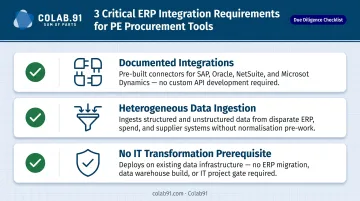
Look for platforms that check all three of the following:
- Documented integrations across the major ERP systems (SAP, Oracle, NetSuite, Dynamics)
- Heterogeneous data ingestion - pulls from multiple source systems simultaneously
- No IT transformation prerequisite - functional before infrastructure standardization is complete
How We Chose the Best Procurement Analytics Tools for PE
Tools were evaluated on five criteria:
- PE-relevance of deployment model - speed, flexibility, and multi-entity capability
- Depth and accuracy of spend analytics - classification quality and spend cube granularity
- External benchmarking availability - peer data for category-level comparisons
- ERP integration breadth - documented integrations across major platforms
- Demonstrated use in PE-backed or mid-market environments - actual PE customer bases, not just enterprise case studies
The most common selection mistake PE firms make is choosing tools designed for large, stable enterprises with clean, centralized data: platforms that require 6–12 month implementations and dedicated internal data teams. That mismatch is costly in PE, where the value creation window is fixed and returns need to materialize quickly.
Tools are only as effective as the talent behind them. Colab91 has built and scaled procurement analytics capability centers for PE-backed companies - including portfolio businesses of Carlyle Group and TPG - deploying dedicated analytical talent alongside the platform itself. The managing partners, through 16-plus years at Impendi (acquired by Accenture), know from experience: the highest returns come when tools are paired with domain experts who translate raw spend data into sourcing strategies and realized savings.
For mid-market PE-backed companies that can't justify a full onshore analytics team, an offshore capability center model delivers that expertise cost-effectively.
Conclusion
The right procurement analytics tool for a PE context isn't the one with the most features - it's the one your portfolio company can actually operationalize given its current data maturity, headcount, and remaining hold period.
The right fit depends on where the portfolio company is in its maturity curve:
- Early-stage or limited analytics infrastructure: SpendHQ delivers fast, credible spend baselines without a lengthy implementation
- Scaling into active sourcing and supplier management: Coupa, GEP SMART, or Jaggaer offer the depth to support that work across the full holding period
- Sponsors prioritizing benchmarking quality: Sievo functions as a best-in-class analytics layer that full suites typically don't match
Whatever tool you choose, plan for the talent requirement. The platform surfaces the data. Turning it into savings requires people with the domain knowledge to act on what they see.
PE firms and portfolio operators who need to stand up a procurement analytics function quickly can explore how Colab91 builds dedicated offshore procurement analytics teams for PE-backed companies - from recruitment through operational delivery. Contact Colab91 to discuss your portfolio's specific needs.
Frequently Asked Questions
What is procurement analytics in private equity?
Procurement analytics in PE involves analyzing portfolio company spend data to identify cost reduction opportunities, benchmark supplier pricing against market, and track savings realization through the hold period. The primary goal is EBITDA improvement and building an operationally clean story that supports exit value.
What CRM do private equity firms use?
PE deal teams commonly use DealCloud, Affinity, Salesforce, and HubSpot for deal management. Procurement teams at portfolio companies typically use their procurement platform's built-in supplier management module - these are purpose-built for vendor tracking and contract data, not deal flow.
How do PE firms measure procurement value creation?
Key metrics include realized cost savings as a percentage of addressable spend, working capital improvement from payment term renegotiation, reduction in supplier count (consolidation savings), and contract compliance rates.
What is the difference between spend analytics and full procurement analytics?
Spend analytics focuses on classifying and analyzing historical purchasing data to surface patterns and savings opportunities. Full procurement analytics extends this to include supplier performance data, contract compliance tracking, sourcing ROI, and predictive demand forecasting.
How quickly can a PE portfolio company stand up a procurement analytics function?
Point solutions like SpendHQ can deliver first-pass spend visibility in under five weeks. Full suite implementations like Coupa or Jaggaer typically take 2–6 months, depending on ERP complexity and the quality of underlying transactional data.
Do small and mid-market PE portfolio companies need enterprise procurement analytics tools?
Rarely. Sub-$500M revenue portfolio companies typically don't need full source-to-pay suites. A spend analytics point solution paired with capable analytical talent delivers the majority of the value at a fraction of the cost and implementation timeline.