Who can realistically lead this? An internal champion - typically a COO, CDO, or PE operating partner - with clear mandate and decision authority, supported by practitioners who have actually built offshore organizations from scratch. Without both components, the most common outcomes are provider lock-in with no exit path, AI infrastructure deployed without the talent to use it, or a governance structure that looks right on paper but erodes parent company confidence within months.
According to Gartner, at least 30% of GenAI projects will be abandoned after proof of concept by end-2025 - driven by poor data quality, inadequate risk controls, and unclear business value. GCC builds that skip the foundational design work tend to land in exactly that category.
This guide covers the complete implementation of an AI GCC: from organizational readiness through phase-by-phase build-out, post-setup validation, and the failure modes worth knowing before you start.
Key Takeaways
- Defining your operating model, AI platform decisions, and governance architecture must happen before the first hire - not alongside it
- Organizational readiness (executive sponsorship, defined use cases, unified data) is a prerequisite, not a parallel workstream
- Setup follows four phases: Strategy & Operating Model → AI Infrastructure → Talent Build-out → Integration & Go-Live
- Post-setup validation should confirm AI utilization and governance health, not just headcount ramp
- Provider lock-in, talent-infrastructure mismatch, and weak governance are the three most common failure modes - each preventable with upfront design decisions
Before You Set Up an AI GCC: What Must Be in Place First
A GCC build that starts before organizational prerequisites are met almost always requires expensive rework. In PE-backed contexts, rework time translates directly to missed value creation windows.
Organizational Readiness Checks
Three conditions must be confirmed before setup begins:
- Executive sponsorship with real authority - not just nominal support. Someone with the mandate to make cross-border decisions quickly and break organizational deadlock when it occurs
- At least one defined AI use case with measurable output tied to business value - procurement analytics, spend intelligence, FP&A automation - not a general aspiration toward "AI capability"
- Existing or planned data infrastructure the India team can connect to. If ERP, procurement, and finance data is fragmented or inaccessible, AI use cases cannot be activated regardless of the talent hired
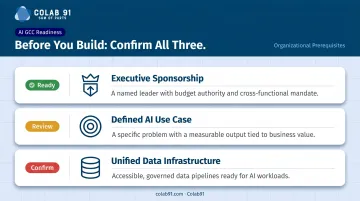
The non-negotiables: if the parent organization cannot articulate what the GCC will own end-to-end within 12 months, or if the data required for AI use cases is not yet unified, defer setup until those gaps are closed.
Resources, Roles, and Partner Readiness
With organizational readiness confirmed, the next step is ensuring the right internal roles and external partners are lined up before build begins.
What needs to exist internally:
- An onshore GCC lead with authority to make day-to-day decisions
- A functional domain owner who defines what the center will actually produce
- An HR/legal point of contact for India entity setup and employment compliance
What is typically sourced externally:
- India entity registration and legal structure
- Real estate and facilities in the chosen hub city
- Talent acquisition and payroll compliance
- AI tooling expertise and vendor selection support
For mid-market and PE-backed companies, the right setup partner can cut months off the path to first output. Colab91 pairs onshore domain expertise with offshore execution, so parent companies retain strategic control without managing India-side operational complexity directly. The leadership team has built and scaled offshore organizations from the ground up for clients including Carlyle Group, TPG, and Pediatric Associates.
How to Set Up an AI GCC: Phase-by-Phase Implementation Guide
AI GCC setup follows a defined sequence. Shortcuts in early phases create compounding problems downstream, particularly around governance and AI adoption.
Phase 1: Strategy and Operating Model Design
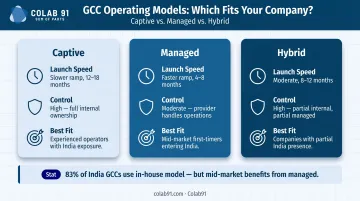
Define the operating model before any hiring begins. The three main options:
| Model | Speed to Launch | Control | Best Fit |
|---|---|---|---|
| Captive (full ownership) | Slower | High | Companies with prior India operations experience |
| Managed (third-party operated) | Faster | Moderate (with transition plan) | Mid-market first-time GCC builders |
| Hybrid | Moderate | High | Companies with some India presence |
The EY GCC Pulse Survey 2024 reports 83% of India GCCs use an in-house model, but that skews toward large enterprises. For companies under $500M in revenue, a managed or co-managed model typically gets the center operational faster, with a structured transition to full ownership built in from day one.
Design the organizational charter. Define:
- Which functions the GCC will own (procurement analytics, spend modeling, FP&A, data engineering)
- What the parent organization retains onshore
- The governance and reporting structure between India and HQ - in writing, signed off by both sides
Establish AI use case prioritization. Identify two to three highest-impact AI applications for year one. Common starting points for mid-market companies:
- Automated spend categorization
- Supplier intelligence dashboards
- FP&A variance analysis
Anchor infrastructure and talent decisions to these outputs. A prioritized shortlist of two to three use cases with defined success metrics will drive better hiring and platform decisions than a broad capability wish list.
Phase 2: AI Infrastructure and Platform Setup
Set up the foundational technology layer:
- Data pipeline architecture connecting to ERP, procurement, and finance systems
- Cloud platform selection (Azure or AWS are the most common in GCC environments)
- AI/ML tooling (Azure ML, SageMaker, or purpose-built analytics stacks)
- Data governance protocols aligned with parent company security and IP requirements
Implement a Zero Trust security framework before any data flows to the GCC. Per NIST SP 800-207, Zero Trust assumes no implicit trust based on physical or network location; the system evaluates access per-request, per-resource.
For PE-backed companies managing portfolio data across multiple clients, this is non-negotiable. Define data residency rules, access controls, and audit logging at this stage, not after go-live.
The most common technical bottleneck: fragmented data. If ERP, procurement, and finance system data is not clean and accessible through a unified layer, AI use cases cannot be deployed regardless of the talent in place. This is the single most frequent reason GCC timelines extend . Resolving data fragmentation before Phase 3 is what separates GCCs that hit their year-one targets from those that miss them.
Phase 3: Talent Acquisition and Team Build-Out
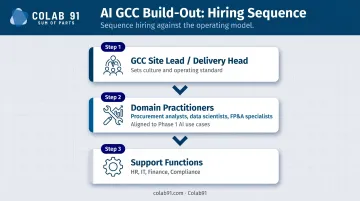
Sequence hiring against the operating model. The right order:
- GCC Site Lead or Delivery Head - someone with experience managing cross-functional offshore teams; this hire sets the culture and operating standard for everything that follows
- Domain-specific practitioners - procurement analysts, data scientists, FP&A specialists aligned to the AI use cases defined in Phase 1
- Support functions - HR, IT, finance, compliance
Build for AI readiness, not just headcount. India's GCC talent market is competitive but deep. The Zinnov-NASSCOM Mid-Market GCC Report 2025 notes mid-market GCCs have a 1.5x higher share of talent in AI, Cloud, Data Science, and Cybersecurity compared to the broader market . The talent pool exists; role design determines whether you can access it.
Key hiring considerations:
- Define AI fluency requirements per role - distinguish between deep model-building expertise and applied analytics capability; most early GCC hires need the latter
- 50% of GCCs are actively reskilling existing workforce (EY 2024) - build a 90-day upskilling plan into every offer
- Average GCC attrition has fallen to 11.16% in 2024 from 12.6% in 2023, but early attrition remains a risk when role design is weak
Bengaluru, Hyderabad, and Gurugram are the primary hiring hubs. Gurugram - where Colab91 operates - has particular depth in procurement, analytics, and finance-domain talent for PE-adjacent organizations.
Phase 4: Integration and Go-Live
Run a structured parallel-operation period before full cutover. The transition follows three stages:
- Shadow: GCC team observes onshore processes and output standards
- Co-own: GCC team shares accountability with onshore counterpart
- Independently own: GCC team operates the process end-to-end
This timeline is typically 60–90 days per function. Track progress against defined handoff criteria - not calendar dates alone.
Establish operating rhythms from day one:
- Daily standups within the GCC team
- Weekly stakeholder calls with the parent company
- Monthly business reviews with KPI dashboard review
- Quarterly governance reviews at executive level
The absence of cadence is the leading cause of drift between GCC output and parent company expectations. Centers that skip structured check-ins in the early weeks consistently find themselves rebuilding trust and realigning priorities months later.
Build these rhythms into the first week. Retrofitting operating structure into a center already at scale is far harder than establishing it from the start.
Post-Setup Validation: Confirming Your AI GCC Is Performing
Validation is not a one-time sign-off. It's a 90-day structured review that confirms the GCC is functioning as designed before it scales further.
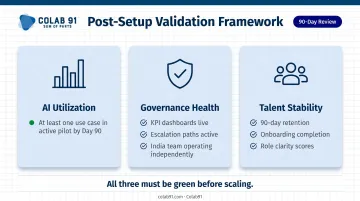
Verify AI utilization: Confirm that the use cases identified in Phase 1 are live, producing outputs, and actively consumed by business stakeholders. 37% of India GCCs are actively piloting GenAI use cases and 21% are deploying at scale (EY 2024). A newly stood-up center should have at least one use case in active pilot by day 90 - not still in configuration.
Governance health:
- KPI dashboards are live and reviewed on schedule
- Escalation paths are being used, not bypassed
- The India team has the access and context needed to operate independently - verified through actual usage, not assumed
Talent stability:
- 90-day retention rates
- Onboarding completion by role
- Role clarity assessments from new hires
Early attrition in a GCC is almost always a signal of role design or leadership gaps - not a talent market problem. If it's happening, diagnose the specific roles and the clarity of output expectations before drawing any conclusions about the market. Used together, these three checks give you a clear signal on whether the center is ready to scale - or where it needs intervention first.
Common AI GCC Setup Mistakes and How to Fix Them
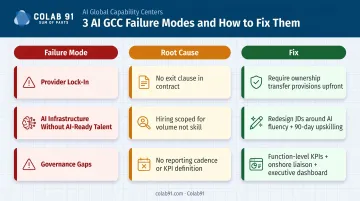
Provider Lock-In With No Exit Path
Problem: The setup partner retains control of hiring pipelines, vendor contracts, and infrastructure, making it legally and operationally difficult for the parent company to take ownership.
Likely cause: Operating agreements were not reviewed for exclusivity clauses and asset ownership terms before signing.
Fix: Before engaging any GCC setup partner, require explicit contractual provisions for ownership transfer of talent, contracts, and infrastructure. Negotiate vendor-agnostic infrastructure from day one. A well-structured engagement model should define entity ownership, IP rights, and strategic control upfront - before any contract is signed, not after problems emerge.
AI Infrastructure Without AI-Ready Talent
Problem: Cloud platforms and tooling are deployed, but practitioners cannot use them to produce business outputs. The center runs as a basic data processing team.
Likely cause: Hiring was scoped for volume and cost, not AI skill depth. Tooling decisions were made by the parent company's IT team without input from the people who will operate them.
Fix:
- Involve the GCC's domain leads in tooling selection
- Redesign job descriptions around AI fluency requirements
- Build a 90-day upskilling plan into every offer letter
Governance Gaps That Erode Parent Company Confidence
Problem: The parent company loses visibility into GCC output quality and begins to bypass the India team - duplicating work onshore and turning the GCC back into a pure cost center.
Likely cause: Reporting cadences were not established early, KPIs were not defined at a granular enough level, or there is no onshore-India leadership bridge to maintain alignment.
Fix:
- Establish specific KPIs per function before go-live
- Assign an onshore liaison with authority to resolve cross-border blockers
- Implement a performance dashboard reviewed at executive level monthly - one that leaders actually use, not just access in theory
Pro Tips for Setting Up an AI GCC Effectively
Three patterns consistently separate smooth AI GCC launches from expensive restarts:
On sequencing: Do not move from Phase 1 to Phase 2 before the operating model and charter are finalized in writing. Verbal alignment between stakeholders rarely survives the complexity of a cross-border build. Get the document signed off before any India-side activity begins.
On operating model selection: For companies under $500M in revenue, a managed or co-managed model delivers faster time-to-value than a fully captive build. An experienced partner handles entity setup, hiring, and day-to-day operations while the parent retains strategic control - with a clear transition to full ownership built in from the start. This is the engagement structure Colab91 uses with mid-market and PE-backed clients.
On documentation and sign-off: Treat every phase transition as a formal milestone with documented deliverables, acceptance criteria, and named approvers on both sides. This prevents scope creep, protects both parties during leadership transitions, and creates institutional memory that survives individual departures.
Frequently Asked Questions
How long does it typically take to set up an AI GCC in India?
Most mid-market companies reach initial go-live in 6–12 months from strategy to first operational output. A managed model is faster than a fully captive build. The most common factor that extends timelines is data infrastructure readiness - if ERP and finance data isn't accessible before Phase 2 begins, the clock resets.
What is the difference between an AI GCC and a traditional offshore delivery center?
A traditional offshore center arbitrages labor cost on defined, repeatable tasks. An AI GCC is designed to extend the parent company's analytical capabilities - combining domain expertise with AI tooling to generate outputs that drive business decisions, not just execute processes.
What functions are best suited for an AI GCC in a mid-market or PE-backed company?
The highest-value, most commonly implemented functions are procurement analytics, spend intelligence, financial planning and analysis, data engineering, and supplier and vendor management. These areas combine India's deep talent pool with mature AI application tooling, and they generate measurable financial impact within the first year.
How do you maintain governance and control over an offshore AI GCC?
Three mechanisms matter most: contractual asset ownership provisions that prevent provider lock-in, and structured reporting cadences (weekly operational, monthly KPI, quarterly executive). Beyond that, an onshore liaison with real authority to resolve cross-border blockers prevents issues from escalating to leadership unnecessarily.
What is the minimum team size to start an AI GCC?
A functional starting team is typically 8–15 people: a Site Lead, two to three senior domain practitioners, two to three AI/data analysts, and supporting functions. Going smaller produces a team too thin to operate independently, and the parent company ends up filling gaps onshore.
How do PE sponsors typically evaluate AI GCC performance during a hold period?
PE sponsors focus on cost savings generated, cycle time reduction on core processes (procurement cycle, financial close), AI adoption rate across defined use cases, and headcount-to-output ratios versus onshore equivalents. The GCC has to show it's generating intelligence, not just reducing labor cost - that's what justifies the build in a value creation context.