Introduction
Most mid-market and PE-backed companies exploring India expansion hit the same wall: they want the strategic benefits of an owned India team, but lack the local infrastructure, regulatory knowledge, and operational bandwidth to build one from scratch.
Setting up a foreign subsidiary, navigating Indian employment law, hiring in an unfamiliar talent market, and managing a remote team simultaneously - with no prior India presence - is a significant execution risk.
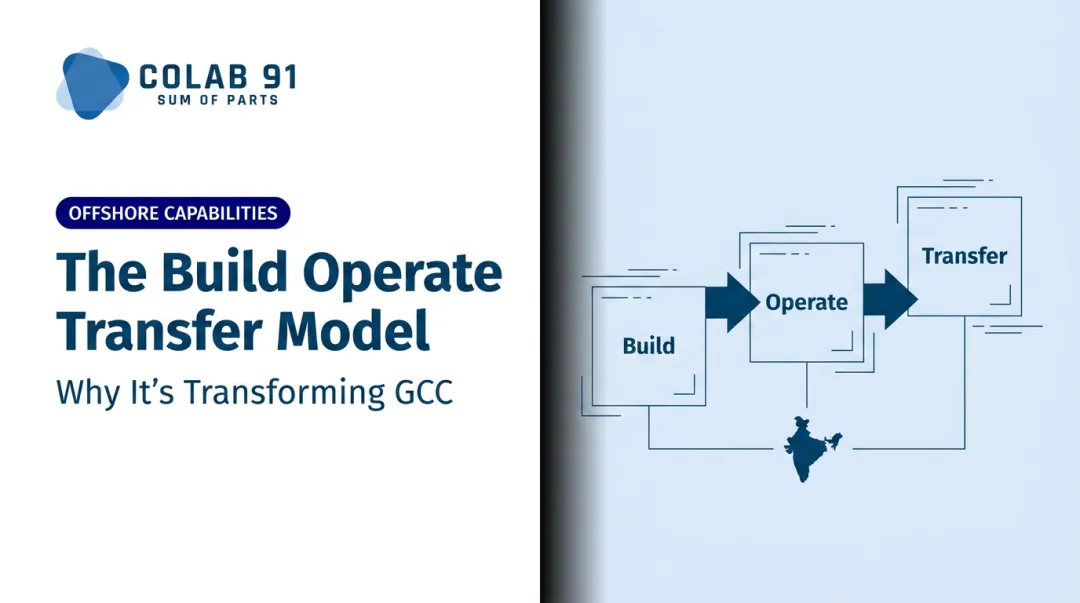
The Build-Operate-Transfer (BOT) model exists to solve exactly this problem. A specialized partner handles the early-stage complexity - entity setup, hiring, compliance, day-to-day operations - while the client retains strategic direction and full ownership transfers once the team reaches operational maturity.
This guide explains what the BOT model is, why India has become its primary destination, how each phase works in practice, what determines whether an engagement succeeds or fails, and when a different model might serve you better.
Key Takeaways
- Three phases: Build (team and infrastructure setup), Operate (partner manages daily operations), Transfer (full ownership moves to the client), completing in 3–5 years total
- Designed for: Companies that want long-term ownership of their India team but lack the local expertise or bandwidth to set one up independently
- Key advantage over outsourcing: You get a built-in transfer endpoint - ownership of the team, not permanent vendor dependency
- Most common failure point: Cultural drift during the Operate phase, not the Transfer itself
- India is the dominant BOT destination due to talent depth, cost structure, and a rapidly maturing GCC ecosystem
What Is the BOT Model in India?
The BOT model is a contractual engagement in which a specialized partner - the operator - builds an offshore team or capability center in India on behalf of a client, runs it for a defined period, then transfers complete ownership to the client. That transfer includes people, processes, infrastructure, and intellectual property.
The outcome: the client ends up with a fully functional, owned India operation without absorbing the early-stage execution risk, capital expenditure, and regulatory complexity of building it independently.
How BOT Differs from Related Models
BOT gets conflated with two adjacent models. Here's how they actually differ:
- Traditional outsourcing: The vendor is the permanent employer and controls delivery processes indefinitely. BOT builds toward a transfer endpoint from day one - that changes how talent is hired, how IP is managed, and how governance is structured throughout.
- Direct captive GCC setup: The client owns the operation from day one. In BOT, the partner holds operational ownership during the Build and Operate phases, so the client takes over only once the operation is stable and proven.
As Deloitte describes in its BOTT framework, the Transfer phase legally moves 100% of the operation - including IP and assets - to the client, and the model differs from traditional BPO through shared governance, management control, and higher pricing transparency throughout.
Why the BOT Model Is Used to Build India Teams
India's Talent Depth Makes It the Logical Destination
India's technology workforce stands at 5.8 million employees in FY2025, according to NASSCOM's 2025 Strategic Review - adding 126,000 net new roles in a single year. India ranks second globally in annual STEM graduate supply, producing 2.14 million graduates per year.
For specialized functions, the picture is equally strong. India holds the second-largest AI/ML and data analytics talent pool globally, with over 416,000 professionals in that domain as of 2022 - and demand projected to exceed one million by 2026.
The GCC ecosystem built on this talent base is substantial. According to Zinnov and NASSCOM, India had 1,700+ GCCs employing 1.9 million people and generating $64.6B in revenue as of FY2024 - with projections of $99–105B and 2.5–2.8 million workers by 2030.
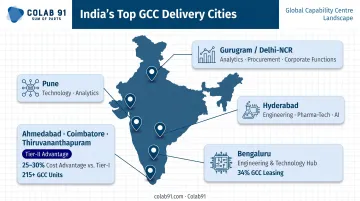
Key delivery cities include:
- Bengaluru - India's largest concentration of engineering and technology talent (34% of GCC leasing in 2024)
- Hyderabad - Strong in engineering, pharma-tech, and AI
- Gurugram/Delhi-NCR - Strategic hub for analytics, procurement, and corporate functions
- Pune - Growing tech and analytics presence
- Tier-II cities (Ahmedabad, Coimbatore, Thiruvananthapuram) - 25–30% cost advantage versus Tier-I, with 215+ GCC units
That talent depth is exactly what draws first-time entrants - but accessing it requires infrastructure most mid-market firms don't have in place.
What Mid-Market Companies Specifically Need
Mid-market firms and PE-backed portfolio companies typically arrive without:
- A local legal entity or registered employer-of-record capability
- HR, payroll, and compliance infrastructure built for Indian employment law
- Relationships with India-based talent networks in specialized domains
- Internal project bandwidth to manage a foreign subsidiary setup alongside core operations
The BOT partner absorbs all of this upfront. Entity setup risk, early hiring mistakes, compliance exposure, and operational uncertainty during the Build phase sit with the partner - not the client.
Why PE Sponsors Favor BOT Specifically
Private equity interest in India GCCs has accelerated sharply. The Economic Times reported that investments by PE-backed companies in GCCs quadrupled over the previous five years, with one in three recently established mid-market GCCs being PE-backed. Firms including KKR, Blackstone, and Warburg Pincus are actively pushing portfolio companies to establish India capability centers.
The BOT model fits PE logic particularly well: the India team becomes a transferable, owned asset - contributing to enterprise value at exit rather than being a vendor relationship that disappears when the contract ends. For sponsors with defined hold periods, this distinction is material.
That dynamic is familiar territory for Colab91's leadership team, which has worked directly with PE sponsors including Carlyle Group, TPG, Elliott, and BC Partners - scaling Impendi's India operation to 100+ practitioners before its acquisition by Accenture.
How the BOT Model Works: The Three Phases
The three phases are sequential but interdependent. Decisions made in the Build phase directly determine the smoothness of the Transfer phase - and most clients only recognize this connection once Transfer is already underway.
The Build Phase (Months 1–6)
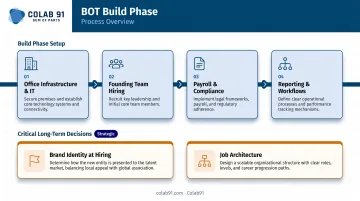
The Build phase is where the operational foundation is established. The partner either creates a new legal entity or operates under its own employer-of-record structure, then:
- Secures office infrastructure and IT systems
- Hires the founding team across target functions
- Sets up payroll, compliance, and HR processes
- Establishes reporting lines and operational workflows
Timeline reference: EY's Capability-as-a-Service cases include a 50-person data and analytics center stood up in 10 months and a 200+ person team onboarded within 8 months - though timelines depend on function complexity and hiring conditions.
Two Build-phase decisions carry disproportionate long-term weight:
- Brand identity at hiring - Teams hired under the client's identity from day one develop stronger alignment to the parent company's culture. Teams hired under the partner's brand tend to identify with the partner, which creates friction at Transfer.
- Job architecture - Roles, levels, and reporting lines set during Build determine how cleanly the team maps to the client's organizational structure at Transfer. Misalignment here is difficult to correct later.
The Operate Phase (Years 1–4)
During the Operate phase, the partner manages day-to-day operations: HR, payroll, performance management, employee engagement, and team scaling. The client owns strategic direction - setting priorities, reviewing work output, and embedding its own leadership presence within the India team.
This phase matters most for Transfer readiness. It's also where most BOT engagements either build genuine organizational alignment or develop loyalty gaps that become expensive to close at Transfer time.
What determines Operate-phase quality:
- Governance checkpoints at defined intervals (quarterly business reviews, leadership site visits, structured cultural onboarding)
- Client leadership embedded in India (not just remote oversight)
- The India team treated as a strategic hub, not a back-office execution unit
When clients disengage during this phase and let the partner operate in isolation, the India team builds culture, habits, and loyalty relative to the partner rather than the eventual owner. Reversing that is possible, but it typically requires 6–12 months of deliberate re-engagement after Transfer.
Deloitte's GCC Culture Sensing Report 2025 found a Culture Index of 82/100 across Indian GCCs, with a notably high empowerment score of 89 - but only 23% of organizations demonstrating high adaptability. For BOT clients, that adaptability gap is the clearest argument for structured client involvement throughout the Operate phase, not just at handover.
The Transfer Phase (Months 3–6 at end)
The Transfer phase involves legal and operational handover:
- Legal entity establishment or transfer to the client
- Employee offer letters under the new employer, with benefit continuity
- Asset, contract, and IP transfer
- Operational handover and system access migration
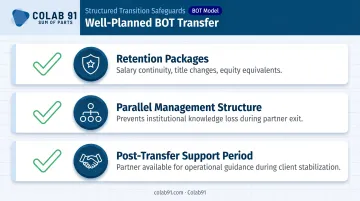
A well-planned transfer includes:
- Retention packages for critical employees (salary continuity guarantees, title changes, or equity equivalents) (uncertainty peaks during this window, and signals matter)
- Parallel management structure during handover, so institutional knowledge doesn't disappear when partner staff exit
- Post-transfer support period where the partner remains available for operational guidance while the client's internal team stabilizes
A poorly planned transfer looks like this: employees learn about the ownership change through HR paperwork rather than leadership communication, key hires receive no retention signal, and the client's internal team isn't ready to absorb the management load. The legal transfer completes on schedule - but attrition among top performers spikes in the following 90 days.
Key Factors That Affect BOT Outcomes
Partner Selection: Domain Expertise Matters More Than Scale
A generalist HR vendor can run payroll and manage facilities. Attracting top-tier procurement analysts, spend analytics specialists, or sourcing managers to a mid-market client's brand in a competitive India talent market is a different challenge entirely.
The BOT partner's domain expertise - specifically its ability to recruit for specialized functions - is the single biggest differentiator in Build-phase quality. Colab91, for instance, focuses specifically on procurement, analytics, and technology functions for mid-market clients. That domain focus shapes both the recruiting pitch and the role architecture from day one, in ways a generalist vendor typically cannot replicate.
Clarity of the Transfer Agreement from Day One
The transfer scope - which entity transfers, which employees, which systems, which IP, and at what financial terms - must be contractually specified at signing, not negotiated when transfer approaches. Leverage shifts significantly toward the partner as the transfer date approaches. What feels like a minor ambiguity at signing becomes a negotiation the client is not positioned to win.
At minimum, the transfer agreement should define:
- Legal entity structure and employee transfer mechanism
- IP ownership, system access, and data portability terms
- Financial terms including transfer fees, notice periods, and transition costs
- Dispute resolution provisions tied to specific milestones
Talent Retention Across the Transition
India's overall attrition rate was 16.2% in 2025, down from 17.7% in 2024 - and GCC-specific attrition has been declining as organizations focus more on career mobility, engagement, and workplace stability. Transition periods introduce specific retention risk, even when baseline attrition is trending down.
Effective retention incentives in the Indian talent market include:
- Joining bonuses tied to two-year clawbacks
- Clear career development paths post-transfer - SHRM research identifies career growth as a primary turnover driver
- Title changes or expanded scope signaling growth under the new employer
- Salary continuity guarantees through the transition period
BOT vs. Alternative India Engagement Models
| Dimension | Direct Captive GCC | BOT | Managed/Outsourced |
|---|---|---|---|
| Upfront capital | High | Moderate | Low |
| Time to first hire | 6–12+ months | 3–6 months | Immediate |
| Early-stage risk | Client absorbs all | Partner absorbs | Vendor absorbs |
| Operational control | Full from day one | Strategic (partner runs ops) | Limited |
| IP ownership | Client owns throughout | Transfers at end | Vendor retains |
| Long-term cost | Lowest over 5+ years | Middle | Highest (perpetual fees) |
| Transfer intent | N/A (already owned) | Built-in endpoint | None |
When each model fits:
- Direct captive - Companies with prior India experience, internal project capacity, and strong preference for control from day one
- BOT - First-time India entrants with a clear long-term ownership goal and no existing local infrastructure to build on
- Managed/outsourced - Companies that want indefinite vendor delivery with no transfer intent
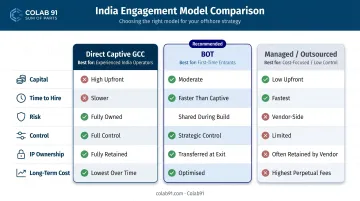
Many companies use BOT for their first India function, then expand subsequent functions as direct captive hires once local infrastructure is in place. That sequencing works precisely because a well-executed BOT leaves behind more than a team - it leaves behind the processes, management layer, and institutional knowledge needed to scale independently.
Common Misconceptions About the BOT Model
"BOT is just outsourcing with extra steps." The structural distinction matters. In outsourcing, the vendor is the permanent employer and owns the delivery process. In BOT, the client is the intended permanent owner - and that changes how talent is hired, how IP is protected, and how governance is designed from the start. The two models look superficially similar during the Operate phase; their purpose and endpoints are fundamentally different.
"The Transfer phase is where the risk is." Transfer phase problems are almost always symptoms of earlier decisions. Teams built on the partner's culture rather than the client's, processes that were never documented, employees who had no exposure to the parent company's leadership - these create friction during Transfer. Transfer execution is rarely the root cause. The Build and Operate phases are.
"BOT only works at Fortune 500 scale." The data says otherwise. Recent examples show BOT working at far smaller scale:
- Reuters reports India's next GCC wave will include "nano-GCCs" - sub-100-person centers focused on R&D and AI
- EY's CaaS practice cites a 50-person data and analytics center stood up in 10 months
- Visualfabriq launched a Hyderabad GCC using BOT with Indigrators
The model scales down effectively when the partner brings pre-built infrastructure and domain expertise, without requiring clients to justify large headcount to offset setup costs.
Frequently Asked Questions
What does Build-Operate-Transfer mean?
BOT is a three-phase offshore engagement model where a specialized partner builds a team or capability center in India, runs it to operational maturity, then transfers full ownership - including people, IP, and systems - to the client. It differs from outsourcing in that the transfer is built into the contract from day one.
What is the difference between BTO and BOT?
BTO (Build-Transfer-Operate) transfers ownership to the client before the operate phase begins - common in infrastructure projects where the public entity takes over early. BOT retains partner ownership through the operate phase before transfer. For offshore talent and capability center engagements, BOT is the standard structure.
What is the Build-Own-Operate-Transfer (BOOT) scheme?
BOOT is a variant of BOT where the private entity explicitly owns the facility or operation during the build and operate phases. In standard BOT, ownership structure during those phases can be configured differently. For talent and capability center engagements, the two terms are often used interchangeably.
What is an example of BOT in India?
A US-based company engages an India-based partner to hire an initial analytics or procurement team, manage operations for 2–3 years, then transfer the team to a newly incorporated Indian subsidiary. This is the pattern used by PE-backed mid-market firms building specialized capability centers in cities like Gurugram, Bengaluru, and Hyderabad.
How long does a BOT engagement typically take?
Build phase: 3–6 months. Operate phase: 2–4 years. Transfer phase: 3–6 months. Total: 3–5 years depending on team size, function complexity, and client readiness to absorb ownership.
How is BOT different from traditional outsourcing?
Outsourcing is designed for indefinite vendor management - no transfer intent, no client IP ownership. BOT is designed from day one for the client to take direct ownership. That single distinction drives every hiring, culture, and governance decision across the engagement.