
The mandate has shifted. GCCs are increasingly strategic capability hubs, not cost-reduction exercises. And that shift makes the cost question both more important and harder to answer cleanly.
Most publicly available estimates fall into one of two traps: they're either oversimplified headline numbers geared toward large enterprises, or they're vendor-produced figures with obvious commercial bias. Mid-market and PE-backed companies - often evaluating India for the first time - are left without a practical reference.
This guide fixes that. It covers realistic cost ranges by team size, the key variables that move the needle most, a component-by-component breakdown, and the planning mistakes that routinely inflate first-year budgets.
Key Takeaways
- A lean GCC (10–25 people) in India typically costs $150K–$350K in Year 1; a mid-size GCC (25–75 people) runs $350K–$900K; a full-scale GCC (75–150+ people) reaches $900K–$2M+
- Talent and compensation is consistently the dominant cost driver, typically accounting for 60–70% of total operating spend
- City selection, operating model, and capability mix are the three decisions that most significantly move the cost needle
- Hidden costs (leadership premiums, notice-period delays, ramp-up lag) routinely add 8–12% to first-year budgets
- Mid-market and PE-backed companies cut setup risk by partnering with a specialized GCC builder from day one
How Much Does a GCC in India Cost?
There is no fixed "average." Two GCCs with identical headcounts can have significantly different economics based on what the team does, where it sits, and how it's structured. The ranges below only make sense in that context.
When cost is misunderstood early, three things typically go wrong: companies underbudget and stall in Year 1, over-specify infrastructure they don't yet need, or get hit with transition costs they never planned for. The tier framework below is a starting point - not a ceiling.
Lean / Starter GCC: 10–25 People
Estimated Year 1 all-in cost: $150K–$350K
What's typically included at this scale:
- Entity registration and basic legal setup
- Managed or co-working workspace (no long-term lease commitment)
- Initial talent acquisition for a focused function
- Core productivity and collaboration tooling
- Basic HR and payroll infrastructure
What's typically excluded:
- Dedicated senior India leadership
- Purpose-built office fit-out
- Advanced compliance infrastructure
Best suited for: Mid-market companies or PE-backed portfolio businesses testing the India model - typically building one focused capability such as procurement analytics, finance operations, or sourcing support. Often structured as a managed or hybrid model before transitioning to a fully captive setup.
The cost-per-seat is highest at this scale. Fixed setup costs - entity registration, compliance overhead, initial hiring - don't shrink proportionally for smaller teams. A 12-person team bears nearly the same structural overhead as a 30-person team.
Growth GCC: 25–75 People
Estimated Year 1 all-in cost: $350K–$900K
Once you cross 25 people, several cost items become unavoidable:
- A dedicated India leadership hire (site head or delivery lead)
- A leased office footprint with fit-out
- Structured HR, payroll, and compliance systems
- Recruitment investment for multi-functional hiring
Where this fits: Companies ready to own a multi-functional team with defined delivery accountability and a 2–3 year scale roadmap. This is typically where mid-market companies land in their second phase of India expansion - after validating the model at starter scale.
Full-Scale GCC: 75–150+ People
Estimated Year 1 all-in cost: $900K–$2M+
At this size, the economics look different from earlier tiers:
- Talent dominates - typically 60–70% of total spend
- Leadership density (site heads, engineering directors, delivery managers) becomes a material budget line
- Attrition management, hiring pipelines, and governance infrastructure all require dedicated investment
- Dedicated leased office space is standard
Built for: Enterprises or PE-backed companies with a long-term capability mandate across engineering, data platforms, cybersecurity, or global operations - where the strategic case extends well beyond cost savings.
Key Factors That Affect GCC Costs in India
GCC pricing is the outcome of several interconnected decisions made before the center opens. Getting these wrong early drives up cost at every stage.
Capability Mix and Function Type
The function you're building has a bigger impact on cost than most companies expect.
A GCC focused on advanced engineering, AI/ML, cloud, or cybersecurity will cost more than one focused on procurement analytics, finance operations, or shared services. Skill depth, market demand, and competitive compensation all differ sharply by function.
2026 AmbitionBox salary benchmarks illustrate the gap:
| Role | Median Salary |
|---|---|
| Delivery Manager (12+ yrs) | ₹26.4 LPA |
| Data Scientist | ₹15.7 LPA |
| Machine Learning Engineer | ₹12.9 LPA |
| Software Engineer | ₹9.0–9.9 LPA |
| Senior Analyst | ₹8.5–9.4 LPA |
A 25-person analytics team will cost notably less than a 25-person AI engineering team - even in the same city.
City and Location Choice
India is not one talent market. City selection compounds as headcount grows.
| City | Talent Profile | Cost Position |
|---|---|---|
| Bengaluru | Deepest tech and AI talent pool; 38% of India GCC digital talent | Highest salaries; commands a premium for most tech roles |
| Hyderabad | Strong across analytics, cloud, data engineering | Good cost-to-capability balance |
| Pune | Solid enterprise tech and operations talent | Lower cost, strong retention profile |
| Chennai | Deep engineering and operations talent | Competitive costs; strong for shared services |
| Gurugram / NCR | Strong for analytics, procurement, and finance roles | Competitive for non-pure-tech functions |
Defaulting to Bengaluru without evaluating alternatives can add 15–25% to total talent cost. For analytics or procurement functions, Hyderabad and Pune offer comparable talent depth at lower compensation benchmarks.
Operating Model Selection
The three primary models carry very different cost profiles:
- Fully captive: Requires the highest upfront investment in entity setup, direct hiring, and compliance infrastructure - but delivers the lowest long-term cost-per-seat and full IP ownership
- Build-Operate-Transfer (BOT): A partner builds and operates the center, then transfers it to the client. Partner fees during the operate phase add cost, but the model meaningfully reduces setup risk for first-time GCC builders
- Hybrid / managed team: Fastest to launch, lowest entry cost - but limited compounding value and less control over talent and IP over time
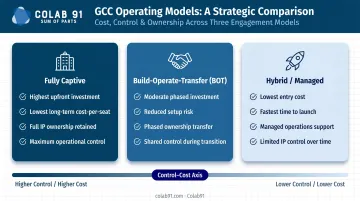
The "cheapest" early model is not always the lowest total cost over 3–5 years. A managed model that saves $100K in Year 1 but limits IP ownership and talent depth may cost far more by Year 4.
Seniority Mix and Leadership Density
Underestimating local leadership cost is one of the most common and expensive planning errors.
Senior and principal-level roles (site heads, engineering directors, finance controllers) can cost 3–5x more than entry-level positions. Delivery Managers with 12+ years of experience command ₹26.4 LPA on average. Senior technology leads in Bengaluru routinely exceed that.
Key risks of under-planning senior leadership:
- Delayed ramp-up when roles are backfilled reactively
- Higher attrition without strong local management presence
- Remedial hiring costs that exceed what proactive planning would have required
The right local leader, budgeted from day one, pays back the investment quickly.
GCC Cost Breakdown: Where Does the Money Actually Go?
Understanding cost at the component level is more useful than any single headline number - it shows where you have control and where surprises tend to emerge.
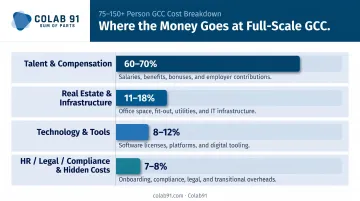
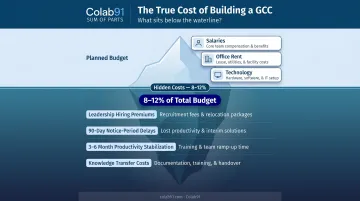
Talent and Compensation: ~60–70% of Total Operating Cost
This includes base salaries, employer-side PF and gratuity contributions, health insurance, performance bonuses, and attrition-driven rehiring costs. The percentage rises as GCCs take on higher-value functions. An engineering-heavy GCC will sit closer to 70%; a shared services GCC may sit closer to 60%.
Real Estate and Infrastructure: ~11–18%
Covers office rent, fit-out, facilities management, security, utilities, and backup power. The workspace model choice - long-term lease versus managed/flexible space - has a significant impact on cash outflow and flexibility.
Most mid-market GCCs benefit from avoiding large upfront lease commitments in Year 1. JLL data shows 1,800+ GCCs now occupy 240M+ sq ft of Grade-A office space across India - the market is established, but the decision to lock in long-term space early carries real risk for smaller teams.
Technology and Tools: ~8–12%
Cloud infrastructure, software licenses, development and productivity platforms, security tooling, and collaboration systems. Technology costs are declining as a share of total spend as platforms move to consumption-based pricing - but they remain a meaningful cost, especially for data, analytics, or engineering GCCs.
HR, Legal, and Compliance: ~3–6%
This covers:
- Entity registration and ongoing legal support
- Payroll processing and statutory compliance (labor law, data protection)
- Background verification and HR systems
Underinvesting here creates expensive problems later - audits, regulatory gaps, and governance issues that slow scaling at the worst possible moment.
Hidden and Transition Costs: ~8–12%
This category rarely makes it into the initial budget - but it consistently shows up. It includes:
- Leadership hiring premiums
- Notice-period delays (90 days is standard for mid-to-senior professionals in India, creating ramp-up gaps)
- Productivity stabilization periods - typically 3–6 months before teams reach full output
- Knowledge transfer costs during the handover phase
Everest Group research finds that hidden or underestimated costs can erode GCC cost advantages within 3–5 years when not planned for from the start. First-year budgets that ignore this category consistently run over.
What Most Companies Get Wrong About GCC Costs
Focusing Only on the Salary Arbitrage Number
Citing "significant savings vs. US salaries" without accounting for setup costs, leadership premiums, transition overhead, and the productivity ramp period leads to unrealistic Year 1 expectations. The savings are real - but they materialize in Year 2 and Year 3, not on Day 1.
Treating City Selection as a Secondary Decision
Defaulting to Bengaluru without analysis - or anchoring on where a leadership team member lives - can add 15–25% to total talent cost. For functions like analytics, procurement, or finance operations, the better-value cities are often:
- Hyderabad - strong analytics and finance talent, lower real estate costs
- Pune - deep engineering and procurement talent, mid-tier salary bands
- Gurugram - proximity to enterprise client bases, competitive for sourcing roles
Comparable talent quality. Meaningfully different cost structure.
Skipping the Operating Model Analysis
Many companies default to a fully captive setup because it "feels right," without pressure-testing whether a BOT or hybrid model would reduce early-stage cost and risk. The reverse error is equally common: choosing the cheapest managed model without recognizing it limits long-term IP ownership and compounding talent advantage.
The operating model choice affects total cost of ownership across the entire GCC lifecycle - not just Year 1 setup. A misaligned model can add 20–30% to five-year costs compared to one chosen through structured analysis.
How to Estimate the Right GCC Budget
The goal is not the lowest possible budget. It's a budget that matches the capability you're building, the timeline you're working against, and the level of control you want over delivery, talent, and IP.
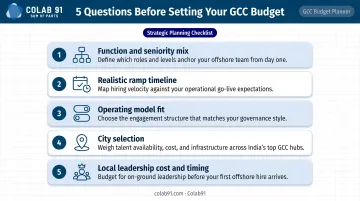
Before building a number, align on these five questions:
- What functions will the GCC own, and what seniority mix does that require? A procurement analytics team looks very different from a cloud engineering team - and costs accordingly.
- What is the realistic ramp timeline? 6 months, 12 months, 24 months? Fixed costs accrue from Day 1 regardless of headcount achieved.
- What operating model fits this stage? Captive, BOT, or hybrid - and what does that mean for Year 1 versus Year 3 economics?
- Which city best matches capability requirements and budget? Don't decide this last.
- What does local leadership cost, and when is it needed? A site lead hired six months late typically costs more in lost productivity than their full-year salary.
None of these questions have universal answers - and the cost of getting them wrong in Year 1 is rarely recoverable. Mid-market and PE-backed companies that launch lean, high-performing India teams typically work with a partner who has already made those calls before.
Colab91's leadership team, who previously led Impendi's India operations before its acquisition by Accenture, built and scaled an offshore center to 100+ practitioners serving PE firms including Carlyle Group, TPG, and BC Partners. That hands-on experience means fewer avoidable errors in setup, hiring, and operating model design from the start.
Frequently Asked Questions
What is the salary in a Global Capability Center in India?
GCC salaries vary by role, city, and function. Based on 2026 benchmarks: Senior Analysts earn ₹8.5–9.4 LPA at the median, Software Engineers ₹9.0–9.9 LPA, and Team Leads ₹9.7–14.6 LPA depending on experience. Specialized roles in AI, cloud, and cybersecurity command a premium - Data Scientists average ₹15.7 LPA, and senior engineering leaders can reach multiples of that.
Is India the right home for global capability centres?
India brings together 2.36 million GCC professionals, the #1 AI hiring market globally, and a cost-to-skill advantage that's hard to replicate elsewhere. That said, success depends on choosing the right model, city, and capability mix. The destination is right for most GCCs; execution quality determines the outcome.
What is the typical breakeven timeline for a GCC in India?
Breakeven typically occurs between 12–24 months for a well-planned GCC, depending on team size, scope, and operating model. Focused, lean teams with clear delivery mandates tend to break even faster than large, complex setups that take longer to reach full productivity.
What is the difference between a GCC and outsourcing in terms of cost?
Outsourcing has lower upfront cost but higher long-term cost due to vendor margins and limited productivity compounding. A GCC requires more setup investment but gives full control over talent, IP, and delivery - making it more cost-efficient over a 3–5 year horizon, provided the setup is executed well.
How much does a small or mid-market GCC in India typically cost in Year 1?
A 10–25 person GCC for a mid-market company typically costs $150K–$350K all-in for Year 1, including entity setup, workspace, initial hiring, and technology. Cost-per-seat is higher at this scale due to fixed overhead, but the model can be structured to grow efficiently as headcount increases.
Which city in India offers the best cost-to-talent ratio for a GCC?
Hyderabad ranks well for cost-to-talent balance across analytics, cloud, and data engineering. Pune and Chennai offer strong economics for enterprise tech and operations. Bengaluru is the right choice for deep-tech and AI - but commands the highest premiums. The right city depends on the function, not on convenience.