Introduction
Mid-market and PE-backed companies face a stubborn tension: the pressure to reduce costs and scale specialized functions quickly, while the onshore talent market makes both harder every year. US financial analysts earn a median of $101,350 annually, procurement buyers average $77,430, and competition for these roles is fierce. Building full onshore teams for procurement, analytics, and FP&A is both expensive and, for most mid-market organizations, genuinely impractical.
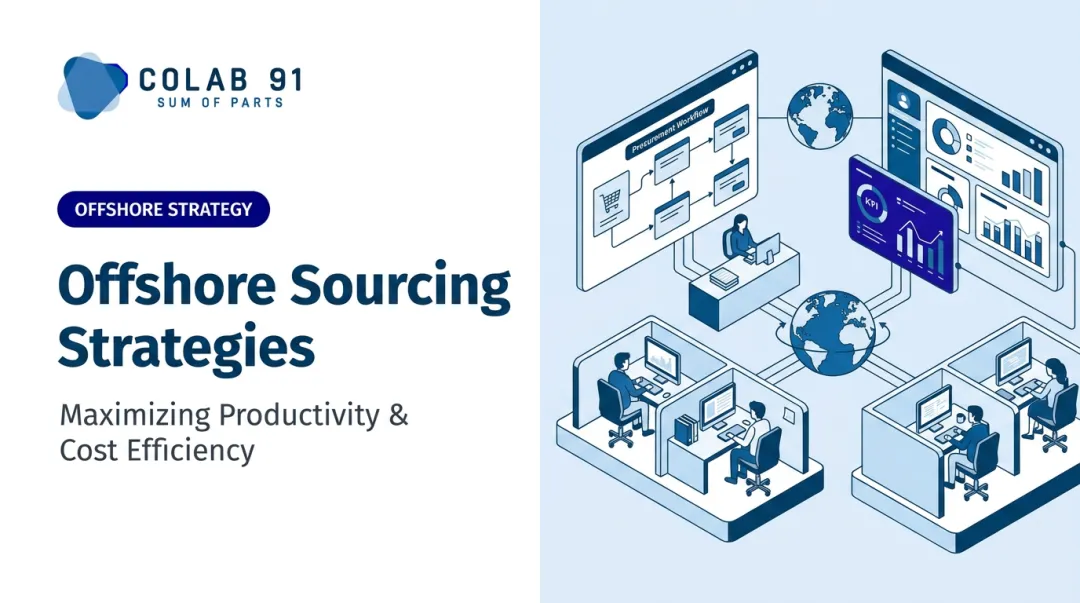
A well-designed offshore sourcing strategy addresses both problems directly - building a dedicated capability that operates as an extension of your core organization, not a low-cost vendor relationship.
This guide covers:
- How to distinguish between offshore delivery models
- Choosing the right approach for your business context
- Identifying the functions most worth offshoring
- Avoiding the operating model mistakes that undermine most offshore programs
Key Takeaways
- Offshore sourcing is an operating model decision - get it wrong at the design stage and no vendor or location will fix it
- Three models dominate: BPO, captive/GCC, and hybrid managed capability center - each with different tradeoffs on cost, speed, and control
- Mid-market and PE-backed companies are increasingly choosing hybrid models for speed and control
- India leads for high-value functions like procurement, analytics, and FP&A
- Most offshore programs fail at operating model design, not at talent sourcing or location selection
What Is an Offshore Sourcing Strategy?
Offshore sourcing strategy is the deliberate, structured approach a company takes to decide which capabilities to move offshore, which delivery model to use, where to locate them, and how to govern and scale the engagement over time.
That distinction matters. Ad-hoc outsourcing solves a task. A sourcing strategy makes deliberate choices about where capability lives, who owns the talent, how institutional knowledge accumulates, and how the offshore team connects to business outcomes - then builds governance around those choices from day one.
Offshore vs. Nearshore vs. Onshore
| Sourcing Model | Typical Cost Arbitrage | Talent Depth | Planning Intensity |
|---|---|---|---|
| Onshore | None | High but limited supply | Low |
| Nearshore | Moderate | Moderate | Moderate |
| Offshore | Highest | Deepest for knowledge work | High |
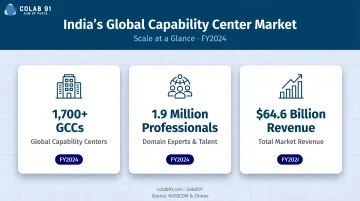
Offshore sourcing - particularly to India - offers the greatest labor cost arbitrage and access to specialized knowledge workers at scale. According to NASSCOM and Zinnov, India's Global Capability Center market reached 1,700+ GCCs, 1.9 million professionals, and $64.6 billion in revenue in FY2024. That scale reflects decades of investment in specialized talent - the kind that mid-market companies can now access without building from scratch.
Accessing that talent pool does come with a real trade-off: planning intensity. Offshore engagements require deliberate decisions on governance, talent ownership, data access, and operating model integration that nearshore or onshore arrangements simply don't demand to the same degree.
Offshore Sourcing Models: Which One Fits Your Business?
Three primary delivery models exist, each with different control levels, setup timelines, and cost structures.
Model 1: Third-Party BPO/Outsourcing
A third-party provider delivers services under contract, and the client pays for defined outputs.
Best for: High-volume, transactional, non-core work with clear deliverable definitions.
Trade-offs: Fastest to deploy and lowest upfront investment, but you surrender control over talent, culture, and institutional knowledge. The offshore team's priorities reflect the vendor's economics, not yours.
Model 2: Captive / Global Capability Center (GCC)
A wholly owned offshore entity that operates as an extension of the parent company.
Best for: Large enterprises with the resources and runway to build independently.
Trade-offs: Maximum control and cultural integration, but high setup cost, slow to deploy, and requires significant in-country management bandwidth. Not realistic for most mid-market companies working against a PE investment timeline.
Model 3: Hybrid / Managed Capability Center
A specialized partner handles setup, compliance, talent acquisition, and infrastructure - while the client directs the work and retains the team's output and institutional knowledge.
Best for: Mid-market and PE-backed companies that need enterprise-grade offshore execution without the overhead of building a captive from scratch.
This is the model Colab91 operates: designing the engagement structure, recruiting domain experts in procurement and analytics, and managing India-side operations - while clients maintain strategic control over priorities, deliverables, and team direction.
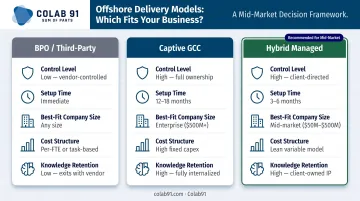
Model Comparison
| BPO | Captive GCC | Hybrid Managed | |
|---|---|---|---|
| Control level | Low | High | High |
| Setup time | Weeks | 6–12+ months | 6–12 weeks |
| Best-fit size | Any | Large enterprise | Mid-market / PE-backed |
| Cost structure | Per-output fees | High fixed investment | Moderate, scalable |
| Knowledge retention | Provider-side | Client-side | Client-side |
The Strategic Case for Offshore Sourcing in Mid-Market and PE-Backed Companies
Why Mid-Market Companies Are Uniquely Well-Positioned
Mid-market companies have enough operational complexity to justify offshore investment - procurement spend management, spend analytics, FP&A reporting - but face a real talent density problem onshore. Building a six-person analytics team or a dedicated procurement operations group from US-based hires is expensive, slow, and often structurally impractical for a $200M–$1B revenue business.
NASSCOM-Zinnov data shows that India already has 480+ mid-market GCC centers with 210,000+ employees - meaning mid-market companies are not pioneering this approach. They're joining a proven model.
The PE Value Creation Angle
For private equity-backed businesses, offshore sourcing maps directly to value creation levers:
- SG&A reduction through labor arbitrage on analytical and operational roles
- Throughput improvement in high-volume functions (spend analytics, supplier management, FP&A)
- Headcount efficiency - scaling output without proportionally growing the onshore org chart
The Hackett Group's 2025 procurement outsourcing research indicates that AI-integrated procurement outsourcing strategies can deliver 34% efficiency gains and 23% cost savings. PE operating partners and portfolio CFOs should use these as baseline targets when building the business case.
Time Sensitivity
With PE holding periods typically running 3–6 years, speed to value is non-negotiable. A captive center that takes 12 months to become productive consumes a significant portion of the investment period before generating returns. Hybrid managed models, which can have productive teams operational in 6–12 weeks, fit this math far better.
That 6–12 week window is where Colab91's model was built to operate. Managing Partners Madhur Kabra and Vijender Kapoor - both former leaders at Impendi (acquired by Accenture) - developed their playbook scaling offshore delivery centers for PE clients including Carlyle Group, TPG, and Elliott, where these timelines are unforgiving.
How to Build a Winning Offshore Sourcing Strategy: A Step-by-Step Framework
Step 1: Define Strategic Objectives and Scope
Start with business goals, not a cost spreadsheet.
Ask: Which capabilities are underbuilt onshore? Which processes are high-volume or analytically intensive? Where would offshore talent create the most leverage?
Then separate your functions into three buckets:
- Offshore with full ownership - analytically intensive, process-driven, English-output work
- Offshore with onshore oversight - functions requiring business context and coordination
- Keep onshore - client-facing relationships, regulatory decisions, C-suite judgment
Step 2: Select the Right Geography and Talent Pool
Evaluate offshore locations across four dimensions: talent availability and quality, cost structure, time zone compatibility, and regulatory/IP environment.
For knowledge-intensive functions, India leads. The All India Survey on Higher Education reports 10.7 million annual pass-outs each year, including:
- 847,000 engineering graduates
- 1.1 million commerce graduates
- 232,000 MBAs
That pipeline supports procurement, analytics, and finance talent at scale - in English - year over year.
Step 3: Choose Your Delivery Model and Partner
Once you've identified the right geography, the next decision is how to structure your engagement - and who to partner with.
When evaluating a hybrid partner, go beyond pricing. Evaluate:
- Domain expertise in your specific function (not just general staffing)
- Ability to recruit and retain top-tier talent in that function
- Experience at your company's scale and with PE-backed businesses
- Operating model design capability to integrate offshore with onshore leadership
Step 4: Design the Operating Model
Operating model design determines whether an offshore program delivers or stalls. Define before hiring:
- Reporting structures between offshore team leads and onshore counterparts
- Communication cadences (daily standups, weekly governance, monthly reviews)
- KPIs and output definitions for each function
- Escalation paths when issues surface
- Overlapping working hours for real-time collaboration
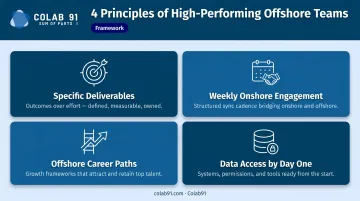
Four principles that separate high-performing offshore teams from underutilized ones:
- Give the offshore team specific deliverables, not vague responsibilities - a clear mandate is non-negotiable
- Require onshore leadership to engage weekly, not monthly or "as needed"
- Build career paths offshore from day one; without them, attrition erodes institutional knowledge fast
- Design data access before the first hire - offshore analysts without clean data access deliver nothing
Step 5: Launch, Measure, and Scale
With the operating model in place, launch in phases rather than all at once:
- Months 1–3: Scoped pilot function with defined baseline metrics
- Months 4–6: Performance review, process refinement, scope expansion
- Month 6+: Progressive handoff of more complex, higher-value work
The best offshore capability centers progressively take on more analytical and strategic work as the team matures. Plan for that trajectory from the start - it's what separates a cost center from a genuine capability hub.
Key Functions Best Suited for Offshore Sourcing
Strong Offshore Candidates
| Function | Why It Works Offshore |
|---|---|
| Strategic sourcing & procurement operations | Process-driven, analytically intensive, English-output |
| Spend analytics & data management | High-volume data work, strong India talent pipeline |
| Financial planning & analysis (FP&A) | Structured reporting, scalable with clear templates |
| Market research & competitive intelligence | Research-intensive, English-language output |
| Reporting automation | Repeatable, high leverage with the right tooling |
For PE-backed companies, procurement and spend analytics carry the highest return. These functions directly drive cost identification and savings capture - translating offshore team output into measurable EBITDA impact. Colab91 advisor Erika Jung, former CPO at Pediatric Associates (a TPG portfolio company), brings firsthand experience building exactly this kind of offshore procurement delivery.
Functions That Typically Stay Onshore
- Client-facing relationship management
- Regulatory and compliance decision-making
- C-suite strategy and board-level engagement
- Roles requiring significant physical presence or local market judgment
The practical scoping test is straightforward: functions that depend on local relationship capital or real-time physical presence belong onshore. Anything built around analytical depth, process repeatability, and English-language output is a strong offshore candidate.
Common Pitfalls in Offshore Sourcing Strategy
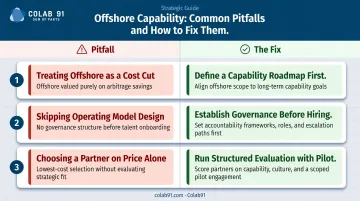
Most offshore programs don't fail because of geography or talent - they fail because of decisions made before the first hire. Here are the three pitfalls that consistently derail well-intentioned offshore strategies.
Pitfall 1: Treating Offshore as a Cost Cut, Not a Capability
Companies that offshore to "save money" without building a capability roadmap end up with under-resourced, under-managed teams that deliver a fraction of their potential value.
The fix: Define a capability roadmap before the first hire. Treat offshore leadership engagement as non-negotiable - not a nice-to-have.
Pitfall 2: Skipping Operating Model Design
Failing to define clear accountability, communication rhythms, and escalation paths between offshore and onshore teams is the most common failure mode. Offshore teams without clear mandates drift.
The fix: Invest in operating model design before hiring anyone. Establish overlapping working hours and structured weekly governance from day one.
Pitfall 3: Choosing a Partner on Price Alone
A low-cost partner without domain expertise in your specific function - procurement, analytics, FP&A - will staff generalists who can't drive the outcomes you need.
The fix: Run a structured evaluation, check references from companies of similar size and function, and start with a scoped pilot before committing to full deployment.
Frequently Asked Questions
What are the four types of outsourcing?
The four main types are:
- BPO (Business Process Outsourcing) - delegating operational processes to a third party
- KPO (Knowledge Process Outsourcing) - outsourcing analytical or research-intensive work
- ITO (IT Outsourcing) - outsourcing technology services or operations
- Manufacturing/Operations Outsourcing - outsourcing physical production
For mid-market companies in procurement and analytics, KPO and BPO are most relevant.
What is an example of offshore outsourcing?
A US-based PE-backed company establishes a dedicated analytics and procurement team in India to run spend analysis, category benchmarking, and supplier data management - freeing the onshore team to focus on strategic negotiations and stakeholder relationships. This dedicated-team model is particularly common among PE-backed companies managing lean onshore headcount during a hold period.
What is the difference between offshore outsourcing and a captive center?
Offshore outsourcing contracts a third-party vendor to deliver services - the vendor owns the talent and infrastructure. A captive center (or GCC) is a wholly owned entity established in the offshore location. It gives full control over talent, culture, and institutional knowledge - but requires significantly more setup investment and management bandwidth.
How do PE-backed companies specifically benefit from offshore sourcing?
The primary benefits are direct SG&A reduction through labor arbitrage, faster scaling of analytical functions without growing onshore headcount, and access to specialized procurement talent that's difficult to hire affordably in the US. Within a 3–6 year holding period, every margin point counts - and offshore teams deliver measurable impact quickly.
What functions are best suited for offshore sourcing?
Analytically intensive, process-driven, English-output functions: procurement operations, spend analytics, FP&A, market research, data management, and reporting automation. Client-facing relationship roles, regulatory decision-making, and senior strategic judgment typically remain onshore.
How long does it take to build an effective offshore team?
A managed/hybrid model can have a productive team operational in 6–12 weeks. A captive center typically takes 6–12 months to stand up. The first 90 days of structured onboarding and operating model integration determine whether the team becomes a strategic asset or an underperforming cost line.