Introduction
Procurement leaders at mid-market and PE-backed organizations are making critical sourcing decisions based on data they don't fully trust. Spend sits scattered across ERPs, AP platforms, P-cards, expense management tools, and supplier invoices - each with different formats, currencies, and classification schemes. No unified view exists.
The consequences are real. External supplier spend typically represents 40%–80% of a company's total cost base, yet most organizations can't answer basic questions about it with confidence. Where is our money going? Which suppliers carry concentration risk? Where are we losing savings to contract leakage?
Digital innovation has made comprehensive spend visibility achievable. Technology is a necessary part of the equation, but it's not sufficient on its own. This article covers:
- What spend visibility actually means in practice
- Why most organizations still fall short
- Which digital tools are changing the equation
- How to staff and sustain the function long-term
Key Takeaways
- Spend visibility is a consolidated, real-time picture of all purchasing activity: what's being bought, from whom, at what price, and at what risk level
- Most organizations fail due to fragmented data, poor data quality, and a shortage of procurement-specific analytical expertise - not just missing technology
- AI-powered classification, integrated data pipelines, and self-service dashboards are closing these gaps
- PE-backed companies gain direct EBITDA impact through cost reduction, supplier consolidation, and eliminating maverick spend
- Sustainable visibility needs the right technology stack paired with dedicated analytical talent - often sourced through offshore capability models
What Is Spend Visibility and Why Does It Matter?
Spend visibility is the ability to consolidate all procurement spend data - across categories, business units, suppliers, geographies, and time periods - into a single, accurate, and accessible view.
That distinction matters: visibility is the prerequisite; analytics is what you do with it. You can't analyze data you don't have, and you can't trust analysis built on incomplete or miscategorized inputs.
The Foundation of Every Procurement Initiative
Without knowing where money is going, you cannot:
- Identify savings opportunities or prioritize sourcing initiatives
- Manage supplier risk or detect concentration dependencies
- Enforce contract compliance or measure maverick spend
- Forecast demand or plan capacity with suppliers
Without this foundation, procurement teams make decisions based on incomplete data - and in competitive or capital-constrained environments, that gap compounds quickly.
Why the Stakes Are Higher for PE-Backed Companies
For PE sponsors and their portfolio companies, third-party spend visibility is directly tied to EBITDA improvement targets and value creation plans. Alvarez & Marsal estimates that indirect procurement savings can uplift EBITDA by 0.4–2.0 percentage points in PE contexts - a range that only becomes accessible when you can see and analyze what you're spending.
The Sub-Tier Blind Spot
The definition of "comprehensive" has expanded well beyond Tier 1 suppliers. Only 15% of CPOs reported visibility into Tier 2 suppliers and beyond, according to Deloitte's CPO Survey - and this gap carries real consequences.
The 2021 automotive semiconductor shortage illustrated exactly what limited sub-tier visibility costs. KPMG documented that automakers generally relied on Tier 1 suppliers to manage chipmaker relationships, leaving OEMs with no direct visibility into the semiconductor supply chain - exposure that contributed to an estimated $125B in lost automotive sales globally.
That example highlights the gap between tactical visibility (what did we spend last quarter?) and strategic visibility (what are our concentration risks and optimization opportunities?). Closing that gap is precisely where digital tools - and the data infrastructure behind them - do their most valuable work.
Why Most Organizations Still Struggle with Spend Visibility
The Data Fragmentation Problem
Spend data doesn't live in one place. A typical mid-market company pulls purchasing data from some combination of:
- ERP systems (often multiple, post-acquisition)
- Accounts payable platforms
- P-card and corporate expense tools
- Procurement portals and sourcing systems
- Supplier invoices processed outside any system
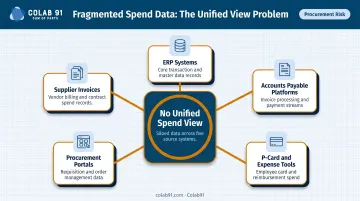
Each source uses different supplier naming conventions, category codes, currencies, and completeness levels. Consolidating them isn't a one-time project - it's an ongoing operational challenge.
Data Quality and Classification
Even after consolidation, the data often can't be trusted. Raw spend records are frequently miscoded, inconsistently categorized, or missing supplier-level detail entirely. Deloitte's research identifies data quality as one of the biggest obstacles to AI adoption in procurement - and accurate classification is foundational to any meaningful spend analysis.
Without a rigorous cleansing and classification process, even a unified dataset produces misleading insights - and category managers end up making sourcing decisions based on incomplete pictures.
The Analyst Productivity Gap
Poor data quality doesn't just produce bad outputs - it consumes analyst time. Hackett Group benchmarks show that Digital World Class procurement teams enable analysts to spend 26% more time on data analysis rather than manual data collection, which means the average organization is burning most of its analyst capacity on gathering and massaging data rather than generating insights.
The Talent Gap
Many organizations have invested in spend analytics tools and aren't getting the expected return. The missing ingredient is usually people. Procurement professionals are typically trained as category specialists or sourcing practitioners - not data analysts. Configuring, maintaining, and running day-to-day a spend analytics platform requires a different skill set that most procurement teams don't have in-house.
For mid-market companies, this gap is sharper:
- No dedicated spend analytics team
- Can't justify the cost of enterprise-grade platforms
- No internal bandwidth for ongoing data enrichment
- Higher exposure to spend blind spots as a result
That capacity problem is getting worse. The Hackett Group projects procurement workload will rise 9.8% in 2025, while FTE counts increase just 1.0% - a gap that makes the talent shortage more acute, not less.
Key Digital Innovations Enabling Spend Visibility
AI-Powered Spend Classification
Manual spend classification is slow, inconsistent, and doesn't scale. Machine learning models address this by automatically categorizing spend transactions using standardized taxonomies - such as the UNSPSC global classification system - or custom category hierarchies tailored to the business.
Classification accuracy improves over time as models learn from corrections, and new transactions are enriched automatically rather than manually. This directly addresses one of the most stubborn failure modes of traditional spend analysis: stale, poorly categorized data that analysts simply don't trust.
Integrated Data Ingestion and Enrichment
Modern spend intelligence platforms replace the manual "data dump" approach - quarterly exports, spreadsheet merges, hours of deduplication - with automated pipelines that connect directly to source systems via API.
The continuous flow means:
- Data is current, not weeks or months stale
- Deduplication and normalization happen automatically
- New source systems can be added without rebuilding the entire process
External enrichment builds on this foundation - appending supplier master data, market benchmarks, and risk intelligence onto internal spend data creates a fuller picture that supports cost optimization and supplier risk management at the same time.
Real-Time Dashboards and Self-Service Analytics
Role-based dashboards have changed who can access spend data and how quickly. Category managers, finance partners, and CPOs no longer wait for a centralized team to run reports - relevant spend views are available on demand.
Purpose-built spend intelligence platforms differ from generic BI tools in a practical way: they're designed around procurement workflows and KPIs out of the box - spend by category, supplier concentration, compliance rate, savings pipeline. Generic tools require significant configuration to approximate this, and still fall short for procurement-specific use cases.
Hackett Group research shows that 50% of procurement leaders expect deep real-time data visibility to have transformational impact over the next five years - suggesting that visibility infrastructure is now a competitive differentiator, not just a reporting convenience.
Predictive Analytics and Scenario Modeling
Advanced platforms now enable forward-looking capabilities:
- Forecasting spend based on historical trends and market signals
- Modeling the EBITDA impact of supplier consolidation scenarios
- Identifying categories ripe for strategic sourcing intervention
- Flagging emerging supplier risks before they become disruptions
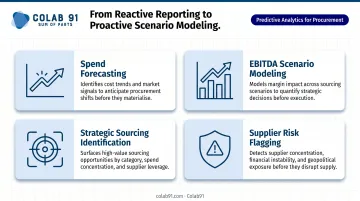
For PE-backed businesses in particular, this shift matters. Procurement teams that move from reactive reporting to proactive scenario modeling can contribute directly to EBITDA improvement - which is precisely what sponsors and portfolio leadership expect from the function.
From Visibility to Action: Connecting Spend Data to Strategic Outcomes
Spend visibility is only valuable when it drives decisions. A clean, consolidated spend view enables prioritization - ensuring procurement resources target the highest-value categories rather than spreading effort uniformly across the portfolio.
EBITDA Levers for PE-Backed Companies
For portfolio companies, the connection between spend visibility and EBITDA improvement runs through several specific mechanisms:
- Third-party cost reduction - competitive sourcing and contract renegotiation in categories that were previously invisible
- Supplier consolidation - rationalizing fragmented supplier bases once the full picture is visible
- Maverick spend elimination - Hackett reports Digital World Class procurement teams produce 60% less savings lost from maverick buying and contract noncompliance
- Working capital improvement - payment term optimization across the supplier base, which requires visibility into current terms at scale
McKinsey has documented a midsize PE portfolio company case where digital procurement initiatives contributed to a 20% EBITDA lift within six months. That kind of outcome depends entirely on a spend data foundation strong enough to identify and sequence the right interventions fast.
Supplier Risk Management
The financial case for visibility connects directly to risk. Once concentration data surfaces - single-source dependencies, geographic clustering, supplier financial exposure - procurement can shift from firefighting to a deliberate risk-adjusted sourcing strategy.
Deloitte's research puts the gap in sharp relief: only 26% of CPOs could confidently predict risks within their direct supplier base, and 52% were not using supplier risk management tools for collaboration.
Organizations that extend visibility into sub-tier supply chains and supplier health indicators operate with a structurally different risk profile than those managing Tier 1 relationships alone.
Building Spend Visibility Capabilities: People, Process, and Technology
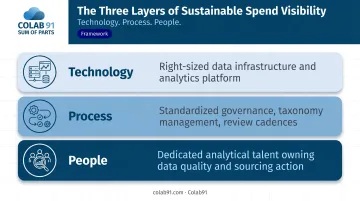
Sustainable spend visibility requires three layers working together:
| Layer | What It Requires |
|---|---|
| Technology | Right-sized data infrastructure and analytics platform for the organization's scale |
| Process | Standardized data governance, taxonomy management, and regular spend review cadences |
| People | Dedicated analytical talent who own data quality, generate insights, and translate findings into sourcing action |
Why Technology Alone Falls Short
The ROI gap in procurement technology is well documented. Hackett reports that Digital World Class procurement teams deliver 2.6x greater ROI and 2.03x greater cost savings as a percentage of spend compared to peers - a gap that reflects execution capability, not just tool selection.
The human layer converts system output into business value. Skilled spend analysts who understand both the data and the procurement context - spotting a supplier consolidation opportunity buried in a category breakdown, or flagging a classification anomaly that's hiding maverick spend - are what make the technology worth the investment.
Deloitte's 2025 CPO Survey, covering more than 250 CPOs across 40 countries, found a strong correlation between combined technology and talent investment and procurement performance outcomes.
The Offshore Capability Model
For mid-market and PE-backed companies that can't justify the cost of a large in-house spend analytics team, building a dedicated offshore procurement analytics capability offers a practical path to enterprise-grade spend visibility at the right cost structure.
Colab91's model does exactly this - building India-based procurement analytics teams in Gurugram that function as strategic extensions of clients' onshore procurement functions. The model combines AI-powered data infrastructure with practitioner-level sourcing expertise, giving mid-market organizations access to the analytical depth that large enterprises build internally.
The distinction from traditional outsourcing is meaningful. Colab91 builds teams of domain experts who integrate deeply with client culture, functioning as an extension of in-house functions rather than a siloed offshore operation running standardized reports.
The "Sum of Parts" approach augments in-house talent rather than replacing it. Onshore leadership - including Jeff Skiles, Director of USA Operations - maintains strategic alignment with client procurement leadership while offshore teams handle the analytical depth.
This model is particularly well-suited to PE portfolio company contexts. The Colab91 leadership team brings direct experience here, having previously scaled a 100+ practitioner organization serving PE firms including Carlyle Group, TPG, Elliott, and BC Partners.
Frequently Asked Questions
What is spend visibility in procurement?
Spend visibility is the ability to see all organizational purchasing activity - what's being bought, from whom, at what cost, and under what terms - consolidated into a single, accurate, real-time view. Without it, procurement decisions rely on incomplete data and informed guesswork.
What are the biggest barriers to achieving spend visibility?
The three core barriers are fragmented data spread across multiple systems, poor data quality and inconsistent categorization, and a lack of dedicated analytical talent to maintain and operationalize the data. Technology is rarely the primary limiting factor.
How does spend visibility improve cost savings?
Visibility enables organizations to identify savings opportunities (consolidation, competitive sourcing, contract compliance), prioritize initiatives by value, and measure realized versus targeted savings. Without it, teams frequently pursue lower-impact initiatives while missing the largest spend categories.
What role does AI play in digital procurement transformation?
AI automates spend classification, enriches supplier data, detects anomalies and maverick spend patterns, and enables predictive forecasting - capabilities that were previously too resource-intensive for most organizations to execute manually at scale.
What is the difference between spend visibility and spend analytics?
Spend visibility means having clean, consolidated, accurately categorized spend data in one place. Spend analytics is the process of interrogating that data to surface insights and drive decisions. Visibility comes first - analytics built on incomplete data produces unreliable outputs.
How can mid-market companies achieve spend visibility without large procurement teams?
Mid-market organizations can reach enterprise-grade spend visibility by combining right-sized analytics platforms with offshore or blended team models - accessing specialized procurement analytics expertise without the overhead of building a large in-house function from scratch.