Introduction
Most procurement teams treat software buying as a series of one-off decisions - a renewal here, a new tool request there - without any consistent framework connecting them. That approach is expensive. According to Zylo's 2025 SaaS Management Index, organizations waste an average of $21 million annually on unused SaaS licenses, a figure that grew 14.2% year-over-year.
The underlying problem isn't careless spending. It's the absence of a repeatable process. Without one, procurement and operations leaders face the same traps repeatedly: surprise renewals, redundant tools, vendors with unchecked price escalations, and software decisions made without legal or finance input.
A structured software sourcing strategy makes that complexity manageable. This guide covers what that strategy looks like, how to build it step by step, and which practices help procurement leaders control costs, reduce redundancy, and negotiate from a position of knowledge rather than urgency.
Key Takeaways
- A software sourcing strategy is a formal, repeatable process for finding, evaluating, and managing software vendors - aligned to business goals, not just lowest price.
- Organizations using competitive bids capture savings on 20% more deals and increase average savings by 86% (Vendr, Q1 2024).
- A structured process covers seven steps - from spend analysis and RFP development through to negotiation and ongoing vendor management.
- Avoid the most costly mistakes: single-vendor evaluation, ignoring total cost of ownership, and sidelining legal and finance teams.
What Is a Software Sourcing Strategy?
A software sourcing strategy is a structured organizational approach to identifying, evaluating, selecting, and managing software vendors - one where purchasing decisions align with business goals rather than just immediate cost.
Sourcing vs. Procurement: Not the Same Thing
These terms are often used interchangeably, but they describe different activities:
- Sourcing is upstream - finding, vetting, and qualifying the right vendor before a purchase decision is made
- Procurement covers the full purchase-to-pay lifecycle: purchase orders, approvals, invoicing, contract management, and supplier oversight
Strong sourcing makes the rest of procurement more effective. Without it, teams spend their time managing the fallout from poor vendor selection rather than driving value.
Why Software Sourcing Is Different
Sourcing physical goods is straightforward. Software sourcing is not - several factors make it genuinely complex:
- SaaS subscription models lock organizations into multi-year commitments with limited downward flexibility mid-contract, per Gartner
- Usage-based and tiered pricing obscures true costs until well after signature
- Integration dependencies make switching costs far higher than the license fee suggests
- Shadow IT distorts spend visibility - Gartner projects that by 2027, 75% of employees will acquire or modify technology outside IT visibility
- Vendor landscape velocity means a tool that led its category 18 months ago may already face a credible challenger
Together, these factors mean that sourcing software without a structured strategy doesn't just risk overspending - it risks locking the organization into the wrong tool entirely.
Why a Dedicated Software Sourcing Strategy Matters
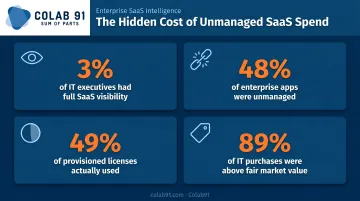
The data on unmanaged software spend is stark:
- Only 3% of IT executives had complete, real-time SaaS visibility in 2024
- 48% of enterprise apps were unmanaged, per Productiv
- Companies used just 49% of provisioned licenses on average
- 89% of IT purchases and renewals analyzed by NPI Financial were above fair market value
For large enterprises, these numbers represent significant waste. For mid-market and PE-backed companies, the stakes are proportionally higher - lean procurement teams are expected to move fast, budgets face intense scrutiny, and every software decision must demonstrate a clear contribution to value creation.
There's no room for a $200K renewal that nobody reviewed until 30 days before auto-renewal.
A repeatable sourcing process addresses this. Done well, it:
- Creates visibility before spending occurs, not after
- Ensures decisions reflect full cost information - not just headline license fees
- Gives procurement teams the structure to manage vendors proactively rather than reactively
How to Build a Software Sourcing Strategy: A Step-by-Step Process
Most strategic sourcing frameworks follow a seven-stage structure, as defined by CIPS. Applied to software, each stage requires tailored thinking to account for pricing complexity, integration risk, and vendor dynamics.
Step 1: Conduct a Spend and Needs Analysis
Start by auditing what you already have. Map every software tool currently in use - by cost, owner, contract end date, and actual utilization.
The findings are often surprising. Zylo's 2024 data showed the average company had 15 duplicative online training applications alone, and more than one-third of applications qualified as shadow IT. This analysis directly funds the sourcing budget: unused licenses reclaimed and redundant tools eliminated create savings before a single new vendor conversation begins.
The output of this step should be a clear inventory: what exists, what it costs, who uses it, and whether it's delivering value.
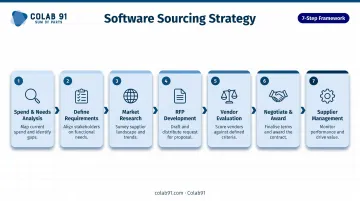
Step 2: Define Business Requirements and Evaluation Criteria
Before engaging any vendor, define what you actually need. This includes:
- Functional requirements (what the software must do)
- Security and compliance standards
- Integration requirements with existing systems
- Scalability expectations over 2–3 years
- Non-negotiable contract terms (data portability, termination rights, SLA minimums)
Involve IT, finance, legal, and end-users at this stage. Teams that skip cross-functional input often discover problems after contract signature - tools that don't get adopted, contracts with problematic terms, or purchases without budget approval.
Step 3: Conduct Supplier Market Research
Map the vendor landscape for the category. Identify the major players, understand pricing norms, assess vendor financial stability, and - above all - identify credible alternatives before any conversation begins.
Two or three viable alternatives give your procurement team real negotiating leverage. Vendr's Q1 2024 data showed that buyers using competitive bids captured savings on 20% more deals and increased average savings by 86%.
Step 4: Develop and Issue an RFP or RFQ
A well-structured RFP surfaces more than functional fit. It should reveal:
- Total cost of ownership (implementation, integration, training, support, year-two pricing)
- Implementation timeline and approach
- Data ownership and portability terms
- Support model and SLA commitments
- Pricing transparency across the contract lifecycle
How a vendor responds to an RFP is also informative. A vendor that hedges on pricing, glosses over implementation complexity, or resists data portability questions is telling you something important about how the relationship will unfold.
Step 5: Evaluate Vendors and Shortlist Finalists
Use structured, weighted scoring - not subjective comparison. Define your criteria weights before receiving proposals, not after.
A side-by-side total cost analysis frequently reveals dramatic differences between vendors with seemingly similar headline prices. Implementation fees, training costs, and year-two escalations can easily shift a "cheaper" vendor into the more expensive option across a three-year window.
Step 6: Negotiate and Award the Contract
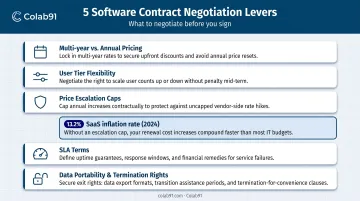
Software negotiation has specific levers that differ from physical goods:
- Multi-year vs. annual pricing - vendors often offer discounts for multi-year commits, but review mid-contract flexibility
- User tier flexibility - negotiate the ability to scale down, not just up
- Price escalation caps - SaaS inflation reached 13.2% as of March 2026, per Vertice; uncapped escalation clauses are expensive
- SLA terms - define remedies, not just targets
- Data portability and termination rights - critical for avoiding lock-in
Maintain competitive tension by negotiating with two finalists simultaneously where possible. Different vendors will concede on different terms - one may flex on price while another offers stronger SLA commitments.
For mid-market and PE-backed companies with lean internal procurement teams, this is where offshore capability centers deliver real impact. Firms like Colab91 build India-based teams with deep domain expertise in strategic sourcing and spend analytics - allowing procurement leaders to augment their internal capacity with specialists who can run benchmarking analysis, model TCO scenarios, and support negotiation preparation without the overhead of a large onshore team.
Note that renewing software took 30% longer in Q1 2024 than the prior year, averaging 53 days per renewal. Starting this process late is not a minor inefficiency - it's a negotiation disadvantage.
Step 7: Manage Supplier Relationships and Conduct Performance Reviews
Sourcing does not end at contract signature. Ongoing supplier management includes:
- Tracking KPIs: license utilization, compliance rate, support responsiveness
- Monitoring renewals proactively - Gartner recommends beginning renewal planning 6–12 months ahead of expiry
- Conducting regular performance reviews to assess whether the vendor continues to meet business needs
- Revisiting the market at each renewal to confirm no better alternatives have emerged
Key Best Practices for Effective Software Sourcing
Understand the True Total Cost of Ownership
The license fee is rarely the whole story. As CIPS defines it, TCO encompasses end-to-end costs including purchase price, acquisition, usage, and end-of-life costs. For software, that means investigating:
- Implementation and configuration fees
- Training and change management costs
- Integration development and maintenance
- Support tier limitations (24/7 vs. business hours, response SLAs by tier)
- Year-two and year-three price escalation rates
- Data retrieval fees and exit costs upon termination
Gartner is direct on this point: a narrow focus on unit price alone can increase total costs. Structure your RFP and vendor evaluation to surface these hidden categories before you're committed.
Maintain Competitive Tension Throughout the Process
Narrowing to a single finalist before contract execution is one of the most common and costly mistakes in software sourcing. Once a vendor knows they're the only option, negotiating leverage shifts in their favor.
Keep two vendors active through final negotiation rounds and make both aware they're competing. Vendors concede on different dimensions: price, SLA terms, implementation support, contractual flexibility. Maintaining that tension gives you more levers to pull - and more room to walk away if terms don't work.
Segment Software Categories Strategically
Not every software purchase warrants the same sourcing effort. Applying a category segmentation lens - similar to the Kraljic Matrix framework, which categorizes purchases by business impact and supply risk - helps allocate sourcing resources appropriately:
- Mission-critical enterprise platforms (ERP, core analytics, security infrastructure): high business impact, high switching cost - warrant a full RFP process, deep TCO analysis, and extended negotiation
- Departmental SaaS tools (project management, collaboration): moderate impact - structured evaluation, lighter RFP
- Commodity software (low risk, easily replaceable): quick procurement cycle, minimal sourcing overhead
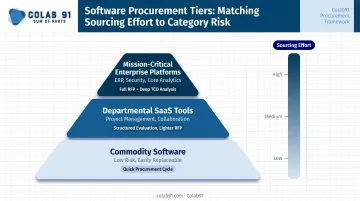
Applying deep sourcing effort to low-risk tools and light-touch procurement to mission-critical platforms is the inverse of what the strategy should achieve.
Use Data to Drive Decisions, Not Intuition
Benchmarking vendor pricing against market data, modeling TCO scenarios, and tracking utilization metrics are what separate strategic sourcing from reactive buying. Teams that run this analysis before and during negotiations routinely find 15–25% variance between initial vendor quotes and what the market will actually bear.
This is where mid-market procurement teams most often hit a wall. The judgment is there; the bandwidth isn't. Running rigorous benchmarking and TCO modeling while managing active vendor negotiations simultaneously is difficult to staff for. Colab91 builds India-based teams of domain experts in sourcing and analytics that operate as an extension of the client's procurement function, providing that analytical depth without requiring additional headcount onshore.
Build Governance and a Preferred Vendor Program
Data-driven decisions only stick when governance keeps future purchases on track. A preferred vendor list, documented sourcing policies, and clear approval workflows prevent shadow IT, ensure compliance, and eliminate the cost of re-evaluating the same vendor categories every 12–18 months. Without this infrastructure, sourcing gains erode quickly as the organization grows.
The basics of a workable governance framework include:
- Approved vendor registry by category, with contract and renewal dates
- Minimum sourcing requirements by spend threshold (e.g., RFP required above $50K)
- Defined approval authorities and escalation paths
- Regular audits of the preferred vendor list against market alternatives
Common Mistakes in Software Sourcing
Mistake 1: Treating Sourcing as a One-Time Event
Teams that complete vendor selection and move on inevitably end up locked into underperforming contracts - or miss better alternatives that entered the market mid-term. Renewal management, utilization tracking, and periodic market reviews protect the value of that original decision. None of them are optional.
Mistake 2: Focusing on License Price While Ignoring Total Cost
The headline fee is often a fraction of the real cost. The hidden categories add up fast:
- Implementation timelines that slip past estimates
- Integration complexity that was underestimated at the outset
- Support tier limitations that surface at the worst moments
- Year-two price escalations that arrive without warning
A procurement team that locked in a great license price but ignored these factors may find their "cost-saving" decision becomes a budget liability by month 18.
Mistake 3: Skipping Cross-Functional Stakeholder Input
Software decisions made in isolation - by IT or procurement alone, without legal, finance, and end-user involvement - produce consistent, avoidable problems: contracts with problematic terms, tools with low adoption, and purchases that lack budget approval. Aligning stakeholders before engaging vendors prevents wasted negotiation cycles.
Frequently Asked Questions
What are the 4 pillars of sourcing?
Most strategic sourcing frameworks organize around four core activities: supply market analysis, spend analysis, supplier evaluation, and contracting and negotiation. Definitions vary across CIPS, ISM, and Gartner, but these four consistently anchor any structured approach.
What are the 5 Rs of sourcing?
CIPS defines procurement's role as securing products and services at the right quality, right quantity, right time, right place, and right price. Applied to software sourcing, the five rights serve as a practical checklist - keeping evaluation balanced across quality, timing, and cost rather than defaulting to price alone.
What are the 7 levers of sourcing?
McKinsey's sourcing work references levers including demand management, specification optimization, supplier base optimization, process improvement, pricing model changes, total cost of ownership improvement, and relationship restructuring. Teams use these as a practical framework for uncovering value that straight price negotiation would miss.
What is the difference between software sourcing and software procurement?
Sourcing is the upstream process of identifying, vetting, and selecting the right vendor. Procurement covers the broader purchase-to-pay lifecycle - purchase orders, approvals, invoicing, and supplier management. Strong sourcing makes the rest of the procurement process more effective by ensuring the right vendor is selected before any of those activities begin.
How do you evaluate software vendors during the sourcing process?
Key evaluation dimensions include functional fit, total cost of ownership, implementation approach, integration capability, vendor financial stability, SLA terms, and support quality. Weighted scoring against predefined criteria - set before proposals are received - prevents subjective selection that favors whichever vendor presented last.
What are the most common mistakes in software sourcing?
The top three: evaluating only one vendor (eliminating negotiation leverage), focusing on license price while ignoring total cost (missing the real cost story), and failing to involve legal and finance before contract negotiation (producing avoidable contractual problems). Each is preventable with a structured process.