Introduction
For most of the past two decades, procurement lived in the back office: negotiating contracts, tracking spend, and measuring success in cost savings percentages. That model is breaking down.
According to the 2025 Annual ProcureCon CPO Report, 53% of CPOs now play a more substantial role in high-level decision-making, up from 46% the prior year. The direction is clear: procurement is moving toward the center of strategic decision-making.
But earning a seat at the C-suite table and actually holding it are two different things. The expectations that come with that seat - managing geopolitical risk, driving ESG commitments, contributing to EBITDA, adopting AI - are fundamentally different from what traditional procurement leaders were trained to deliver.
Managing geopolitical risk, driving ESG commitments, contributing to EBITDA, deploying AI at scale: these demands are fundamentally different from what traditional procurement leaders were built to deliver.
This article breaks down what that agenda actually requires - and what separates CPOs who are navigating it from those still catching up.
Key Takeaways
- The CPO role has shifted from cost-cutter to enterprise-wide strategic partner
- Four priorities now define the modern CPO agenda: risk, AI, ESG, and revenue impact
- Aligning with the CFO is procurement's most direct path to board-level credibility
- Proving procurement's value at the board level requires metrics that go beyond savings rates
- Closing talent and technology gaps is what separates high-performing CPOs from the rest
The Expanding Mandate: From Cost-Cutter to Strategic Powerhouse
The "Peacetime CPO" Is No Longer Enough
The traditional procurement leader was optimized for stability: managing supplier contracts, reducing unit costs, tracking spend under management. That model worked when supply chains were predictable and procurement's job was fundamentally transactional.
The pandemic ended that assumption permanently. Global disruptions exposed how deeply supply chain decisions affect production continuity, brand reputation, and investor confidence. McKinsey research found that a single 100-day production shock can erase 30% to 50% of one year's EBITDA - and that companies can expect to lose the equivalent of nearly 45% of one year's profits from supply chain disruptions over a decade.
That kind of financial exposure demands a different kind of procurement leader.
What "Strategic CPO" Actually Means
The strategic CPO role isn't a title upgrade. It's a fundamentally different orientation - one focused on decisions that affect revenue, risk, and growth, not just contract outcomes.
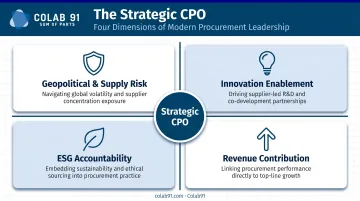
A strategic CPO operates across four dimensions simultaneously:
- Geopolitical and supply risk - identifying exposure before it becomes a crisis
- Innovation enablement - embedding supplier capabilities into product pipelines
- ESG accountability - owning the supply chain's environmental and social footprint
- Revenue contribution - accelerating time-to-market and freeing capital for growth
Getting there requires more than procurement expertise. Gartner's survey of 111 procurement leaders found 86% reported business acumen gaps and 96% identified technology and data skills gaps within their functions.
The skills that actually differentiate elite CPOs today - executive presence, cross-functional diplomacy, translating procurement data into CFO-ready narratives - are precisely the ones that traditional procurement training never prioritized.
One common pitfall: CPOs who earn the strategic title but stay tactically focused - still presenting on price reductions and cost avoidance percentages - quickly lose credibility with the board. The conversation needs to move to risk-adjusted value, supplier-led innovation, and growth enablement. CPOs who make that shift earn a permanent seat at the table; those who don't get repositioned back into an execution role.
The 4 Strategic Priorities Defining Today's CPO Agenda
Priority 1: Supply Chain Risk and Resilience
Managing supply chain complexity has become the defining challenge - not a background responsibility. Tariffs, geopolitical tensions, raw material shortages, and extended lead times have made risk management a front-office issue.
The problem is structural: according to the ProcureCon CPO Report, 53% of procurement teams are only involved after purchasing requirements are defined. That late involvement transforms procurement from a proactive risk manager into a reactive order-filler.
The semiconductor shortage illustrates the cost of that gap. McKinsey found that chip lead times average at least four months when capacity exists - and up to 18 months if capacity expansion is needed.
Companies that had embedded procurement in their capacity planning well before the shortage hit were able to secure supply commitments early. Those that waited scrambled through spot markets at inflated prices.
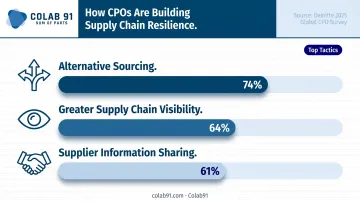
Deloitte's 2025 Global CPO Survey shows the industry is catching up: the most widely adopted risk tactics are alternative sourcing (74% of CPOs), greater supply chain visibility (64%), and supplier information sharing (61%). The CPOs building resilience proactively - rather than chasing it reactively - are the ones redefining what procurement's strategic value looks like.
Priority 2: AI and Data-Driven Procurement
AI is creating a real divide between procurement organizations that generate intelligence and those that still generate reports.
The adoption numbers are instructive but also cautionary. According to Gartner, 73% of procurement leaders expected to adopt GenAI by end of 2024. The Hackett Group found that 49% piloted GenAI - but only 4% had large-scale deployment. The gap between experimentation and enterprise-scale value capture is wide.
Where AI is already delivering results:
- Spend analytics - real-time identification of savings opportunities across categories
- Predictive supplier risk - flagging concentration risk, financial instability, or geopolitical exposure before it escalates
- Contract automation - reducing cycle times and catching non-compliant terms at scale
- Procurement intelligence - freeing CPO bandwidth from data gathering to actual decision-making
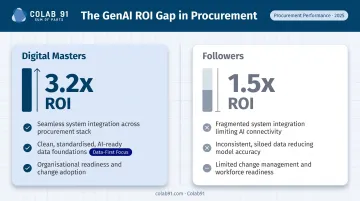
Those use cases explain why the ROI gap is so stark. Deloitte's 2025 CPO Survey found that Digital Masters achieved 3.2x returns on GenAI investments, versus slightly above 1.5x for followers. The difference wasn't technology - it was integration, clean data, and organizational readiness. For CPOs without those foundations, AI deployment will disappoint.
Priority 3: ESG as a Competitive Advantage
ESG ranked as the number-two enterprise priority in Deloitte's 2023 Global CPO Survey - well past compliance, and climbing. According to SBTi, supply chain emissions average 11x a company's direct Scope 1 emissions and represent more than 70% of a company's total environmental footprint. That means the CPO, not the sustainability team, controls the largest lever in any credible ESG strategy.
The business case is equally clear. McKinsey research indicates strong ESG credentials in procurement can drive cost reductions of 5% to 10% through operational efficiency and waste elimination. CDP estimates environmental supply chain risks could cost companies $120 billion by 2026 if left unmanaged.
CPOs who treat supplier selection as an ESG decision - not just a cost decision - build supply bases that improve brand value, attract better supplier terms, and reduce regulatory exposure simultaneously.
Priority 4: Procurement as a Revenue Driver
The framing of procurement as a cost center is a choice, not a fact. Leading CPOs have moved beyond it.
McKinsey research found that procurement leaders carry EBITDA margins at least 5 percentage points higher than laggards. Deloitte's 2025 data shows Digital Masters outperform peers on innovation enablement at 56% vs. 24% - a gap that compounds over time as supplier-led capabilities translate into product differentiation and faster time-to-market.
The mechanisms are concrete:
- Supplier-led innovation embedded in product development pipelines
- Contract structures optimized to free working capital for growth investment
- Accelerated time-to-market through supply chain efficiency
CPOs who operate across all four of these dimensions don't just manage spend - they shape the conditions under which the business competes. That shift in scope is what separates the modern CPO agenda from traditional procurement's narrower mandate.
Building the CPO-CFO Partnership for Strategic Alignment
The CFO controls capital allocation and sets the benchmarks that every other C-suite function gets measured against. A CPO who can't communicate in financial terms - cash flow, gross margin impact, working capital, balance sheet risk - will always be managed as a cost center, regardless of what they're actually delivering.
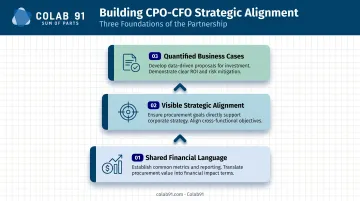
Three foundations make the CPO-CFO relationship work:
Shared financial language: CPOs must be as fluent in CFO-relevant metrics as they are in procurement KPIs. That means presenting procurement initiatives in terms of working capital improvement, EBITDA contribution, and risk-adjusted return.
Visible strategic alignment: Procurement priorities need to map explicitly to the CFO's financial agenda for the period. If the CFO is focused on margin improvement, procurement's story should lead with how supplier strategy contributes to that goal.
Quantified business cases: Every proposal needs a clear, defensible business case built from clean, integrated procurement data. Vague savings estimates erode credibility with finance; precise, sourced numbers build it.
The gap remains wide. The 2025 ProcureCon CPO Report found only 42% of CPOs are currently aligning procurement goals with company objectives - meaning most procurement functions still lack the organizational weight to influence strategic decisions.
CPOs should push for inclusion in budgeting and strategy cycles from the start, before requirements are finalized. Getting in early means procurement shapes priorities rather than just executing them.
From Savings to Value: New Metrics for Strategic Procurement Leaders
Cost savings rates and spend under management still matter. They're no longer sufficient on their own.
Enterprise Value Contribution - defined as procurement's measurable impact on resilience, innovation capacity, and long-term growth - is the performance standard C-suite audiences now demand.
Three KPI categories now defining procurement's strategic value:
| Metric Category | What It Measures |
|---|---|
| Supply Chain Resilience Scorecards | Supplier diversification, recovery capability, single-source exposure |
| Innovation Pipeline Contribution | Supplier-sourced ideas, new capabilities, speed-to-market improvements |
| ESG and Social Impact Metrics | Scope 3 emissions reduction, supplier diversity spend, sustainability compliance |
Managing these metrics requires more than spreadsheets. CPOs need integrated platforms that capture supplier performance data, surface emerging risks in real time, and generate board-ready outputs automatically. The technology investment doubles as a credibility investment - showing the CFO and board that procurement operates with the same rigor as any other enterprise function.
Closing the Procurement Capability Gap: Talent, Technology, and Offshore Models
The Talent Problem Is Structural
Even CPOs with clear strategic vision run into a hard constraint: their teams can't always execute at the level the strategy demands.
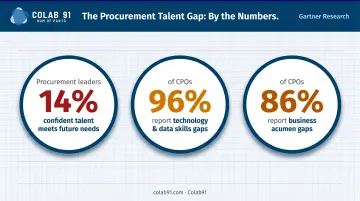
Gartner's data makes this stark. Only 14% of procurement leaders are confident their talent can meet future functional needs. 96% report technology and data skills gaps. 86% report business acumen gaps. These aren't marginal shortfalls - they represent a fundamental mismatch between the skills that exist in most procurement organizations and the skills the strategic CPO agenda requires.
The shift toward data-driven decision-making means procurement professionals need analytical and digital capabilities that traditional procurement career paths never developed. Upskilling existing teams takes time. Hiring senior specialists in-house is expensive and competitive.
The Offshore Capability Model as a Strategic Option
For mid-market and PE-backed companies that can't build a fully staffed in-house procurement function overnight, offshore capability centers offer a practical path to specialized domain expertise:
- Spend analytics and savings identification
- Strategic sourcing and category management
- Supplier risk monitoring
All without the cost structure of permanent senior headcount.
This is exactly the model Colab91 has been built around. The firm establishes dedicated India-based teams of domain experts in procurement and analytics for mid-market and PE-backed companies, with a leadership team that previously scaled Impendi's India operations to 100+ practitioners serving firms including Carlyle Group, TPG, Elliott, and BC Partners. Colab91's AI-powered suite (spend analytics, savings opportunity assessment, and supplier risk management) provides the intelligence layer that enables those teams to operate at a strategic level from day one.
The distinction matters: this isn't staff augmentation or BPO outsourcing. The offshore team functions as an integrated extension of the client's in-house procurement function, with the strategic control, IP ownership, and cultural alignment that wholesale outsourcing typically sacrifices.
The Sum of Parts Principle
That distinction - integrated extension versus outsourced vendor - is what separates transactional offshoring from a genuine capability play. The highest-performing procurement organizations blend in-house institutional knowledge with external domain specialists who fill specific gaps. That hybrid model preserves strategic control while expanding execution capacity.
For mid-market companies, this is often the most cost-effective path to a procurement function capable of operating at the strategic level. Colab91's "Sum of Parts" approach is built for exactly this: augmenting in-house leadership with offshore domain expertise in the areas that matter most, scaled to the client's size and complexity.
From Strategy to Execution: A Practical Roadmap for CPOs
Three actions CPOs should prioritize immediately:
Secure early involvement - Push for procurement's inclusion in annual strategy and budgeting cycles before purchasing requirements are defined. Late involvement is the single biggest structural barrier to proactive risk management and strategic contribution.
Invest in AI and clean data foundations - Start with high-impact automation in invoice processing and contract management. Prioritize data quality before layering in sophisticated analytics. Without clean data, AI tools generate noise rather than intelligence.
Reframe the procurement narrative internally - Stop presenting in savings percentages. Start framing procurement's contribution in terms of risk-adjusted business value, innovation pipeline input, and growth enablement. The language you use shapes how the C-suite perceives the function.
C-suite influence is earned through a track record of delivering on commitments, aligning with corporate priorities, and surfacing procurement intelligence that enables better decisions. CPOs who build that track record become indispensable to leadership - not just as cost managers, but as genuine business partners.
The organizations that outperform over the next decade are those that treated procurement as a growth engine early. For mid-market and PE-backed companies, building an analytics-driven procurement capability is one of the highest-ROI decisions available to leadership today. That capability can be built in-house, through an offshore model like the dedicated India teams Colab91 deploys, or through a hybrid combining both - depending on the organization's scale and strategic priorities.
Frequently Asked Questions
What are the 5 pillars of procurement?
The five widely cited pillars are strategic sourcing, supplier relationship management, procurement operations (procure-to-pay), risk and compliance management, and performance analytics. Modern CPOs must operate all five at a strategic level, moving well beyond transactional efficiency, to drive enterprise value.
How is the CPO role different from traditional procurement management?
Traditional procurement management focused on transactional efficiency, contract compliance, and cost savings. The CPO's mandate now spans enterprise value creation, C-suite influence, ESG governance, innovation sourcing, and risk management. That breadth demands a fundamentally different skill set and executive orientation.
What metrics should a CPO use to demonstrate strategic value to the C-suite?
Cost savings alone no longer make the case. CFOs and boards respond to metrics like supply chain resilience scores, Scope 3 emissions reduction, working capital improvement, and EBITDA impact - measures that tie procurement directly to enterprise performance.
How can mid-market companies build a strong procurement function without Fortune 100 budgets?
A hybrid model works best: invest in core in-house leadership, then use offshore capability centers for specialist functions like spend analytics, strategic sourcing, and category management. Prioritize technology tools that deliver data visibility without heavy IT infrastructure investment.
What is the CPO's role in ESG and sustainability strategy?
Since more than 70% of a company's environmental footprint flows through its supply base, the CPO is a primary ESG actor. That means owning supplier selection criteria, Scope 3 tracking, supplier diversity programs, and ensuring procurement practices align with stated corporate ESG commitments.
How does AI change the CPO's strategic role?
AI enables real-time spend visibility, predictive supplier risk alerts, automated contract compliance, and data-driven sourcing decisions. The result: CPO bandwidth shifts from data gathering to strategic work.