
The real challenge isn't deciding whether to hire in India - most companies have already made that decision. The challenge is knowing how to structure, source, and integrate a team that functions as a strategic asset rather than cheaper headcount. Get the structure right and you have a capability center that delivers measurable ROI within months. Get it wrong and you're managing a disconnected team with unclear accountability and high early turnover.
This guide walks through the exact steps: defining your operating model, sourcing and onboarding talent, establishing legal structure, and building the governance that keeps the team high-performing long-term.
Key Takeaways
- A dedicated India team is a long-term, integrated offshore team - not project outsourcing or a freelance arrangement
- India's cost advantage is substantial: US data analysts earn $72K–$122K annually; their India counterparts earn roughly ₹4.35L–₹10.7L (~$5K–$13K)
- Define your operating model before sourcing talent - this is the most common skipped step and the most common failure point
- Legal structure, onboarding quality, and performance governance are just as critical as finding the right candidates
- Companies that treat the India team as a strategic extension of HQ see faster ROI and stronger retention than those that treat it as a cost center
What Is a Dedicated Team Model?
A dedicated team is a group of professionals hired exclusively to work for your organization on an ongoing basis. They operate as an integrated extension of your in-house team - not as project contractors, not as vendor staff.
Three other hiring models are often confused with this one:
| Model | Who controls scope? | Continuity | Institutional knowledge |
|---|---|---|---|
| Freelancers | Freelancer | Task-by-task | None |
| Staff augmentation | Client (short-term) | Project duration | Limited |
| Traditional outsourcing | Vendor | SLA-based | Vendor-owned |
| Dedicated team | Client | Ongoing | Builds with the client |
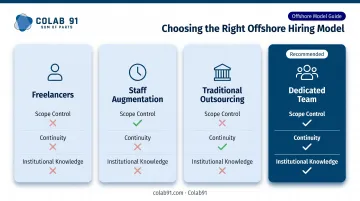
The key distinction: in a dedicated team model, you retain strategic direction, team ownership, and the institutional knowledge your team accumulates over time.
Dedicated teams in India today extend well beyond software development. According to the EY GCC Pulse Survey 2024, Global Capability Centers are expanding into knowledge-intensive services including risk, marketing, legal delivery, and customer interaction. For mid-market companies, this means procurement analytics, spend management, and finance operations are increasingly viable domains for India-based dedicated teams.
Why Hire a Dedicated Team in India?
The Scale of India's Talent Market
India hosted over 1,700 GCCs generating $64.6 billion in revenue and employing 1.9 million professionals in FY2024, according to the NASSCOM/Zinnov India GCC Landscape Report. That number is projected to exceed $100 billion by 2030.
For mid-market and PE-backed companies specifically, this matters because the infrastructure - talent supply, legal frameworks, and managed service providers - is mature. The market is well-established, and the playbook for building India teams is proven.
The Cost Advantage (With Real Numbers)
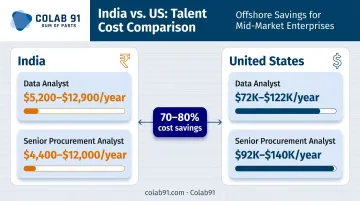
India's cost advantage is frequently cited but rarely quantified. Here's what the data actually shows for two common roles:
Data Analyst:
- India: ~$5,200–$12,900/year (INR 435K–1.07M)
- US: $72K–$122K total pay per year
Senior Procurement Analyst:
- India: ~$4,400–$12,000/year (INR 369K–1.0M)
- US: $92K–$140K total pay per year
At current exchange rates, even senior Indian professionals in these roles cost 70–80% less than their US equivalents - before factoring in US employer-side costs like benefits and payroll taxes, which widen the gap further.
Three Non-Cost Advantages Worth Noting
Cost savings are the entry point. These three factors are what sustain the ROI over time:
- Graduate output: India produced over 1.07 crore graduates in 2021–22, per the Ministry of Education's AISHE report, sustaining a deep and consistent pipeline across technical and non-technical disciplines
- Western business compatibility: Indian professionals in GCC environments are typically accustomed to US business norms, structured communication, and outcome-oriented reporting, especially in hubs like Gurugram, Bengaluru, and Hyderabad
- Time zone overlap: India's morning (8–11 AM IST) aligns with the US afternoon, creating a reliable daily overlap window for real-time collaboration. IST has no daylight saving shifts, so the schedule stays consistent year-round
How to Build a Dedicated Team in India: Step-by-Step
The sequence matters. Companies that jump straight to job postings without first designing their operating model consistently struggle with misaligned hires and unclear accountability. Follow these steps in order.
Step 1: Define Your Operating Model and Scope
Before hiring a single person, answer these questions:
- Which functions does the India team own versus support?
- Which decisions stay onshore, and which move offshore?
- How does this team interact with your existing organization day-to-day?
- What does success look like in 6 months? In 18 months?
This is not an HR exercise. It's a strategic design decision that determines everything from team size to seniority levels to reporting lines. Companies that skip it almost always course-correct later - at significantly higher cost.
For companies building teams in complex domains - procurement analytics, spend data, or finance operations - this design step benefits from a partner who brings domain expertise alongside talent placement experience. Colab91's "Sum of Parts" approach does exactly this: pairing offshore domain experts with your in-house team rather than filling headcount slots.
Step 2: Map Roles, Functions, and Team Structure
Translate your operating model into a concrete team blueprint:
- List the specific roles needed (job titles, seniority levels, required domain experience)
- Decide whether the team will be flat or have a team lead structure
- Define how success will be measured for each function
This step often reveals that the right India team is multifunctional. A 5-person team might span a procurement analyst, a data analyst, an ops coordinator, and a reporting lead - not five versions of the same role. Colab91's leadership scaled exactly this kind of structure to 100+ practitioners at Impendi, serving clients including Carlyle Group, TPG, and BC Partners. It never started as a single-function hire.
Step 3: Source, Screen, and Select the Right Talent
Sourcing channels vary significantly by role type:
- Technology roles: Broader supply across job portals (Naukri, LinkedIn) and freelance networks
- Procurement and analytics specialists: Require targeted sourcing through referral networks and specialist recruitment partners - most qualified candidates in this space aren't actively job hunting
A practical screening process for strategic roles:
- Skills assessment or case-based evaluation tailored to the function (not generic aptitude tests)
- Behavioral interview focused on communication clarity and cultural fit with Western business norms
- Reference checks from prior employers - particularly for senior or client-facing roles
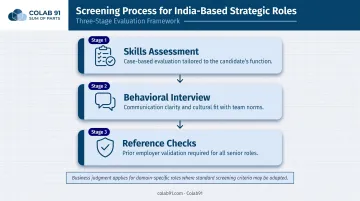
For domain-specific roles like procurement or spend analytics, problem-solving approach and business judgment matter as much as technical credentials.
Step 4: Establish Legal Structure, Contracts, and Compliance
Three main structures for hiring in India:
| Structure | Speed | Control | Cost | Best for |
|---|---|---|---|---|
| Local entity (Pvt. Ltd.) | Slow (months) | Full | High upfront | Long-term, 10+ person teams |
| Employer of Record (EOR) | Fast (days to weeks) | Moderate | Ongoing fee | Early-stage or smaller teams |
| Managed capability center / BOT | Medium | Grows over time | Variable | Companies wanting to transition ownership later |
Non-negotiable contract elements regardless of structure:
- NDAs and IP assignment clauses
- Clearly defined scope and deliverables
- Compensation and benefits aligned to Indian market norms
- Exit and termination provisions compliant with Indian labor law
Misclassification risk is real in India - courts may reclassify contractors as employees if direct supervision or other employment indicators are present. Consult an India-based legal advisor before finalizing your entity and employment structure.
Step 5: Onboard, Integrate, and Set Up for Success
Onboarding a dedicated India team requires more structure than a hire in your home market. Poor onboarding is the leading cause of early attrition and performance gaps. Treat the first 90 days as a structured project with clear milestones.
30-60-90 day integration framework:
- Week 1: Tools access, system setup, introductions to onshore counterparts
- Weeks 2–4: Shadowing or parallel workflows alongside onshore team members
- Month 2: Independent execution with daily check-ins and real-time feedback
- Month 3: KPI review, formal feedback cycle, and calibration against expected outcomes
The onshore team must invest real time during this phase - this is not a "set and forget" handoff. The first 90 days carry the highest risk for team cohesion. How much you invest here directly determines how quickly the team reaches full productivity.
Key Factors That Determine Long-Term Success
Getting your India team up and running is one challenge. Sustaining performance over months and years is another. These three factors consistently separate teams that deliver long-term value from those that plateau or churn.
Performance Governance
Set KPIs aligned to business outcomes - not task completion metrics - from day one. The difference matters:
- Task metric: "Processed 150 supplier invoices this week"
- Outcome metric: "Reduced supplier payment cycle from 32 days to 18 days"
Hold structured review cadences monthly or quarterly where the India team's output is evaluated against outcomes, not activity levels.
Communication Infrastructure
India-based teams need deliberate communication protocols:
- A defined 2–3 hour daily overlap window for collaboration
- Async documentation discipline (written summaries after calls, shared project logs)
- A single escalation path to onshore leadership - ambiguity here creates bottlenecks fast
Talent Retention
India's job market is competitive, particularly for experienced professionals in Gurugram and other Tier-1 GCC hubs. EY's 2024 GCC Pulse Survey reports average GCC attrition at 11.16% - down from 12.6% the prior year, but still a meaningful cost if your team churns early.
Effective retention levers:
- Benchmark compensation to current local market rates (GCC salary increases are projected at 9.3% in 2026, per Aon)
- Build clear career progression paths within the India team
- Include India team members in company culture and decision-making, not just delivery workflows
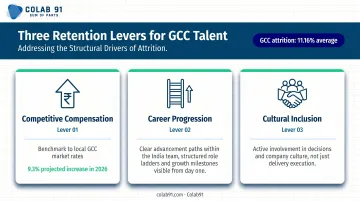
Teams treated as strategic contributors retain better than those treated as interchangeable labor pools. The EY data bears this out: the GCC organizations with the lowest attrition tend to be those where India teams own outcomes, not just tasks.
Common Mistakes to Avoid
Three patterns consistently derail otherwise well-resourced offshore engagements:
Defining the team by cost, not capability. When the India team's purpose centers on "doing things cheaper," it attracts the wrong talent and creates misaligned incentives. The strategic value a dedicated team can deliver gets left on the table. Define the team by what it will own, not what it will save.
Hiring before the operating model is ready. Starting recruitment before defining scope, reporting lines, and success metrics leads to role confusion, overlapping responsibilities with the onshore team, and early attrition. This is especially common under timeline pressure from PE sponsors - and entirely preventable.
Treating onboarding as optional. Companies that treat the India team as external vendors rather than internal team members see communication gaps, low ownership, and high early turnover. The first 90 days set the trajectory. Companies that invest here recover it quickly; those that skip it spend months correcting problems that were preventable.
Frequently Asked Questions
What does a shared services team do?
A shared services team centralizes one or more business functions - such as finance, HR, procurement, or analytics - to serve multiple parts of an organization from a single hub. The goal is consistency, reduced redundancy, and lower operational cost across the business.
What is an example of a shared service in an India offshore team?
A centralized procurement analytics function in India that supports multiple business units or PE portfolio companies with spend data, supplier analysis, and reporting is a common example - one specialized hub serving several internal clients simultaneously.
What departments use shared services or dedicated offshore teams?
While IT and software development remain the most common, functions like procurement, finance operations, data analytics, HR operations, customer support, and research are increasingly common in India-based dedicated teams - particularly for mid-market and PE-backed businesses.
What is the difference between a dedicated team and traditional outsourcing?
In traditional outsourcing, the vendor manages the team and owns the scope. In a dedicated team model, the client retains strategic direction, team visibility, and direct ownership - the team works exclusively for them, aligned to client priorities rather than a vendor's delivery targets.
How long does it take to hire and operationalize a dedicated team in India?
Basic hiring can happen within 4–8 weeks, but a fully integrated, high-performing team typically takes 3–6 months to reach operational maturity. The timeline depends on role complexity, how clearly the operating model was defined upfront, and the quality of onboarding.
How do I manage a dedicated India team across time zones?
Establish a 2–3 hour daily overlap window, maintain async documentation discipline, run weekly check-ins, and designate a clear onshore point of contact. India's IST runs 9.5 hours ahead of US Eastern, making India's morning hours workable for US afternoon collaboration.