Introduction
Most US companies building India-based teams invest heavily in technical vetting - skills assessments, portfolio reviews, trial projects. The cultural side gets a fraction of that attention. That's where offshore engagements most commonly break down.
The symptoms are consistent: team members wait to be told what to do rather than flagging problems early; feedback loops produce polite agreement instead of honest status; high performers leave within 18 months. None of these failures show up in a technical interview.
Research on offshore software delivery consistently identifies cultural differences - not capability gaps - as the root cause of missed deadlines and delivery breakdowns. A 2008 AMCIS study on offshore IT projects found that technically capable teams still underperformed when escalation norms, risk communication, and decision rights weren't explicitly established.
That's the gap this guide addresses. It's written specifically for US companies building India-based capability centers - covering which cultural dimensions matter, how to screen for fit during hiring, how to onboard effectively, and how to sustain alignment as the team scales.
Key Takeaways
- Cultural misalignment - not technical gaps - is the leading cause of offshore team underperformance and attrition
- India's higher power distance (77 vs. 40 for the US on Hofstede's scale) directly shapes how teams escalate, disagree, and commit
- Cultural integration starts during hiring, not onboarding - screen for ownership behaviors, not just credentials
- US managers need cross-cultural preparation too - offshore alignment is a bilateral responsibility
- Cultural alignment dilutes as teams scale; deliberate governance keeps it intact
Why Cultural Alignment Determines Offshore Team Success
There's a meaningful difference between an offshore vendor relationship and a true capability center. In a vendor model, cultural differences are tolerated because the engagement is transactional: work is scoped, delivered, invoiced. In a capability center model, the team functions as an integrated extension of the business. Cultural misalignment in that context isn't a friction point - it's an operational breakdown.
Colab91's approach is explicitly the latter. The firm helps mid-market and PE-backed companies build India teams that serve as strategic hubs - not order-taking arms - for global operations. That distinction changes everything about how cultural alignment needs to be managed.
The Problem of Cultural Drift
Cultural drift is what happens when an offshore team gradually disconnects from organizational values without anyone noticing until the damage is visible. It doesn't happen from a single bad hire or a missed onboarding step. It accumulates.
The concrete symptoms:
- Team members stop raising problems until they become crises
- Status updates become optimistic rather than accurate
- High performers - the ones with other options - start leaving
- The team defaults to execution mode, waiting for direction instead of bringing ideas
This drift accelerates when there's no deliberate cultural framework. The team fills the vacuum with whatever norms feel safest, which in a high-power-distance culture often means deference and compliance over proactive ownership.
The Business Case for Getting This Right
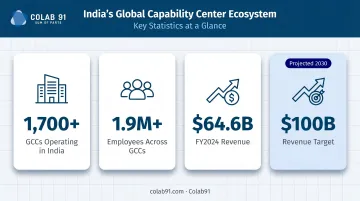
India has a large, highly educated workforce, strong English proficiency, and deep domain expertise across technology, analytics, and professional services. According to NASSCOM's India GCC Landscape Report, the ecosystem now includes:
- 1,700+ Global Capability Centers
- 1.9 million+ employees
- $64.6 billion in FY2024 revenue, with projections reaching $100 billion by 2030
The opportunity is real. But the cultural gap with US work norms is also real, and glossing over it doesn't make it go away. Companies that invest in cultural alignment frameworks early - during hiring, onboarding, and ongoing management - report better retention, stronger ownership behaviors, and faster ramp-up times. The payoff shows up in productivity, retention, and how quickly new teams reach full operating velocity.
Key India-Specific Cultural Dimensions US Companies Must Understand
Understanding these dimensions doesn't mean stereotyping individuals - it means building systems that work with how professional culture actually operates, rather than assuming US defaults apply everywhere.
Hierarchy and Authority Structures
India scores 77 on Hofstede's Power Distance index versus 40 for the US. In practice, this means Indian professionals may be reluctant to challenge a manager's decision openly, raise problems upward without being explicitly invited to, or voice dissent in group settings.
For US companies accustomed to flat structures and open debate, this creates a specific failure mode: silence gets misread as agreement. The meeting ends with apparent alignment. The deadline gets missed.
What to do differently:
- Use 1:1 check-ins as the primary feedback channel - they're safer for surfacing real concerns
- Explicitly invite input ("What risks are you seeing that we haven't discussed?")
- Frame disagreement as valued, not disrespectful - name it out loud as a norm
Indirect Communication Norms
US professionals tend toward direct, explicit communication. Indian professionals - particularly when delivering bad news or pushback - often communicate more indirectly. A "yes" in a meeting frequently means "I heard you," not "I agree and will execute."
The fix isn't to demand US-style directness. It's to build practices that surface real status:
- Send written pre-meeting status updates so issues surface before the call
- Ask explicit "what are the blockers?" questions rather than waiting for volunteers
- Confirm commitments in writing after discussions to close the loop
Relationship-First Work Culture
Business relationships in India are built on personal trust and rapport, not just professional credentials. Team members who feel genuinely known by their US counterparts - not just managed at arm's length - are consistently more engaged and less likely to leave.
US managers need to invest time in relationship-building, not just task-tracking. A five-minute conversation about someone's weekend before a project check-in pays dividends in trust - and trust is what keeps strong performers from walking out the door.
Growth Orientation and Learning Culture
India's talent market is intensely competitive. High performers are strongly motivated by career development, skill growth, and organizational visibility. 72% of GCC leaders identified talent management as a key priority in KPMG/NASSCOM's 2024 survey - and difficulty retaining digital talent was a consistent theme.
US companies that treat their India teams as execution arms without career pathing will lose their best people. Build in structured growth: clear promotion timelines, exposure to client-facing work, and skill development tied to business goals. That's what keeps top performers from being recruited away.
Festival Calendar and Work-Life Context
India has a rich and geographically varied holiday calendar: Diwali, Holi, Dussehra, Eid, regional state holidays, and more. Beyond holidays, joint family obligations and community commitments shape how team members think about availability.
Proactively mapping these into planning cycles - rather than treating them as scheduling conflicts - signals respect and reduces friction. Build the India holiday calendar into your project planning from the start.
Hiring for Cultural Fit When Building Your India Team
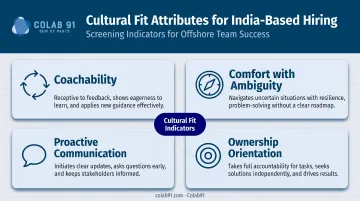
Cultural fit in the offshore context doesn't mean finding someone who mirrors US corporate culture exactly. That's neither realistic nor desirable. It means finding candidates who demonstrate:
- Coachability - can take feedback and adjust without taking it personally
- Comfort with ambiguity - can operate without a detailed playbook
- Proactive communication - flags problems before they become crises
- Ownership orientation - treats outcomes as theirs, not just tasks assigned to them
Structuring Interviews to Test for These Behaviors
Beyond technical assessments, include scenario-based questions that reveal how a candidate actually operates:
- "Tell me about a time you disagreed with a manager's direction. What did you do?"
- "Describe a situation where you had unclear requirements. How did you handle it?"
- "Have you ever flagged a project risk before it became a problem? Walk me through what happened."
Structured behavioral questions - asking for past evidence rather than hypothetical responses - outperform unstructured interviews in predicting job performance. Past behavior reveals operating style in ways that hypotheticals rarely do.
The Two-Way Fit Problem
Cultural fit hiring also means avoiding mismatches that look good on paper. A candidate with an impressive CV who thrives in heavily supervised, process-driven environments may struggle in a model that requires initiative and autonomous judgment. Screening for technical skills without screening for operating style creates this mismatch.
The operating style signals worth watching for during screening:
- Asks clarifying questions rather than waiting for complete instructions
- References past examples of self-directed problem-solving
- Describes disagreements with managers in terms of outcomes, not grievances
- Shows awareness of how their work connects to broader team or business goals
Building these screening frameworks from scratch takes time most hiring managers don't have. Colab91's leadership team developed and stress-tested this approach while scaling Impendi's India operations to 100+ practitioners - iterating on the model across functions and seniority levels before the process was handed to clients. That institutional knowledge is what compresses the learning curve for companies building their first India team.
Cultural Onboarding: Integrating Your India Team from Day One
The first 30–90 days are disproportionately important. This is when habits form, communication patterns solidify, and team trust either takes root or doesn't.
A 2024 HBR analysis of Microsoft's hybrid onboarding model found that new hires with strong onboarding support were 3–4x more likely to contribute to team success in the first 90 days and 5–7x more likely to be satisfied. Yet SHRM data shows only 12% of employees say their organization does onboarding well.
What Culture-First Onboarding Actually Looks Like
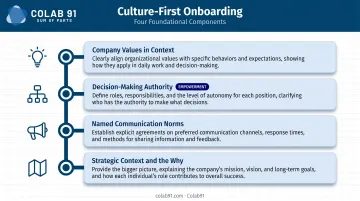
Most companies front-load onboarding with IT access, org charts, and tool walkthroughs. That covers the basics - it doesn't cover culture. A culture-first onboarding layer includes:
- Explicit discussion of company values with real examples - not just slides, but stories about how decisions were actually made
- Clarity on decision-making authority - what can the team decide autonomously, what requires escalation?
- Named communication norms - "escalate early, don't solve silently" needs to be stated out loud, not implied
- The 'why behind the what' - offshore team members who understand strategic context make better autonomous decisions; those who only understand workflows become order-takers
The Onshore Buddy Model
Offshore team members ramp up faster when paired with an onshore counterpart who is genuinely invested in their success. This relationship works when the buddy:
- Holds regular touchpoints (weekly for the first 60 days, at minimum)
- Explicitly invites "naive" questions - normalizes not knowing
- Explains informal norms that aren't written anywhere: how the leadership team actually prefers to receive bad news, what "ownership" looks like in practice, which communication channels are formal vs. informal
Shared Rituals That Build Inclusion
Team-wide standups, virtual all-hands, shared Slack channels for non-work conversation, and inclusion in strategic planning sessions all signal to the India team that they are part of the company - not contractors on the periphery. These rituals build on each other over time. They're what prevents the "us vs. them" dynamic that gradually erodes team performance.
Training Your US-Side Team for Cross-Cultural Collaboration
Cultural alignment is bidirectional. The India team must learn the US company's values and ways of working. At the same time, US managers and colleagues must learn how to lead across cultural differences. Most offshore failures involve both parties being underprepared - not just the offshore team.
A 2021 meta-analysis of 37 studies and 7,040 trainees found that cross-cultural training had a meaningful positive effect on adjustment and measurable positive effects on job performance and cultural intelligence. Train US managers before the India team scales, not after the first friction points emerge.
What This Training Should Cover
- Hierarchy dynamics - how to create safe channels for upward communication
- Feedback delivery - giving feedback in ways that land constructively, not as personal criticism
- Meeting facilitation - time zone fairness, agenda distributed in advance, explicit invitation to speak (don't wait for India team members to volunteer opinions in group settings)
- Interpreting silence - silence is not agreement; ask direct, specific questions rather than waiting for volunteers
Build High-Frequency Feedback Loops
US managers often default to quarterly reviews or project retrospectives as their primary feedback mechanism with offshore teams - and that cadence is too slow. Gallup research shows employees are significantly more engaged when they receive manager feedback multiple times per week.
For cross-cultural contexts - where team members may not proactively raise issues - weekly or biweekly 1:1s are the baseline cadence that actually works.
The goal isn't surveillance. It's creating enough low-stakes contact that real problems surface before they compound.
Sustaining Cultural Alignment as Your Team Scales
A five-person India team has a tight cultural surface area. A 30- or 50-person team does not. As headcount grows, cultural norms dilute, new hires arrive without adequate integration, and functional silos develop their own subcultures. The team that felt cohesive at 10 people can feel fragmented at 40.
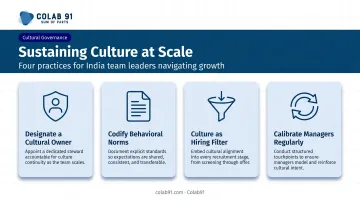
What Cultural Governance at Scale Looks Like
- Designate a cultural owner - someone accountable for cultural integration, not just HR compliance
- Codify behavioral norms explicitly - what does "ownership" look like in practice? What does "escalate early" actually mean in your operating context?
- Make culture a filter at every hiring stage - team leads who role-model values, peer interviews that test for alignment, a clear behavioral definition of what "great" looks like
- Calibrate managers regularly - US and India-side leads should discuss cultural integration explicitly, not just project delivery metrics
In-Person Touchpoints Have Outsized Impact
No volume of video calls fully replicates what happens when US leadership visits the India office, or when India team members spend time at US headquarters. These visits build trust and goodwill that carries through months of remote collaboration.
Treat in-person touchpoints as a strategic investment. A practical baseline by stage:
- Under 20 people: at least one US leadership visit per year
- 20–50 people: increase visit frequency; consider reciprocal India-to-US travel
- 50+ people: formalize a recurring calendar - visits become a cultural anchor, not a discretionary expense
Culture as a Hiring Filter
As the India team scales, the values team leads carry become the default standard for every new hire. Team leads - not just US leadership - are the primary carriers of organizational culture. That makes how you select and develop them a cultural decision, not just a talent one:
- Select team leads partly on cultural modeling, not just technical seniority
- Include culture-transmission explicitly in team lead role expectations
- Ensure new hires experience cultural integration from week one, not just tool onboarding
Frequently Asked Questions
How do you manage cultural differences in global teams?
Both sides need to learn - not just the offshore team. Start with bidirectional cultural education, then build from there:
- Set explicit communication norms (escalation paths, how feedback is delivered)
- Run structured feedback loops at regular cadences
- Treat cultural alignment as an ongoing process, not a one-time onboarding task
What are the key considerations when offshoring beyond cost savings?
Beyond cost and talent access, the factors that determine whether offshoring actually works include:
- Cultural alignment and communication infrastructure
- Time zone management and operational overlap
- Legal, compliance, and entity setup
- Organizational investment to integrate the team as a genuine extension of the business
Underestimating any of these converts a capability center into an expensive vendor relationship.
What are the most significant cultural differences between US and Indian work environments?
The four most practically significant differences:
- Hierarchy: India's Power Distance score is nearly double the US - authority shapes how decisions and disagreements surface
- Communication style: Indirect, especially around bad news or pushback
- Trust-building: Relationship-first before task execution
- Career priorities: High-performing talent places strong value on learning and development opportunities
How long does it take for an offshore India team to fully align with a US company's culture?
Meaningful alignment typically takes 3–6 months with intentional onboarding and regular touchpoints. But cultural alignment is never "done" - it requires ongoing investment, especially as the team grows and new members join without the original context.
Do US managers need cross-cultural training to work with India-based teams?
Yes. US managers who haven't worked with India-based teams often misread silence as agreement, underestimate hierarchy dynamics, and give feedback in ways that don't land effectively. Cross-cultural management training improves outcomes and reduces attrition on both sides of the engagement.
How do you maintain offshore team culture as it scales from a small pilot to a larger team?
Scaling culture requires deliberate structure, not assumption:
- Designate a cultural owner who holds accountability for team norms
- Codify the behaviors that define your culture and make them an explicit hiring filter
- Invest in in-person touchpoints as headcount grows
- Ensure team leads model the values you want - not just manage delivery metrics