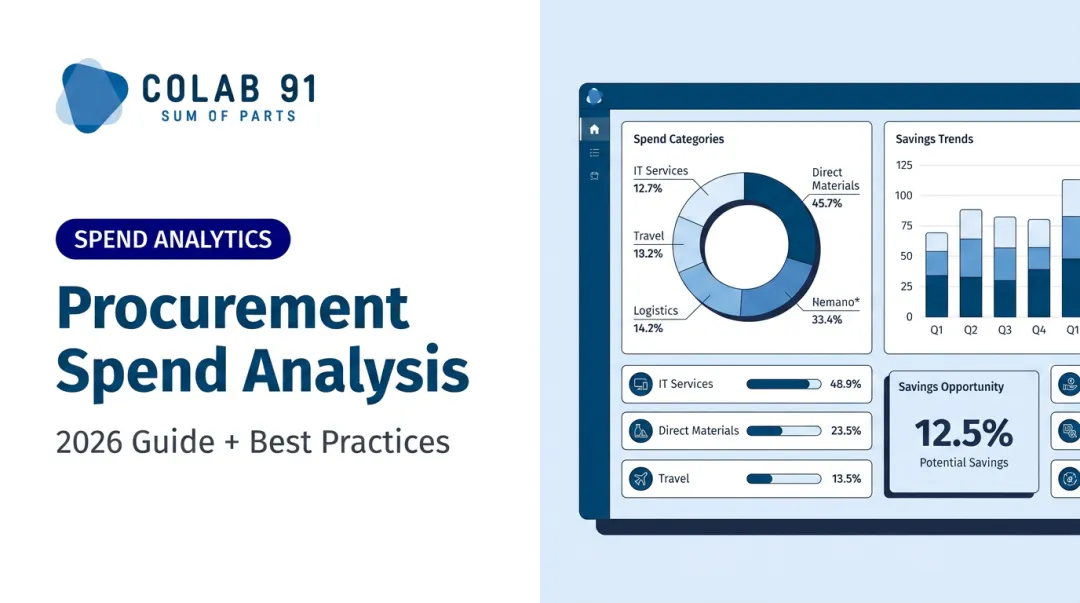

Spend analysis changes that equation. It's what turns fragmented purchasing data into cost optimization, supplier risk visibility, and — critically — production continuity when raw material markets swing. According to McKinsey, supplier spend commonly represents 40%-80% of a company's total cost, and manufacturers typically sit at the higher end given how much of their cost base is tied to direct materials and components.
This guide reviews the top platforms built for manufacturing spend in 2026, and why the software is only half the answer.
Key Takeaways
- Spend analysis classifies direct, MRO, and indirect spend to reveal savings and supplier risk
- Manufacturers face harder classification challenges due to multi-plant ERPs and deep supplier tiers
- SAP Ariba, Coupa, GEP SMART, JAGGAER, and Ivalua each serve different manufacturing profiles
- Choose tools based on ERP fit, direct-spend depth, and implementation bandwidth, not brand name
- A platform only pays off with a team dedicated to running it continuously
Overview of Spend Analysis in the Manufacturing Industry
For a manufacturer, spend analysis means collecting and classifying purchasing data across four distinct buckets:
- Direct materials and BOM spend: raw materials, components, packaging
- MRO: maintenance, repair, and operating supplies keeping plants running
- Capital equipment: machinery, tooling, and infrastructure investments
- Indirect categories: freight, contract labor, utilities, professional services

Manufacturers carry a much larger share of direct spend than sectors like professional services or retail, since raw materials and components often dominate the cost of goods sold. That's a big part of why the 40%-80% external-spend range referenced above skews toward the top end for industrial companies.
Add multiple ERPs across plants, regional purchasing autonomy, and thousands of tail-spend suppliers, and you get a data environment that's genuinely harder to classify than in most other industries. That's exactly why choosing the right spend analytics platform matters more here than it does almost anywhere else: a poor fit means months of manual reclassification before you see a single insight.
Top Spend Analysis Tools for Manufacturing in 2026
Selection criteria for this list focused on manufacturing-relevant factors: ERP integration depth, direct-versus-indirect classification accuracy, multi-plant scalability, and documented industrial use cases — not marketing claims.
SAP Ariba Spend Analysis
Built on SAP HANA, Ariba's spend analysis module comes with native, deep integration into the SAP ERP landscapes that run a huge share of large manufacturing plants worldwide. It uses machine learning to enrich and classify spend by supplier, category, and business unit, often pulling in third-party data like Dun & Bradstreet for supplier profiles.
For manufacturers already standardized on SAP, this matters because plant-to-procurement data flows without heavy custom mapping. It also supports global sourcing policy enforcement and network-level supplier intelligence across regions, which matters when you're managing dozens of facilities on the same backbone.
| Factor | Details |
|---|---|
| Implementation Time | Full suite deployments generally run several months; scope and module count are the main drivers |
| Best Fit | Large, multi-plant manufacturers already running SAP ERP |
| Pricing | Premium to high-end enterprise pricing, contract- and configuration-dependent |
Coupa Spend Analysis
Coupa's spend intelligence layer unifies direct, indirect, and travel spend with anomaly detection and community benchmarking. Its AI-native platform draws on trillions of dollars in aggregated transaction data to flag pricing outliers and off-benchmark categories.
The strongest manufacturing proof point here is Jabil, a global manufacturing services company with more than 140,000 employees. Jabil used Coupa to run 50+ automated sourcing scenarios per event and saved roughly $13 million across three sourcing initiatives, cutting project cycle times by about a month each.
| Factor | Details |
|---|---|
| Implementation Time | 12-24 weeks for full suite, scope-dependent |
| Best Fit | Manufacturers pursuing broader procurement transformation, not just standalone analytics |
| Pricing | Premium to high-end pricing |
GEP SMART Spend Analysis
GEP SMART is available through the Microsoft Azure Marketplace, giving it Azure's underlying scalability and reliability for large data volumes. Its AI-driven spend analysis engine handles complex indirect and MRO categories that trip up simpler tools, and GEP promotes AI-supported forecasting and benchmarking capabilities relevant to raw material trend tracking.
It's well suited to manufacturing specifically because GEP built the platform with intricate, multi-tier supply chains in mind: the kind manufacturers deal with daily across hundreds of component suppliers.
| Factor | Details |
|---|---|
| Implementation Time | 14-22 weeks for full suite, scope-dependent |
| Best Fit | Manufacturers with complex indirect categories and multi-tier supplier networks |
| Pricing | Premium pricing |
JAGGAER Spend Analytics
JAGGAER's IntelliClass engine delivers 95%+ classification accuracy out of the box, built on Snowflake and Tableau within the JAGGAER One platform. It ships with 65+ prebuilt dashboards and nine AI spend classifiers, plus tail-spend consolidation and ESG compliance views baked in.
This makes it a strong fit for engineering-heavy and asset-intensive operations. The platform manages roughly $2.9 trillion in aggregated spend across its network, giving it broad classification training data even before you connect your own systems.
| Factor | Details |
|---|---|
| Implementation Time | 8-14 weeks |
| Best Fit | Multi-site manufacturers needing standardized analytics and shared-services models |
| Pricing | Moderate to premium pricing |
Ivalua Spend & Procurement Analytics
Ivalua's classification engine is highly configurable, with no-code rule setup and AI/ML confidence scoring rather than a rigid, fixed taxonomy. This flexibility helps teams surface consolidation and rationalization opportunities without waiting on vendor development cycles.
Its proven fit for asset-heavy manufacturing shows up in a published aerospace and defense customer case, where consolidated spend visibility across business units helped the team identify cost-reduction opportunities and optimize sourcing strategy.
| Factor | Details |
|---|---|
| Implementation Time | 6-12 weeks per module; 6-12 months for full platform customization |
| Best Fit | Manufacturers with complex, multi-business-unit procurement requiring deep customization |
| Pricing | Moderate to premium pricing |

How We Chose the Best Tools for Manufacturing
The evaluation weighted four manufacturing-relevant factors:
- ERP compatibility: how cleanly a tool pulls data from SAP, Oracle, or plant-level systems without heavy custom middleware
- Direct vs. indirect classification depth: whether the taxonomy handles raw materials and BOM spend as rigorously as indirect categories
- Multi-plant scalability: proven performance across dozens of facilities, not just a single headquarters deployment
- Documented industrial case studies: real outcomes, not generic AI claims
A common mistake we see: picking a tool based on brand recognition alone. A platform with a great logo but weak classification accuracy on direct materials will leave your biggest spend category unmapped.
Every factor above ties back to a business outcome — faster savings realization, less maverick spend on MRO and direct materials, and clearer supplier risk visibility across your supply chain.
Beyond the Software: Why Manufacturers Need the Talent to Act on Spend Insights
Here's the part vendors don't emphasize: even the best spend analysis platform only delivers value if someone is cleansing data, maintaining the taxonomy, and translating dashboards into actual negotiation actions. A dashboard showing 12% savings potential in MRO doesn't save a dollar until someone runs the sourcing event.
Many mid-market and PE-backed manufacturers don't have that bandwidth in-house. Analytics headcount gets cut during lean years, and the spend analysis tool that looked so promising at go-live sits half-used a year later.
This is where Colab91 operates. We build dedicated offshore procurement and analytics teams in India that run the platform day-to-day — regardless of which vendor you've chosen — covering:
- Cleanse data and maintain taxonomy (UNSPSC or client-specific)
- Build spend cubes and refresh them continuously
- Identify off-contract and tail spend
- Benchmark prices and support negotiations
- Report procurement KPIs weekly and monthly
Our leadership team scaled Impendi's India operations, later acquired by Accenture, to more than 100 practitioners serving PE sponsors including Carlyle Group, TPG, Elliott, and BC Partners.
That's the same playbook we now bring to mid-market and PE-backed manufacturers building offshore analytics capability, whether through a dedicated team, a build-operate-transfer arrangement, or full managed operations.
The software identifies the opportunity. A dedicated capability center makes sure someone actually acts on it, week after week — not just at the annual review.

Conclusion
There's no universally "best" spend analysis tool for manufacturing. The right pick depends on your ERP ecosystem, how many plants you're consolidating data from, and how deep your direct-material spend runs.
Here's how each platform typically fits:
- SAP Ariba fits SAP-heavy enterprises
- Coupa suits broader procurement transformation efforts
- GEP, JAGGAER, and Ivalua bring strengths for indirect complexity or multi-business-unit customization
Before committing, evaluate classification accuracy, scalability across plants, and total cost of ownership — not just brand reputation. And once you've chosen, remember the platform is only step one.
If you're ready to build the offshore analytics capability that turns whichever tool you select into ongoing, realized savings, talk to Colab91 about what that could look like for your operation.
Frequently Asked Questions
What is the best spend analysis software?
There's no single universal answer — it depends on your ERP ecosystem, spend complexity, and company size. For manufacturers, SAP Ariba, Coupa, and JAGGAER tend to be the strongest contenders depending on existing systems and plant count.
What are the key purchasing goals for 2026?
Manufacturing purchasing teams are prioritizing AI-driven classification, tighter contract compliance, supplier risk resilience, and bringing more indirect and tail spend under active management. Deloitte notes leading CPOs now allocate up to 24% of procurement budgets to technology.
What are some examples of spend analysis?
Common manufacturing examples include raw material price variance analysis and MRO tail-spend consolidation. Many manufacturers also run supplier concentration analysis across multiple plants to flag single-source risk.
How much can manufacturers typically save through spend analysis?
Colab91's own diagnostic work typically identifies 5-15% of addressable spend in savings opportunities. Direct material categories often deliver the largest dollar impact, given their outsized share of total manufacturing spend.
How long does it take to implement a spend analysis tool?
Best-of-breed analytics tools can go live in as little as 8-14 weeks, while full enterprise source-to-pay suites often take 6 months or more. The right timeline depends on your organization's data readiness and scope.
Do manufacturers need a dedicated team to run spend analysis effectively?
Yes. Software alone rarely sustains savings without a team dedicated to ongoing data cleansing, classification, and negotiation follow-through. That ongoing effort is exactly where offshore capability centers add value.